
Japan’s aid tops $29b as interest rates rise

Graphics: Agamir Somoy
Japan has provided financial and technical assistance to several mega projects in Bangladesh, including Dhaka’s Metro Rail, the third terminal of Hazrat Shahjalal International Airport (HSIA), the Matarbari coal-fired power plant, and the deep-sea port.
Over the next five years, nearly Tk 75,000 crore in additional investments will arrive from the country. Beyond these recent investments, Japan has made outstanding contributions to Bangladesh’s reconstruction and development since independence.
Beginning in fiscal year 1971-72 with a grant of just $10.6 million or Tk 8.48 crore (an exchange rate of Tk 8 per dollar at that time), Japan’s assistance - combining loans and grants - has now accumulated to $29.68 billion or Tk 3,67,000 crore (at the exchange rate of Tk 123.59 per dollar).
However, changing times have tightened the terms of assistance. The Japan International Cooperation Agency (JICA) once provided loan assistance at an interest rate of 0.1 percent, but that rate has now risen above 3.05 percent, driving up concerns within the government.
Experts suggest that positive outcomes regarding interest rates could emerge during Prime Minister Tarique Rahman’s visit following talks between the heads of government of both nations.
At the invitation of Japanese Prime Minister Sanae Takaichi, Tarique departed for Japan on Sunday night for a four-day official visit, during which he will hold high-level bilateral talks with the Japanese prime minister.
Economic Relations Division (ERD) former senior secretary Kazi Shofiqul Azam told Agamir Somoy, “Japan is our long-standing friend. Japan’s role in the development and progress of this country cannot be denied. However, we have now achieved socioeconomic progress. We are graduating from the list of least developed countries.
“Our Gross Domestic Product (GDP) growth is increasing. As a result, access to low-interest loans is decreasing. In addition, Japan’s parliament requires accountability. Questions may arise there as to why low-interest loans are being given to Bangladesh despite its progress. They face various constraints like this on their side as well. Nevertheless, an opportunity for discussion exists at the prime ministerial level.
“If talks take place on this issue, positive results regarding a reduction in interest rates can be expected. If interest rates can be reduced, the debt repayment burden for implementing development projects in Bangladesh will be somewhat lightened.”
ERD sources said Japan’s initial grant assistance to Bangladesh after independence in FY 1971-72 totaled $10.6 million, which the country provided primarily as “commodity grant assistance” to reconstruct the war-torn nation.
Then, in FY 1976-77, Bangladesh received its first loan assistance from Japan, amounting to $9 million. From then until FY 1999-2000, Japan disbursed a total of $5.7336 billion, against commitments of $6.2379 billion.
According to the latest ERD report, Japan disbursed $23.9492 billion to Bangladesh from FY 1999-2000 to 2024-25, while total commitments during this period reached $34.21 billion.
Japan’s expanding aid and key infrastructure mega projects
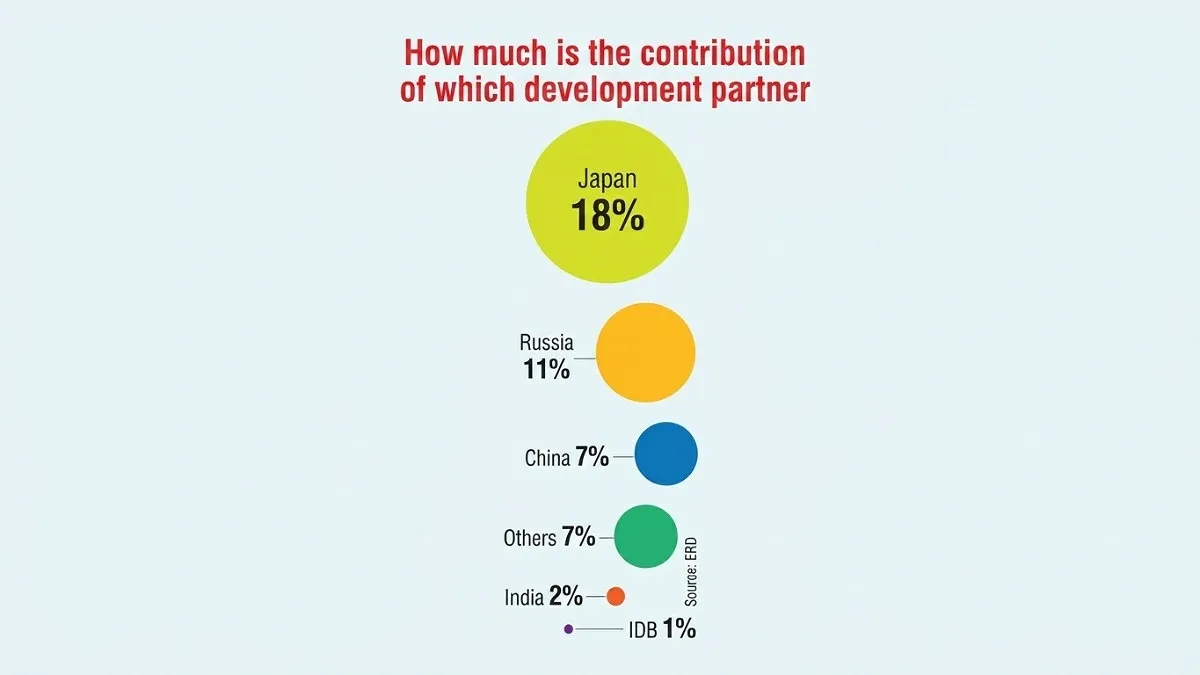
ERD’s latest report outlines the contributions of various development partners toward Bangladesh’s progress, placing Japan third overall. The World Bank (WB) holds the top position with a 29 percent contribution, followed by the Asian Development Bank (ADB) at 23 percent, and Japan at 18 percent.
However, as an individual bilateral partner, Japan ranks highest. Following Japan among single nations are Russia at 11 percent, China at 7 percent, India at 2 percent, and others accounting for 7 percent.
A major portion of Japanese loan assistance supports mega communication and infrastructure projects. Japan provided financial and technical assistance to establish the Matarbari deep sea port, which carries an estimated cost of nearly Tk 18,000 crore, with JICA financing Tk 13,000 crore.
For the construction of the third terminal at HSIA, JICA provides nearly Tk 16,000 crore out of the total Tk 21,398 crore project cost. In the Uttara-Motijheel Metro Rail MRT Line-6 project, JICA supplies Tk 16,595 crore out of the total Tk 21,985 crore cost.
Moreover, the MRT Line-1 project will cost Tk 1,14,094.89 crore, with JICA providing a loan of Tk 83,842.62 crore. The MRT Line-5 (Northern Route) carries an estimated cost of Tk 89,848.36 crore, with JICA’s loan amounting to Tk 67,518.24 crore.
Out of the Tk 16,780 crore total cost for the completed Jamuna Railway Bridge project over the Jamuna River, JICA financed Tk 12,149 crore. Japan supports the under-construction Japanese Economic Zone project in Araihazar, Narayanganj.
JICA interest rate hikes and government debates
In the beginning, JICA offered loans at an interest rate of 0.1 percent, maintaining that rate through 2015. The interest rate rose to 0.7 percent through 2022 and continued to increase over time, reaching 2.35 percent until 14 April.
The latest interest rate hike took effect on 15 April, pushing the current rate to 3.05 percent. Loan interest rates for consulting services increased step by step from 0.75 percent to 1 percent, alongside several other added conditions, while the repayment timeline and grace period remain unchanged.
Regarding this issue, ERD Secretary Shahriar Kader Siddiky told Agamir Somoy, “JICA usually reviews its loans twice a year. In doing so, it sets interest rates considering the global economic situation and the condition of the borrowing country. We opposed this interest rate increase from the very beginning. We wrote to JICA repeatedly, but they did not respond.”
Several ministers, state ministers, and secretaries expressed concern regarding rising project costs and interest rates on Japanese-funded initiatives during the Executive Committee of the National Economic Council (ECNEC) meeting held on 16 September.
The meeting approved two revised projects for constructing the metro rail in Dhaka using Japanese loans, sparking discussion about borrowing terms.
During the meeting, Finance Division Secretary Md Khairuzzaman Mozumder said, “Taking loans from JICA is becoming increasingly expensive. Therefore, we must explore alternative loan sources. Japanese loan conditions are such that no other country can participate in the tenders.”
Commerce Minister Khandakar Abdul Muktadir also raised concerns over JICA’s interest rate hikes, while Finance and Planning Adviser Rashed Al Mahmud Titumir echoed a similar sentiment.
However, Finance Minister Amir Khosru Mahmud Chowdhury said, “Apart from our loan agreements, we share extensive bilateral economic and political relations with Japan. Although the interest rate is higher, the 10-year grace period and 40-year repayment tenure are very flexible.
“Moreover, the quality of Japan’s work is excellent. Considering these factors, canceling the loan agreement for the metro rail project would not be prudent.”
Ultimately, with the consent of Tarique, the revised proposals for the two projects received approval.
