
Dhaka Buses
Reserved seats for women remain unprotected

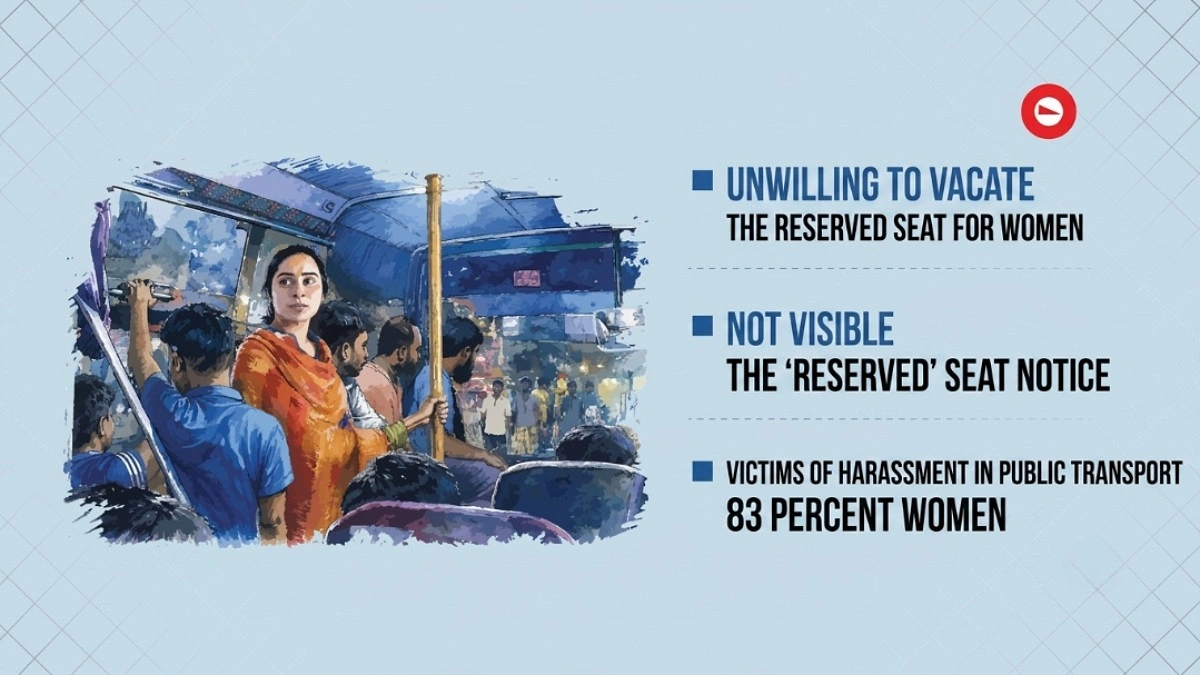
Graphics: Agamir Somoy
Afsana, who works at a private company, commutes by bus every day to and from work. However, she says she rarely finds the reserved seats for women vacant. Instead, she often sees those seats occupied, while regular seats elsewhere on the bus remain empty, forcing her to sit there. At times, when no seats are available, she has to stand throughout the journey. Only if a considerate passenger offers a regular seat does she get a chance to sit. For Afsana, this has become a daily unpleasant experience.
Afsana’s experience is not unique. It reflects the everyday reality for women who travel by bus in the capital. The seats reserved for women are often occupied by male passengers instead. The problem is not limited to women. Children and persons with disabilities also rarely find their designated seats available, even on crowded buses.
Despite this, there are clear government directives requiring reserved seating on public transportation. Under the Bangladesh Road Transport Act 2018, public buses are required to reserve 30 percent of their seats for women, children, and persons with disabilities. Accordingly, the front rows of buses are marked as ‘Reserved Seats.’ Typically, a 27 seat bus has six reserved seats, while a 44 seat bus has nine. However, although the law exists, its implementation remains a major challenge.
A visit to different areas of the capital found that many buses do not display any notice indicating reserved seats. Even where such notices exist, they are often in poor condition and difficult to read.
Ayesha, who works at a private company in Mirpur, travels by bus from Sadarghat to the Secretariat before taking the metro. She says her troubles begin even during that short bus ride.
She told Agamir Somoy, “Many times I get on a bus and see male passengers sitting in the seats reserved for women, even though seats in the back are empty. When I ask them to give up the seat, they simply refuse. Instead, they say, 'There are other empty seats. What's the problem with sitting there?'“
According to Ayesha, “A large number of passengers board the bus from Gulistan. If I sit in the middle or back of the bus, it becomes extremely difficult to get off at my destination because of the crowd. But the seats reserved for women are near the door, making it much easier to get off. That is why the reserved seat is extremely important for women.”
Although the law provides strict penalties for violations, awareness among passengers remains very low. Under the Bangladesh Road Transport Act 2018, anyone occupying seats reserved for women, children, or persons with disabilities may face up to one month in prison, a fine of Tk 5,000, or both. However, because the law is not visibly and strictly enforced, many male passengers do not take the matter seriously.
Several bus drivers said that when they ask male passengers not to occupy reserved seats, they respond by saying they will vacate the seat if a woman boards the bus. But later they refuse to do so. The drivers also claim that there is little they or their assistants can do if passengers ignore their instructions.
According to the Bangladesh Road Transport Authority, more than 7,000 buses and minibuses are authorized to operate in Dhaka, although only about 4,000 runs on an average day. More than 2 million people use these buses daily, and the actual number is believed to be even higher. A significant portion of those commuters are working women, female students, and other women passengers.
Working women say the situation becomes even worse at night when offices close. Since many offices end at the same time, buses become overcrowded. During those hours, drivers allow male passengers to board despite the crowd but are often reluctant to take women. As a result, women are forced to wait for hours for a less crowded bus despite having reserved seats. Many are left searching for alternative transportation.
Acknowledging the issue, Saiful Haque, a driver of Victor Classic bus, said, “At night when office hours end, buses become crowded. Many passengers have to stand. How can I let women board in that crowd? If we take them on the bus, it creates problems for them, and it also becomes difficult for others to get off. Men can even hang from the bus.”
Women commuters say that not only are the number of reserved seats limited, but they also fail to function as intended in practice. As a result, they believe public transportation in the capital is far from women friendly. According to a survey by the Bangladesh Road Safety Network, 83 percent of women using public transportation in the country experience some form of physical or psychological harassment every day.
Commenting on the overall situation, Bangladesh Mahila Parishad President Dr. Fowzia Moslem told Agamir Somoy, “Our buses are not women friendly at all. Even though there are reserved seats on buses, they are not seen in practice. We have still failed to build a society that is sensitive toward women. Whenever we talk about special rights or facilities for women, many people argue that men and women are equal, so why should women need separate opportunities? But is that really the reality? Just last month, 58 women were murdered. We are talking about equality without first ensuring that women have an appropriate social position, which goes against the very principle of equality.”
When asked about law enforcement and monitoring, Mohammad Sajid Anwar, Executive Magistrate of the Enforcement Wing of the Bangladesh Road Transport Authority, said that regular enforcement drives are continuing.
“It is not very common for us to find a situation where a woman or a person with a disability who is entitled to a seat is standing while someone else is occupying it. We often find reserved seats vacant as well. However, we regularly conduct mobile court operations and fine those who violate the law. During inspections, we check whether drivers have valid driving licenses, whether they are smoking, and whether reserved seats are being used properly.”
