
9.5 hours to cover 95 km, extra fares being charged

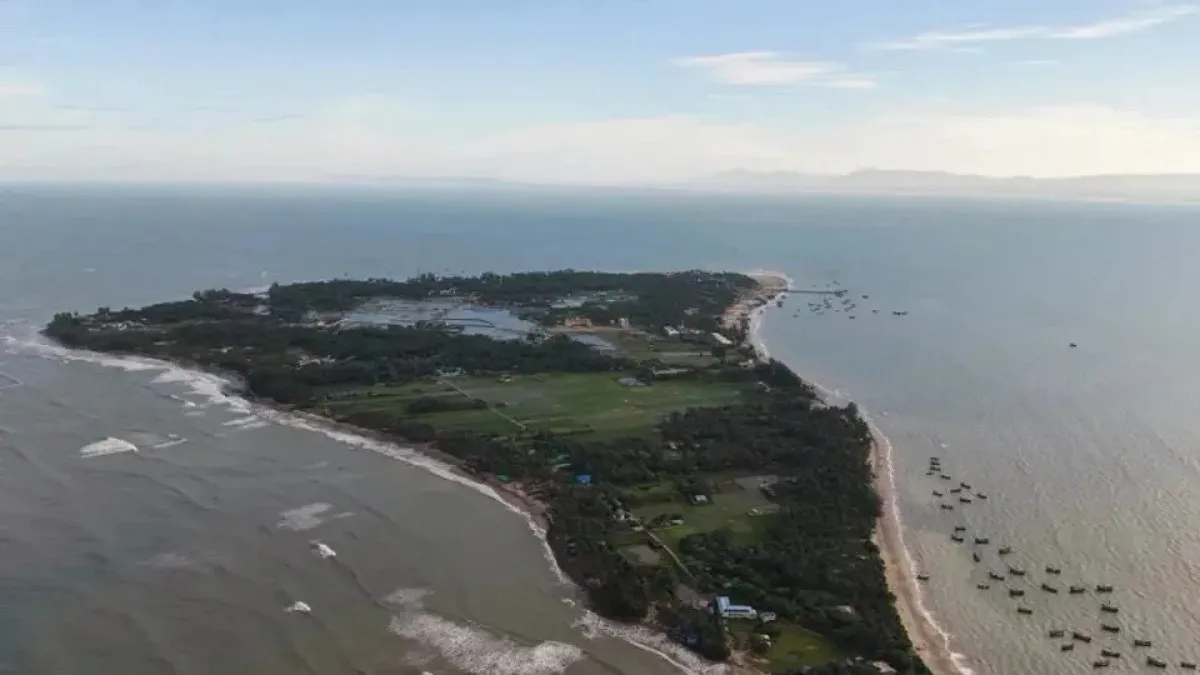
Bird's eye view of the Saint Martin's island. Collected photo.
After a nine-month break, Saint Martin's Island has reopened for tourists. Seaweeds in the crystal clear water line up the island's entrance, flowers bloom on the sandbars, and life has returned to the green ketapang trees.
The main attraction, coral is visible beneath the clear blue water and those are beautiful! But even such natural arrangements are not attracting tourists there. Extra ship fares, long sea journeys, and ticket price deception—many travel enthusiasts are losing interest due to these reasons. And with fewer tourists, most hotels and resorts on the island remain empty.
In the first seven days since November 5, 6,018 people visited the island. Yet more than 250 hotels, resorts, and cottages are ready to accommodate tourists. Tourism-related stakeholders say it will be difficult to increase tourist numbers unless travel costs and transportation hardships are reduced.
Recently, a group of six people bought six deck tickets for the ship MV Bar Aulia from a ticket counter at Sugandha Point in Cox's Bazar town. At Tk 4,200 per person, they were charged Tk 25,200. But each ticket was printed with a price of Tk 3,200. That means Tk 6,000 extra was charged for the six tickets. This allegation was made by affected tourist Iqbal Hossain Manju.
Shafiq, administrative officer of MV Bar Aulia, admitted that some unscrupulous agents are collecting extra money. He said action is being taken against those accused after receiving complaints.
Tourists are also dissatisfied with the fares. Compared to last year, the minimum round-trip ticket price this season has increased by Tk 700 to Tk 4,200. With transportation, food, accommodation, and other expenses added, island travel has become expensive for the middle class. Momenul Hakim, a resident of Rajbari, told journalists at Nuniarchhara Ghat in Cox's Bazar on November 11 that he bought round-trip tickets at Tk 5,000 per person to travel to Saint Martin's with five family members.
Along with the cost, the long sea journey is also increasing tourists' suffering. It usually takes 6-7 hours to reach the island after crossing about 95 kilometers of sea from Nuniarchhara Ghat in Cox's Bazar. But sometimes it takes nine and a half hours.
Tourist Shahzad Alam from Dhaka said he reached the island in just two hours from Teknaf seven years ago. Now spending a long time on the ship is quite boring. In this situation, local businessmen have demanded that ships operate from Teknaf or Inani.
Regarding fare reduction, Hossain Islam Bahadur, General Secretary of the Sea Cruise Operator Owners Association of Bangladesh (SCOAB), said, "Fares are determined considering ship operating costs, staff salaries, and government taxes. However, considering the tourists, the matter of reducing fares is being looked into. Affordable standing tickets have also been introduced."
Meanwhile, the Bangladesh Inland Water Transport Authority (BIWTA) has decided to form a committee to revise fares. Ship owners have proposed a fare of Tk 2,100 for a one-way general class ticket. Nayan Shil, Deputy Director of BIWTA's Cox's Bazar office, said work is underway to create an acceptable fare structure considering the interests of tourists and investors.Although the island was opened to tourists on November 1, ship operations on the Cox's Bazar-Saint Martin route began on November 5. Currently, four ships operate on this route. According to Tourism Board data, a maximum of 1,754 tourists went to the island in a single day.M A Rahim Jihadi, President of the Saint Martin Hotel-Resort Owners Association, said there is accommodation for about five thousand tourists on the island. They are hopeful that tourist numbers will increase in December and January.Although tourist travel to Saint Martin's will be allowed until March 15, a maximum of three and a half thousand people are permitted to go daily.Abu Morshed Chowdhury Khoka, former president of the Cox's Bazar Chamber of Commerce, said Saint Martin's economy and local people's livelihoods depend largely on tourism. If tourists decrease, people in various sectors including hotels, restaurants, and boat businesses suffer. Again, unplanned tourism and environmental pollution are threats to the island's existence. Therefore, along with increasing tourists, ensuring environmental protection is also essential.
