
Slogans without services

Graphics: Agamir Somoy
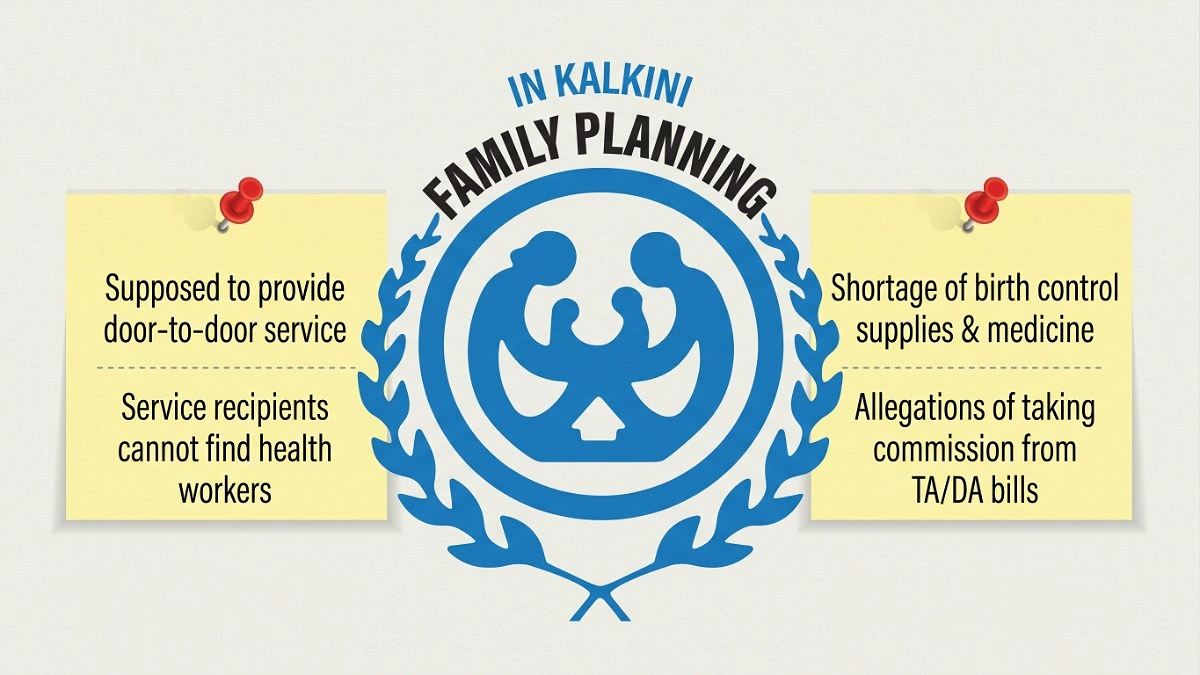
“Not more than two children, one is even better.” Family planning has slogans like this, but people are not receiving services when they need them. Pregnant women and people interested in birth control in Kalkini, Madaripur, have complained that health workers do not respond even when they call for advice. There has also been a prolonged shortage of contraceptives and medicines. Allegations have also emerged that commissions are deducted from field workers’ travel allowance bills. However, the Upazila Family Planning Officer has denied the allegations.
Aklima Akter, a resident of the Ramjanpur area of Kalkini, is expecting her first child. She alleges that although she is supposed to receive necessary advice from health workers of the Family Planning Department during this period, she cannot find them.
Aklima said, “This will be my first baby. But we cannot find the family planning health workers who are supposed to come and give us advice. When we call them now to ask about these matters, they tell us to talk about them later.”
Conversations with several mothers in Kalkini, including Lamia (23), Minara (28), and Dulufa (27), revealed that some of them are interested in keeping their families small. However, they face difficulties obtaining advice and assistance when needed. They also complained that they do not receive proper guidance on what to do if they experience side effects after using contraceptive methods.
Responding to these complaints from service recipients, Masuma Yasmin, an assistant family planning inspector, said, “We have to visit several unions and there is a shortage of manpower. So, it is not possible to spend that much time in every village. We visit every village and check on people. We have provided our phone numbers to every pregnant woman and provide services accordingly.”
Meanwhile, health inspector Parvin Akter cited complications involving travel allowances as a reason for the failure to provide services at the grassroots level. She alleged that commissions are deducted from TA/DA bills. She also claimed that this has reduced field visits.
Parvin Akter said, “We try to provide guidance. Now it is no longer possible to visit them. We have problems with our TA/DA bills. Commissions are deducted from the TA/DA bills. As a result, we visit the field less frequently.”
However, Kalkini Upazila Family Planning Officer Mohammad Abdur Rahman denied the allegation. He said no one’s TA/DA bill is deducted by his office. The allowance payments are transferred directly to each person’s account online.
Regular supplies of contraceptives and necessary medicines are an important part of family planning services. However, Kalkini Upazila Family Planning Officer Mohammad Abdur Rahman acknowledged that these supplies have been in shortage for a long time.
He said there has been a prolonged shortage of contraceptives and medicines. Referring to the responsibility of field workers to visit households and raise awareness, he added that necessary action would be taken if a written complaint was received against anyone who failed to perform their duties.
The complaints from service recipients and the statements of field workers have raised questions about the delivery of family planning services at the grassroots level. While the department cites staff shortages and supply problems, service recipients complain that health workers are not regularly available. The allegations of commissions being deducted from travel allowance bills have added to the concerns, although the relevant official has denied them.
Service recipients in Kalkini hope that the shortages of contraceptives and medicines will be resolved and that regular monitoring of field services will be ensured. They also expect the allegations of commissions being deducted from TA/DA bills to be investigated and necessary action to be taken so that family planning services reach people’s homes instead of remaining limited to slogans.
