
There are nets but no fish

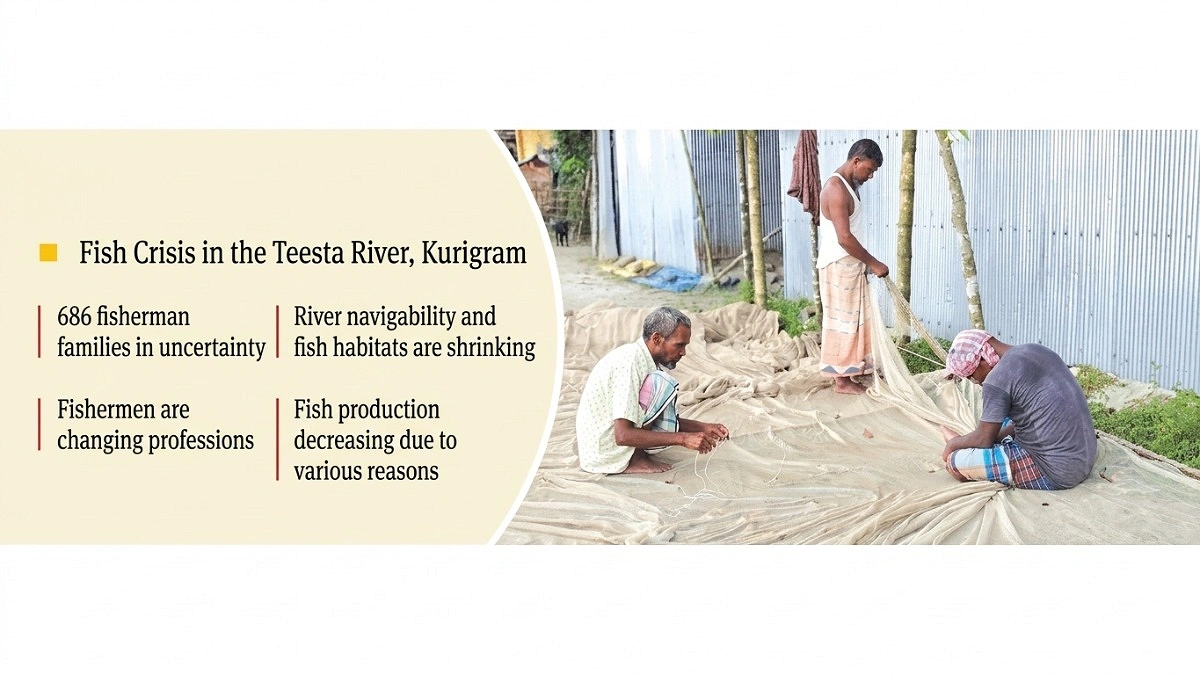
Graphics: Agamir Somoy
Even after casting nets in the Teesta, fishermen often fail to find any fish. They have to pull their nets through the river for hours and often return almost empty handed. Yet once, this river was the main source of income for their families.
As the number of fish in the Teesta has declined, fishermen are now being forced to change professions. Some work as day laborers, some as agricultural workers and others work in brick kilns. Some have even made a living by driving auto rickshaws or catching fish in other people’s ponds. Many are also being forced to travel to Dhaka in search of work.
A total of 686 registered fishing families in three unions along the Teesta in Rajarhat upazila of Kurigram are facing such uncertainty. According to the upazila fisheries department, there are 175 fishing families in Bidyananda Union, 380 in Ghorialdanga and 131 in Nazimkhan. The total number of registered fishing families across the upazila is 1,767.
Local fishermen said that just a few years ago, 40 to 45 species of fish including rohu, catla, mrigel, boal, ayre, shol, gojar, chital, pabda, tengra, bacha, batashi, punti, mola, chela, kachki and chanda were found in the Teesta. Alongside large fish, small native fish were also abundant. Now many of these fish species have declined compared with the past.
Manik, a fisherman from the Singar Dabrirhat area, said, “There used to be 40 to 45 types of fish in the Teesta. Now you cannot even see those fish. It has become difficult to run my family by catching fish in the river.”
Abdul Jalil, a fisherman from the Paramoula area of Bidyananda Union, said, “I used to support my family by catching fish in the river. Now there are no fish, so I work on other people’s land. If there is no work, I go to Dhaka.”
Bijoy, a fisherman from Taiyebkhan Mouza, also shared a similar experience. He said it is no longer possible to support his family by depending on fishing because fish are no longer available in the river as they were before. Therefore, he has to work in agriculture or do other jobs to cover his family’s expenses.
Local fishermen said not only the quantity of fish but also the landscape of the Teesta River has changed. According to them, the river’s navigability has declined in many places due to the accumulation of sand and silt. During the dry season, large parts of the river dry up and turn into sandbars. In some places, the river’s main flow has become narrower. As a result, areas suitable for fish movement, feeding and breeding are also declining.
Fisherman Matin Mia said, “The Teesta is no longer like it was before. The river has changed as it has eroded over and over again. There is no place for fish to stay and there is no environment for them to lay eggs. If there are no eggs, where will the fish come from?”
Fishermen Mozammel and Afzal from Kashem Bazar said, “When the water rises during storms, fish are available and we go to the river. Now the water has decreased and there are no fish either. So, we catch fish in people’s ponds. They pay Tk 300 for one catch. We somehow get by with that money.”
Fishermen said the decline in fish in the river has affected not only them but also local markets and the fish trade. Previously, fish caught in the river were sold in local markets. Now many fishermen have to depend on distant rivers or privately owned ponds to catch fish.
A study titled “Assessment of Fish Biodiversity in the Teesta River of Bangladesh” on fish diversity in the Teesta said the river’s fish habitats are under threat due to reduced navigability caused by the accumulation of silt and sand, declining water depth and flow, pollution, overfishing and obstacles to fish movement. The study identified the Teesta as an important habitat, breeding ground and feeding ground for fish.
Md Emdadul Haque, fisheries officer of Rajarhat Upazila, said the favorable period and environment for fish breeding are declining due to river pollution, reduced navigability and climate change. As a result, fish production is declining and fishermen’s livelihoods are being directly affected.
