
Roadmap ready for drilling, overhauling 150 wells targeting 1,752 mmcfd gas

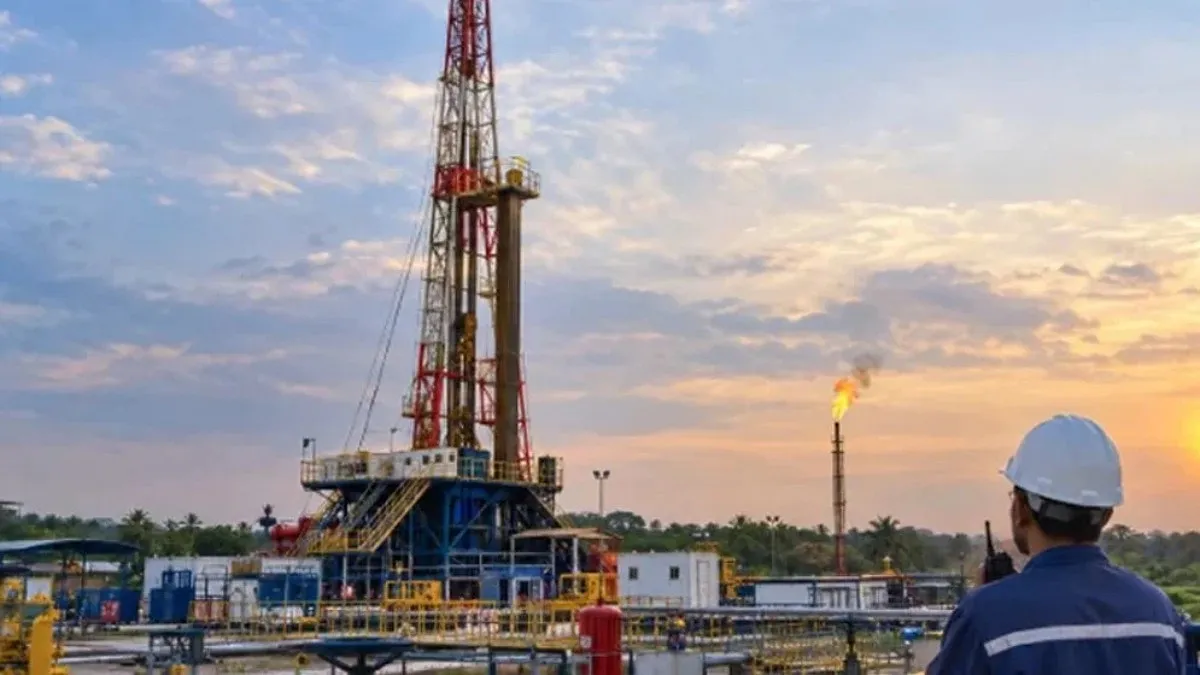
Representational image by AI. BSS.
In a concentrated move to augment the country's local gas production amid global supply chain crunch, the government has drawn up a roadmap to drill and overhaul 150 gas wells in two phases by 2031 targeting 1,752 million cubic feet per day (mmcfd) gas from domestic sources.
Under the roadmap, the authorities have divided the programme into two phases -- the 1st phase by January 2028 and the 2nd phase from February 2028 to December 2031.
Talking to BSS, a Petrobangla official said that they are working to increase domestic natural gas production, reduce dependence on imported liquefied natural gas (LNG) and narrow the widening gap between gas demand and supply.
Another official at the Planning Commission informed that of the total 150 wells, 104 will be new wells while 46 will undergo workover operations.
According to the plan, the government had brought 77 wells under project or board approval, including 77 wells under 27 projects and four workover wells approved by the boards of the relevant gas companies.
"Of the 51 wells approved so far, work on 32 has been completed, 11 are under implementation in the field and work on the remaining eight is awaiting commencement," the official said.
The official added that the authorities would seek approval for another 26 wells under 10 projects currently undergoing the approval process, while they would bring the remaining 73 wells under project or board approval in phases.
Talking to BSS, Petrobangla Chairman Abdul Mannan said the government has set a target to drill 150 wells by 2031 to raise gas output and strengthen the country's local gas production.
"Gas from the new wells will help increase supply to the national gas grid, which will reduce dependence on imported LNG, as the government has been working to drill more gas wells as per its target," he said.
According to the Planning Commission, the 32 completed wells have secured an additional gas supply potential of 270.8 million cubic feet per day (mmcfd). Of this amount, 139.6 mmcfd has initially entered the national gas grid.
Since the present government assumed office on February 17, 2026, work on 11 completed wells through drilling or workover operations has secured an additional supply potential of 58.8 mmcfd. Of this, 41.9 mmcfd has initially entered the national grid.
The 11 wells under field implementation include Sundalpur South-1, Bhola North-3, Bhola North-4, Shahbazpur North East-1, Srikail Deep-1, Mubarakpur Deep-1 and Fenchuganj South-1 under Bangladesh Petroleum Exploration and Production Company Limited (BAPEX); Titas-29, Bakhrabad-7 and Titas-31 Deep under Bangladesh Gas Fields Company Limited (BGFCL); and Rashidpur-13 under Sylhet Gas Fields Limited (SGFL).
The proposed Titas-32 and Titas-33 drilling project is among the 10 projects awaiting approval. Once approved, the authorities will drill the two wells through a turnkey contractor selected through open competitive bidding.Bangladesh's daily gas demand stands at 5,300 mmcfd based on approved loads and 3,800 mmcfd based on actual consumption, while average daily supply remains at around 2,700 mmcfd.Imported regasified LNG supplied through floating storage and regasification units (FSRUs) accounts for 1,100 mmcfd, or 41 percent, of the supply.International oil companies provide 890 mmcfd, or 33 percent, while domestic state-owned companies contribute 726 mmcfd, or 26 percent.The domestic output comprises 480 mmcfd from BGFCL, 138 mmcfd from SGFL and 108 mmcfd from BAPEX. International company production includes 861 mmcfd from Chevron and 30 mmcfd from KrisEnergy Bangladesh.Bangladesh has drilled 262 wells so far, of which 119 are currently producing gas. These include 76 wells operated by domestic companies and 43 by international oil companies.Under the first phase, BAPEX has a target of 21 wells, of which nine have been completed; BGFCL has a target of 13, with seven completed; and SGFL has a target of 16, with 13 completed.The second phase covers 100 wells, including 69 new wells and 31 workovers. BAPEX will undertake 68 wells, comprising 52 new wells and 16 workovers. BGFCL will undertake 21, including nine new wells and 12 workovers, while SGFL will undertake 11, including eight new wells and three workovers.For the second phase, BAPEX has proposed 14 projects to drill 52 new wells. One project has received approval and seven remain under the approval process; no well under this component has been completed.BGFCL has proposed four projects for nine new wells, with two projects under the approval process and none approved. SGFL has proposed five projects for eight new wells, with two projects under the approval process and none approved.The Planning Commission's Project Evaluation Committee (PEC) has held meetings on the following projects:Drilling of three wells by BAPEX: Semutang-7, an appraisal-cum-development well; Begumganj-7, an appraisal well; and Charlakshya-1, an exploration well with an estimated cost of Tk 410 crore from BAPEX's own funds.Drilling of three wells by BAPEX: Sundalpur-5, an appraisal-cum-exploration well; and Subarnachar-1 and Noakhali-1, exploration wells with at an estimated cost of Tk 406 crore from the company's own funds.Drilling of three wells by SGFL: Beanibazar-3, an appraisal-cum-exploration well; and Kailashtila-10 and Batichhia-1, exploration wells with an estimated cost of Tk 831.60 crore.Drilling of two wells at Zakiganj by BAPEX: Zakiganj-2, an appraisal well, and Zakiganj-3, an exploration well with an estimated cost of Tk 314.69 crore. A 3D seismic survey will be carried out over Char Fasson by BAPEX with an estimated cost of Tk 197.10 crore.The government expects the phased drilling and workover programme, alongside exploration activities and seismic surveys will strengthen domestic gas production and improve the country's overall energy supply.
