
Government falls in the fifth battle

File Photo
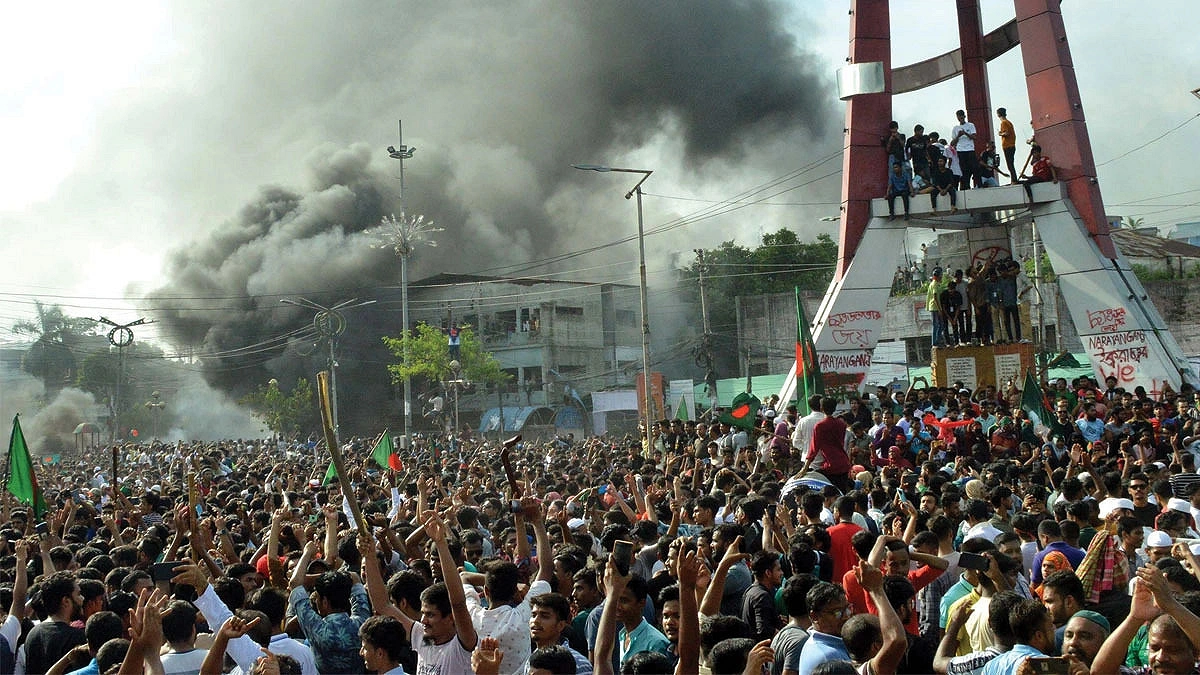
When thousands of young voices on the turbulent streets of July '24 were chanting slogans for the fall of the government, many saw it as a sudden student movement that had exploded out of nowhere. But the fire of that explosion did not ignite in a single day. Its gunpowder had been accumulating for years.
The streets of the 2018 quota reform movement, public engagement in the safe road movement, the death of Abrar Fahad, protests against Indian Prime Minister Narendra Modi's visit, small-scale demonstrations over disappearances and "Aynaghar" (torture chambers), university study circles, historical discussions, and countless unpublicized programs—all combined to create the political preparation of a generation. In their words, July was the fifth and most successful chapter of that long journey.
A new chapter in student movements in the country's political history began in 2018. The movement demanding reform of the quota system in government jobs created, for the first time, a large university-centric student assembly against the Sheikh Hasina government. From Shahbagh to Dhaka University—within a few weeks, the movement spread to various educational institutions across the country. The demand was quota reform. But within the movement itself, new leadership, new networks, and new political confidence were born.
According to Asif Mahmud, one of the organizers of the July Mass Uprising and spokesperson for the National Citizen Party (NCP), their political journey started right there. He told Agamir Somoy, "Many say our fight lasted 36 days. But that's not correct. Our fight started back in 2018. Over these six to seven years, we have carried out one movement after another. Each movement taught us something."
Within a few months of the quota movement, the Safe Road Movement began following the deaths of two students crushed by a bus on the airport road in the capital. Led by school and college students, that movement was a rare phenomenon in Bangladesh's recent history. For a few days, everything from controlling traffic to checking vehicle documents fell into the hands of the students. The state realized that the organized youth community was no longer confined to the campus.
According to Asif Mahmud, the Safe Road Movement taught them how to transform people's emotions into the power of a movement and how to take an issue to the national level.
In October 2019, the murder of BUET student Abrar Fahad became another major turning point in that sequence. Abrar lost his life to torture by Chhatra League activists over a social media status. Following the incident, protests spread not only across BUET but also to various universities across the country.
Asif Mahmud said they consciously did not view Abrar's incident merely as a campus killing. Rather, they tried to establish it as a symbol of state repression. While organizing memorial meetings, they faced attacks, arrests, and imprisonment. He himself spent a month and a half in jail.
Then came the anti-Modi visit movement in 2021. Protests spread across the country over Indian Prime Minister Narendra Modi's visit to Bangladesh. Clashes and deaths occurred in various places, from Dhaka University to Brahmanbaria. Around the same time, after international media published reports on "Aynaghar" (secret detention centers), several young people also organized small-scale protests against disappearances and extrajudicial torture. They claimed that although many of the major political parties did not step forward publicly for such programs at that time, they took the risk and went to the streets.
According to Asif Mahmud, beyond these four major movements, there were countless smaller programs. Even before the 2024 elections, they held programs rejecting elections under Sheikh Hasina. These experiences matured the preparation for July.
Field experience and training through study circles: One of the central pillars of this generation's preparation became the study circles at Dhaka University. Long discussions took place over tea at TSC, in quiet corners of the campus, or at the university library. Some read Bangladesh's political history, some studied global revolutionary experiences, some delved into statecraft, and others explored strategies for social movements. Discussions revolved around how a movement gains public engagement, how a program succeeds, and how to shape public opinion.
An initiative born from this continuity was "Gurubar" (Thursday). It started with just seven students at Dhaka University, meeting every Thursday. Gradually, it turned into a regular study circle. Discussions covered society, state, politics, philosophy, and theology. Through over a hundred meetings in about a year and a half, a space for thoughtful young people was built. Participants say that from there, the idea of "ideology-based student politics" became more organized. The study circle was led by Nahid Islam, a student of the Sociology Department, and coordinated by Mahfuz Abdullah (also known as Mahfuz Alam) from the Law Department.
Asif Mahmud pointed out that while doing research at the Dhaka University library, he went through newspapers from 1965 to 1990. He tried to understand how past movements were organized, how hartals succeeded, and how public opinion was built. He also read books by various political thinkers.
Zahid Ahsan, an organizer of the July movement and president of the National Student Power, said their preparation had three levels: political, intellectual, and cultural. Through the guestroom culture of Chhatra League, the killing of Abrar Fahad, experiences of suppressing dissenting voices, and working with families of enforced disappearance victims, they realized that it was not just about changing the government—they needed to think about the very nature of the state. Thus, alongside the movement, they also discussed the concept of a new state.
DUCSU VP Sadik Kayem told Agamir Somoy that they believed change was not possible only through elections within the existing political reality. Therefore, they began discussing strategies, stakeholders, and focal points for a potential mass movement. After the court verdict on June 5, 2024, reinstating the quota, they decided not to limit the movement to the quota issue alone; instead, they would shape it into a broader anti-government mass uprising.
Chhatra Dal president Rakibul Islam Rakib also believes that the July Mass Uprising was the culmination of a long history of movements and struggles. In his words, the July explosion stood on the foundation of continuous movements by opposition political parties, student organizations, and ordinary students.
Political analyst Dr. Ainul Islam said that no mass uprising ever emerges from a vacuum. Behind it lies a long process of political socialization, organizational practice, and leadership development.
However, he reminded that the credit for the July Mass Uprising does not belong to any single group; rather, the collective participation of various political parties, student organizations, professionals, teachers, and ordinary people transformed it into a national mass uprising.
