


Farmers pay double as black market thrives amid fertilizer shortage

Graphics: Agamir Somoy
A new distribution policy and an escalating fertilizer crisis are now destabilizing the market, as dealer politics and mounting fear overwhelm both changes.
Although the government claims there are adequate reserves, many farmers are failing to secure the required fertilizer from dealers at fixed prices. This is creating a crisis situation at the local level, and there have even been incidents of looting.
While government dealers reportedly lack stock, fertilizer is readily available at higher prices in nearby open markets or retail shops. Milon Ghosh, an authorized dealer of Balidia Union in Magura, claimed that the supply of urea remains normal, but admitted to a temporary shortage of non-urea fertilizers, specifically DAP (phosphate).
However, a sub-dealer in the same area claimed that against a demand of 200 bags of DAP fertilizer, only 17 bags were allocated, and only 10 bags were delivered. He alleged that despite the low allocation, fertilizer is being smuggled to the black market.
Mofazzal Hossain Khokon, a farmer from Barhatta in Netrokona, said failing to get DAP fertilizer at the fixed price, he had to buy TSP (potash) at Tk 1,500 per bag and MOP (potash) at Tk 1,000 per bag from the Gopalpur market.
Those fertilizer bags had “Not for sale in the open market” written on them. Majnur Rahman, a farmer from Bhatpara village in Meherpur, complained that even though dealers claim to have no fertilizer, it is available in outside shops if one pays Tk 500 to Tk 700 more per bag.
However, Sanjib Mridha, deputy director of the Meherpur Department of Agricultural Extension, claimed there is no shortage of fertilizer in the district.
For the farmers, the crisis is not limited to just not receiving fertilizer. Having to buy fertilizer at higher prices instead of the fixed rate increases production costs. Since fertilizer is highly needed during the Amon season, failing to get it on time can create extra pressure on farmers.
Therefore, alongside information about reserves in government warehouses or dealer levels, whether fertilizer is reaching farmers at the fixed price is also a crucial indicator to verify the effectiveness of the supply system, according to agricultural economists. The new dealer appointment policy has emerged as a major reason behind this instability in the fertilizer distribution system. In the integrated policy of 2025, a decision was made to abolish the sub-dealer and retailer system.
This has resulted in a change in the roles of a vast number of businessmen involved in field-level fertilizer distribution for a long time. According to those involved, there were about 10,800 dealers and nearly 45,000 retailers in the country. Under the new system, they can no longer remain in their previous roles.
This change became more visible after the office order was issued on 9 August to implement the revised policy. Due to the redistribution of responsibilities and restructuring of fertilizer distribution under the new system, uncertainty has risen among old businessmen in many areas.
Questions regarding whether dealerships will remain, how allocations will be made in the future, and how much business opportunity there will be under the new system are being discussed at the field level.
A sort of temporary vacuum has been created at the field level during this transition of the long-standing distribution structure. There are allegations that old business groups and dishonest traders are taking advantage of this to create an artificial crisis.
On the other hand, there are also real shortages in allocation and supply in some places. As a result, it is difficult to explain the entire situation by a single factor, whether it is solely an artificial crisis or just a supply shortage. Verifying how much has been allocated where and how much of it has been sold to farmers is now critical.
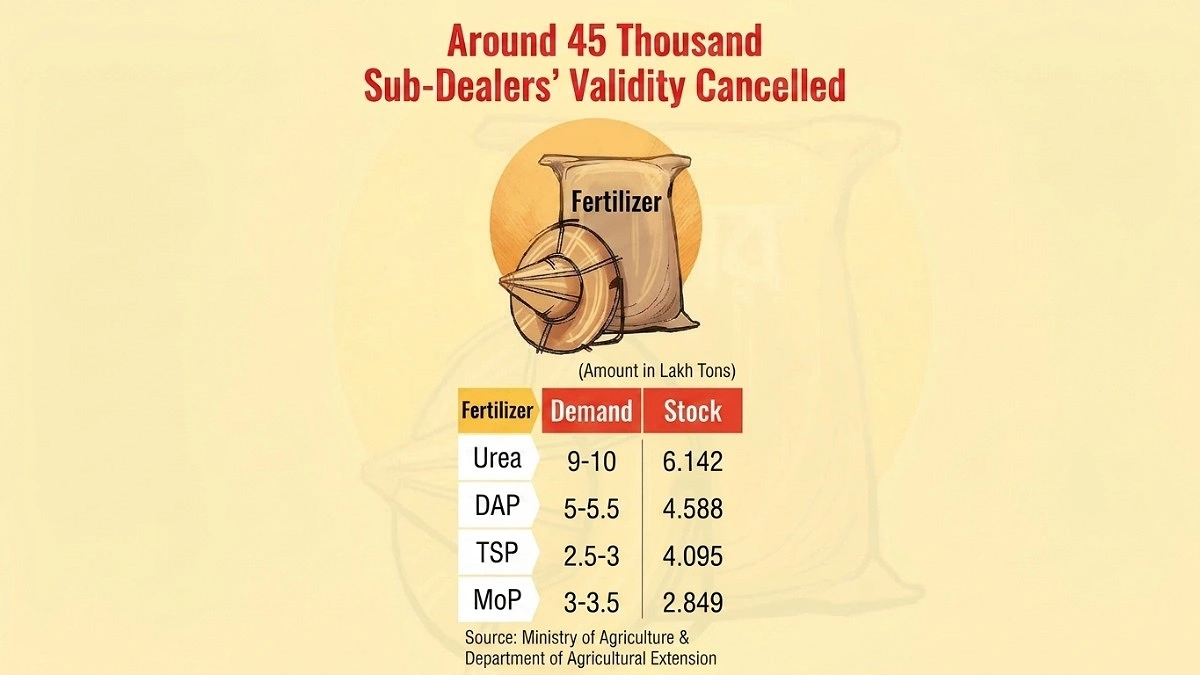
However, government statistics do not show a major deficit at the national level. According to data from the Ministry of Agriculture and the Department of Agricultural Extension, the total demand for the four major types of fertilizer in the ongoing Amon season is about 20-22 lakh tons. The total annual demand is 67.70 lakh tons.
At the beginning of the season, the initial stock of urea was 6.142 lakh tons, DAP was 4.588 lakh tons, TSP was 4.095 lakh tons, and MOP was 2.849 lakh tons. The combined initial stock of these four types of fertilizers was 17.674 lakh tons as of 19 August.
Therefore, if local production and regular import shipments remain active alongside the initial stock, there should not be a major fertilizer shortage at the national level. However, the difference between these statistics and the field reality is the biggest question. The primary reason for this is that production in the country’s fertilizer factories has decreased.
The daily gas demand in the country’s six fertilizer factories is about 330 million cubic feet, but currently, an average of only 150-160 million cubic feet of gas is being supplied. Due to this shortage, three factories are closed, and fertilizer production has declined in the remaining three factories because they are not supplied with the required gas.
Mosharraf Hossain, president of the Bangladesh Fertilizer Association, said there is no overall shortage of fertilizer in the country. However, he believes it is necessary to temporarily increase dealers’ allocations in line with the extra demand from farmers.
He fears that a certain group might try to destabilize the market for personal interest or to put the government in an administrative fix. He advised direct supervision by sub-assistant agriculture officers in every union and strict monitoring by the district administration.
Mosharraf told Agamir Somoy that strict instructions should be given to district committees to ensure the sale of fertilizer at fixed prices to prevent artificial shortages.
Ministry of Agriculture has also increased supervision to control the situation. Agriculture Secretary Selim Khan told Agamir Somoy, “Although there is no real crisis in the country, action is being taken if attempts are made to create an artificial crisis.”
A five-member monitoring team consisting of two joint secretaries and three deputy secretaries has been formed. They are monitoring the fertilizer supply and sales center situations on a daily basis.
An official of the ministry has also been stand-released on charges of negligence of duty. To avoid regional crises, dealers have been given the opportunity to withdraw their September fertilizer allocation in advance starting 25 August. District Fertilizer and Seed Monitoring Committees have been directed to increase field-level surveillance.
These committees, led by the deputy commissioner, have been asked to observe the supply, sale, and stock situation of dealers. The ministry also said action would be taken against those who do not withdraw fertilizer on time even after depositing money.
Out of fear of not finding it in the market, farmers in Bhurungamari, Kurigram, broke open the door of a dealer’s warehouse and took 225 bags of urea fertilizer. Meanwhile, strange manipulations are going on with fertilizer in Bogura.
An artificial fertilizer crisis has emerged in Gangni, Meherpur, due to dealers’ manipulation, black-marketing, and political influence. In Chougachha, Jashore, a syndicate of dishonest businessmen and dealers are engaged in reckless manipulation of fertilizer, with similar examples occurring in various parts of the country.
Agriculture Secretary claimed that even in the recent incident of farmers taking fertilizer from a dealer’s warehouse, there was fertilizer in the warehouse and no shortage. According to him, the problem was artificially created there.
He hopes that the situation will return to completely normal within a week due to government measures. However, field reality shows that having stock at the national level does not guarantee a crisis-free market for farmers.
Following the change in the old distribution structure under the new policy, allocations are low in some places, there are supply deficits in others, and in some areas, fertilizer is available only if one pays several hundred taka more than the government-fixed rate.
As a result, questions are being raised - is this crisis being created by the tension of the fear of losing dealerships, the breakdown of the old distribution structure, and the weakness of the supply system?
Agricultural economist Jahangir Alam Khan told Agamir Somoy, “If there is an adequate stock of fertilizer, why are farmers protesting? Why are they looting from the dealer’s warehouse? The major problem here is in management.”
He added, “A disaster has occurred in the joint management of the Ministry of Agriculture and the Ministry of Industries. There is no problem if there is supply. Dealers are not getting fertilizer according to demand. Looting is occurring and prices are rising because of the crisis. These factors will negatively impact production. Aush rice has already taken a hit.
“Before this, Boro rice was damaged. Now, if Amon production also decreases, it will be a threat to food security. The production of winter vegetables will be hampered. If the fertilizer supply is not normalized, overall agricultural production will be disrupted.”

