
Dhaka airport area braces for transport project overload by 2045

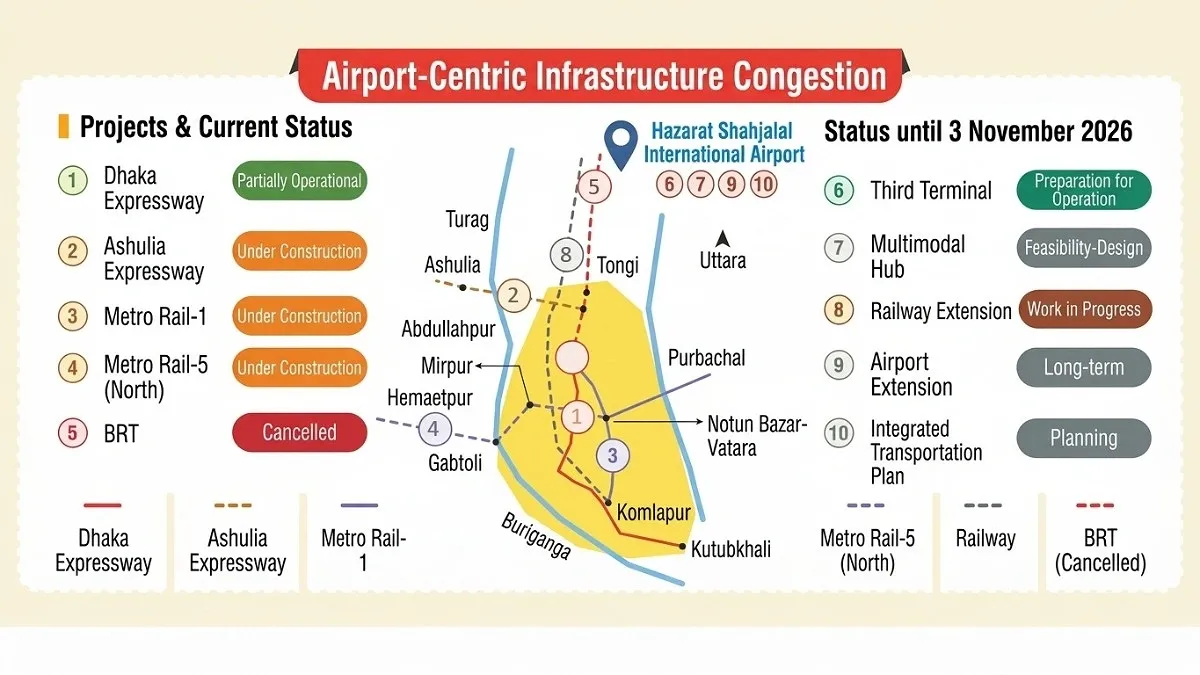
Graphics: Agamir Somoy
Timelines for 10 major mega transport projects for Dhaka will extend up to the year 2045 and there is no integrated plan to ensure the smooth management of so many spider-web-like sprawling projects even after construction ends.
The area in front of Hazrat Shahjalal International Airport (HSIA) is already overcrowded with people, and severe traffic congestion leaves passengers struggling for breath. This means citizens will have to endure this suffering of development for a much longer period.
The elevated expressway flying from Kutubkhali on the Dhaka-Chattogram Highway descends at Kawla near the airport, with one of its branches connecting directly to the Third Terminal of the airport.
Right where the previous elevated road ends at Kawla, another highway - the Dhaka-Ashulia Elevated Expressway - begins its elevated stretch. Moving slightly forward from here leads to the Dhaka-Gazipur BRT corridor, which has been canceled and is now planned to be converted into a six-lane highway.
There is also a plan for an underpass beneath the intersection to connect the airport side with the Haji Camp on the opposite side. Moreover, a Metro Rail line will run from the airport to Kamalapur, while the metro line at Notun Bazar will also impact traffic on this route.
Located across the street in the same area is the Airport Railway Station, one of Dhaka’s busiest rail stations, whose capacity is expanding through the construction of third and fourth railway lines. Plans are also underway to build a Railway Multimodal Hub centered around this station.
However, Road Transport and Bridges Minister Shaikh Rabiul Alam believes that once the projects become operational, managing the situation will not be impossible.
When asked by Agamir Somoy whether the airport area would be able to handle the pressure of so many projects, he said, “Once the Third Terminal becomes fully operational, the view of the current roundabout will change significantly. Alternative plans are also being thought of. As a result, no complication of any kind will be created.”
Overall, massive infrastructure for road, rail, metro rail, and air transport are being developed simultaneously within a few kilometers surrounding HSIA. However, questions remain regarding how prepared the roads and public spaces are to manage the infrastructure connections, vehicular traffic, and passenger boarding and disembarking pressure.
Even if each project is implemented individually, without a unified master plan for the entire area’s movement system, traffic congestion and public pressure will escalate alongside the infrastructure.
The crisis is not merely about the number of vehicles, but also about how to manage the entry of multiple transport systems into the same area, passenger movements, pedestrian crossings, and the pressure of future urbanization.
Transportation expert at Bangladesh University of Engineering and Technology (BUET) Shamsul Hoque expressed concern that while human settlements near industrial zones and long-distance highways are growing, road capacity is not increasing.
He added, “Only straight roads are being built here. No alternative ring road is being constructed. This could be a cause of disaster. The road in front of the airport is the backbone of all surrounding infrastructure. If this backbone is not strengthened, it will collapse. Once all the infrastructure becomes operational, how much vehicle and human movement will increase and whether that will remain within capacity needs to be verified through a central survey.”
The Third Terminal is awaiting inauguration. According to a survey by the Japan International Cooperation Agency (JICA), passenger traffic demand at HSIA will reach 2,48,52,000 by 2035, which is more than double the present figure. Before reaching inside the airport, this massive passenger pressure will fall directly onto the outer roads.
Meanwhile, the nearly 20-kilometer Dhaka Elevated Expressway from the airport to Kutubkhali is partially open up to Hatirjheel. Once it reaches Kutubkhali, the influx of vehicles from outside Dhaka onto the airport road will increase further.
Moreover, construction is underway for the roughly 24-kilometer Dhaka-Ashulia Elevated Expressway, stretching from Kawla through Abdullahpur, Ashulia, and Baipail to Dhaka EPZ. These two elevated expressways will merge right in the airport area.
As a result, the ramps for ascending and descending the elevated expressways and their connectivity with the surface roads will become critical points.
Major additions to public transport centered on the airport will be Metro Rail Line-1 and Line-5 (North). According to JICA’s survey, by 2035, the peak section of Line-1 could generate a maximum demand of nearly 47,970 passengers per hour in one direction.
On the 20-kilometer Line-5 (North) route from Hemayetpur to Bhatara, passenger demand in the busiest section during peak hours in 2035 will reach 28,600 passengers per hour in one direction.
Although Line-5 (North) will not touch the airport directly, it will connect with Line-1 at Notun Bazar. This will expand transit options from the airport toward Gulshan, Banani, Mirpur, Gabtoli, and Hemayetpur.
While the launching of both lines will expand passenger movement scope, benefits will remain limited unless effective mechanisms are established for transferring passengers between stations, terminals, the railway station, and surface roads.
Meanwhile, the government has decided to halt the 20-kilometer BRT project along the Gazipur-Tongi-Airport corridor. The plan now is to replace the dedicated bus corridor with a six-lane highway. As a result, airport-bound commuters on this route will no longer have access to dedicated BRT public transit services.
However, widening the road will lead to higher vehicular volume than normal. At the same time, construction of the third and fourth railway lines between Dhaka and Tongi, as well as the double line between Tongi and Joydebpur, is ongoing.
More than half of Dhaka’s train passengers already use the Airport Railway Station. Expanding the station’s capacity will further increase passenger volume, impacting the road in front.
A proposal to conduct a feasibility study and conceptual design for a Multimodal Hub connecting the Airport Railway Station with rail, metro rail, bus, and airport facilities has been approved.
In addition, an older plan exists for an around 620-meter underpass near the airport roundabout to interlink the airport terminal, railway station, metro rail, and bus stops. However, its current approval and implementation status remain uncertain.
Overall, although individual projects serve distinct objectives, their cumulative impact will converge on the same area. Vehicles taking passengers to and from the Third Terminal, expressway traffic, metro rail users, and railway station commuters will all merge onto the roads adjacent to the airport.
Added to this will be the growing population of North Dhaka. Beyond Uttara, residential and commercial developments are expanding into Uttar Khan and Dakshin Khan. As residents’ commuting needs to workplaces, educational institutions, hospitals, and markets grow, local traffic will merge onto the exact same roads carrying airport-bound vehicles.
This same corridor also connects to the Dhaka-Mymensingh Highway. As a result, the airport area is evolving beyond a simple gateway into a major transport and urban hub for North Dhaka.
The question remains: will these vehicles and passengers move along separate routes, or will they have to rely on the same entrance and roads? There is no guarantee that having elevated highways will reduce traffic congestion on surface roads.
Severe vehicular pressure can build up at the entry and exit ramps of elevated roads. Similarly, even if large numbers of passengers arrive via metro rail or train stations, overcrowding will surge around station areas if adequate sidewalks, pedestrian crossings, bus stops, and feeder roads are lacking.
Urban planner at Jahangirnagar University Aktar Mahmud noted that the airport area has become the epicenter of three modes of transit - rail, road, and air. In his view, there is no alternative to coordination.
He said, “If coordinated properly, public suffering will decrease to some extent and travel will be relatively easy. In terms of coordination, the government must plan keeping in mind how to utilize the three levels in that section - elevated, surface, and underground.”
Work on these projects will neither start nor finish at the same time. Some are targeting partial operation by 2026-27, others will remain under construction into the 2030s, while long-term master plans stretch up to 2045.
As a result, construction on remaining projects will continue even after others become operational. The area will have to handle ongoing construction, vehicle movements, and passenger pressure over an extended timeline.
Md Mashiur Rahman, additional executive director of the Dhaka Transport Co-ordination Authority (DTCA), added, “An integrated master plan for the transport sector up to 2045 has been created. If the directives of that master plan are strictly followed, no problem will be created. However, the reality is that the core plan is not implemented properly.”
