Dhaka’s waste crisis: Unenforced laws, overflowing landfills, toxic air

Collected Photo
Bangladesh Meteorological Department (BMD) recorded 175 millimeters of rainfall over 24 hours from 6 pm on 11-12 July, causing severe waterlogging across most areas of Dhaka.
At that time, the two city corporations of Dhaka said a major driver of this waterlogging was the accumulation of waste, particularly plastic, in stormwater drains. Waste continues to cause immense hardship for the massive population of this city.
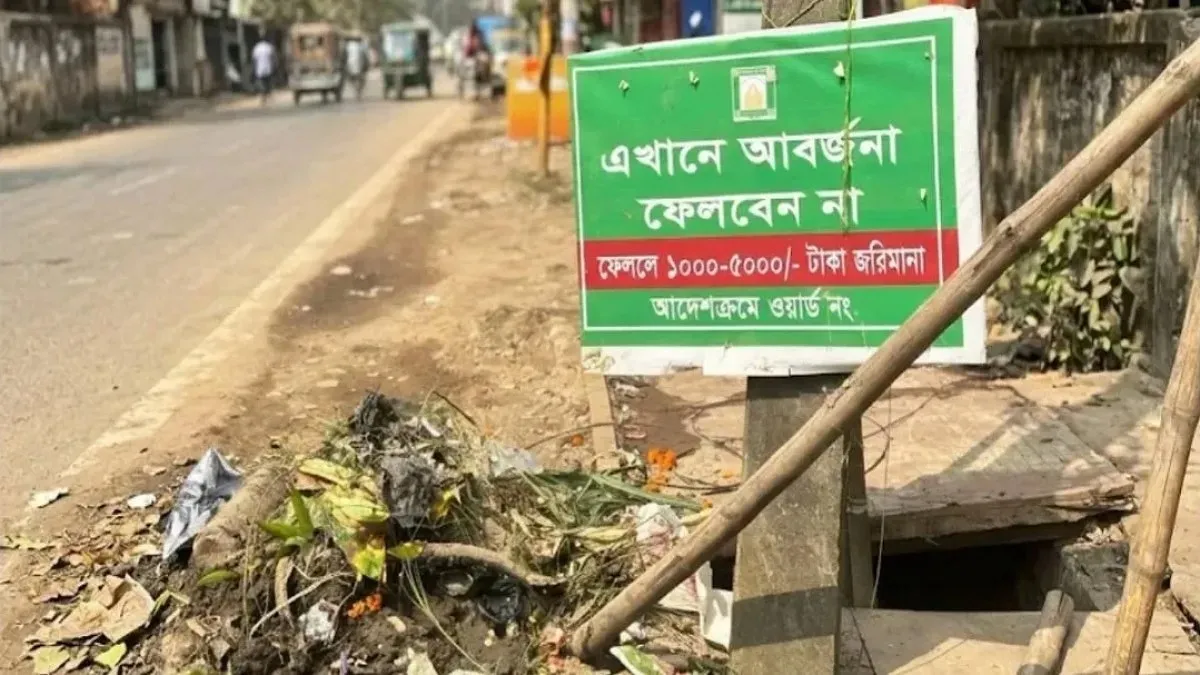
Residents discard garbage everywhere - in alleyways, in front of house gates, on main roads, and in public spaces. Although legal provisions specifying imprisonment and fines exist as penalties for dumping waste indiscriminately, ordinary citizens remain unaware of them due to a lack of enforcement.
As a result, environmentalists advise that the habit of dumping waste everywhere will not stop unless the law is actively enforced.
A major reason for garbage accumulating across the capital is the lack of adequate dustbins. However, after the prime minister initiated special oversight regarding Dhaka’s cleanliness, the city corporations became vigilant.
Among them, Dhaka South City Corporation (DSCC) has installed nearly 600 new dustbins, with plans to provide a total of 1,000 dustbins by this year and 2,000 dustbins by next year.
Meanwhile, Dhaka North City Corporation (DNCC) has also begun placing new bins, installing over 300 dustbins, with additional installations underway. DNCC also placed over 500 green and yellow plastic dustbins about two months ago.
However, authorities have yet to stop transporting waste in open trucks during daytime hours to preserve city aesthetics and prevent stench. Household garbage continues to be carried in open vans throughout the city, subjecting urban residents to foul odors.
Urban planners note that beyond the estimated 7,500 tons of waste generated daily across both city corporations, a significant portion remains in the city, eventually entering drains and water bodies.
Environmental toll and landfill overburdening
A research study conducted in 2024-25 revealed that every ton of soil at the bottom of the Buriganga River contains an average of 1-1.25 kilograms of plastic waste. As a result, urban waste is not only polluting the air and affecting human health, but is also endangering aquatic life.
Daily decomposition of indiscriminate trash and landfill waste releases methane, hydrogen sulfide, and ammonia gas. Due to the Aminbazar landfill, the air across the entire stretch from Gabtoli to the Aminbazar Bridge remains continuously toxic, while toxic emissions from the Matuail landfill harm nearby residents, commuters, and pedestrians.
DSCC generates nearly 3,500 tons of waste daily - 15 percent of which is plastic - which is sent to the Matuail landfill, whereas DNCC produces over 3,000 tons daily, destined for Aminbazar.
Although waste height at these landfills is supposed to be capped at 30 feet, garbage is dumped to a height of nearly 100 feet, posing a severe environmental threat and spreading foul odors. Environmentalists emphasize that the capacity of both the Aminbazar and Matuail sites has already overflowed.
Unenforced penalties and legal framework
The city corporations maintain no visible record of enforcing penalties against citizens who dump trash indiscriminately or contractors who transport waste in open trucks. As a result, open dumpsites have continuously polluted Dhaka’s air for decades.
Under the Solid Waste Management Rules-2021 (framed under the Environmental Conservation Act, 1995), dumping waste outside designated locations or burning garbage in open spaces carries a maximum fine of Tk 2 lakh, up to 2 years of imprisonment, or both.
Moreover, under the Local Government (City Corporation) Act-2009 (Fifth Schedule), dumping or stacking trash on city roads or open spaces attracts a maximum fine of Tk 5,000, with an additional daily fine of Tk 500 for ongoing offenses or imprisonment in default of payment. However, Bangladesh has seen no actual enforcement of these laws.
Speaking on the issue, Ahmad Kamruzzaman Majumder told Agamir Somoy, “To protect the environment, lawbreakers must be fined. If the law is not enforced, people cannot be stopped.”
When asked about the matter, DSCC Chief Waste Management Officer Air Commodore Md. Mahbubur Rahman Talukder told Agamir Somoy, “Although institutions are fined according to the law, individuals cannot be fined in that manner. The city corporation is thinking about raising awareness because the city corporation lacks the capacity to fine a large number of people, and if magistrates remain occupied with that work, other operations will be disrupted.”
He added that fining people without increasing awareness would not yield significant results.
Waste-to-Energy initiatives and future plans
To transform waste into resources, DSCC has partnered with a Korean firm to establish five waste processing plants at the Matuail landfill, expecting to produce methane gas, electricity, and compost fertilizer starting February 2027.
DSCC has also initiated a project with a Chinese company to generate power from waste by March 2027, which will also utilize waste ash to produce raw material for cement.
Meanwhile, DNCC signed an agreement in 2021 with China Machinery Engineering Corporation (CMEC), recently extending their deadline to November 2028 to construct a plant that will burn waste to generate 43.4 megawatts of electricity daily.
DNCC Chief Waste Management Officer Captain Ikhtiar Uddin Ahmed Chowdhury said, “Electricity generation from Aminbazar’s waste will begin in 2028. At that time, the volume of waste in the capital will gradually decrease.”