
3R strategy will repair and rebuild Bangladesh: Tarique

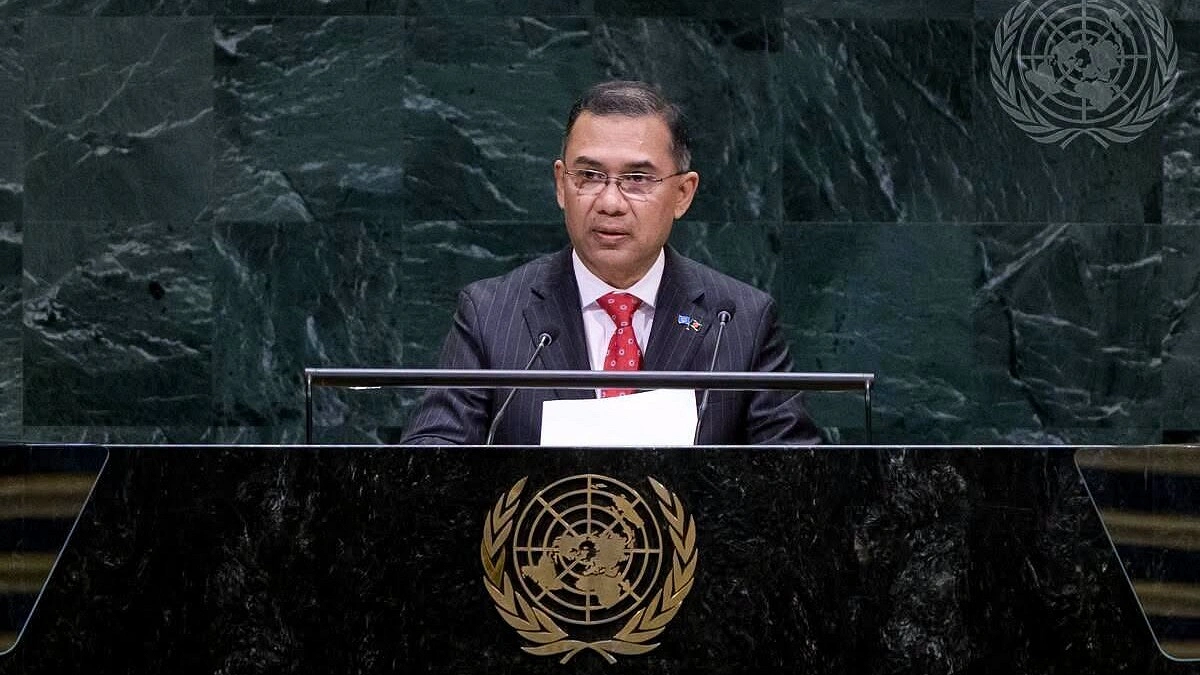
Photo: PMO
Prime Minister Tarique Rahman has pledged to build a safe, peaceful, and welfare-oriented Bangladesh for all.
Delivering his address at the 81st session of the United Nations General Assembly (UNGA), he outlined the government’s plans on a wide array of issues, including Bangladesh’s political transition, state reforms, economy, education, healthcare, women’s empowerment, employment, climate change, and the Rohingya crisis.
Expressing hope for a peaceful world, he said, “Such a humanitarian world society where logic, diplomacy, education, and humanity, rather than deadly weapons, will become the tools of change.”
Tarique added that the government seeks to build a Bangladesh where youths can fearlessly pursue their dreams, women can navigate life with confidence, and every child receives the opportunity to flourish. Above all, the government’s overarching goal is to guarantee a safe and peaceful life for the people.
Repairing Bangladesh via the ‘3R’ strategy
Addressing the nation’s political shift and state restructuring, Tarique said following the end of a decade and a half of rule and exploitation, Bangladesh embarked on a new trajectory in 2024.
He claimed that emerging from crises such as enforced disappearances, murders, abductions, corruption, plundering, and money laundering, Bangladesh is once again moving forward on the path of democracy.
Tarique informed that to repair Bangladesh, the government is pursuing the “3R” strategy - standing for “Recovery, Restoration, and Reconstruction”. Through this strategy, initiatives have been launched to rebuild state institutions, restore economic stability, and fortify the foundation of national development.
The prime minister paid tribute to the martyrs of the Liberation War 1971 and honored those killed and injured in the July mass uprising 2024. Through movement and at the cost of thousands of lives, Bangladesh became free from fascism. In the 13th national parliamentary election, the people entrusted the responsibility of governance to the BNP.
Standing on the UN world stage, Tarique shared that he felt somewhat nostalgic. He recalled that his father, former president Ziaur Rahman, and mother, former prime minister Khaleda Zia, had previously stood on this global stage to speak on behalf of Bangladesh and its people.
Diplomacy for solutions, not conflict
Highlighting the impacts of ongoing conflicts and wars across various regions, Tarique observed that man-made conflicts have created unrest in numerous countries. Many people are being displaced, resulting in severe humanitarian crises, while war and conflict continue to exert pressure on the global economy.
He said, “The resolution of any conflict should be achieved through dialogue, diplomatic processes, and mutual cooperation. Equality, fairness, mutual interest, respect, and dignity among states must be the foundation of bilateral and multilateral relations.
“Our expectation is a peaceful world, such a humanitarian world society where logic, diplomacy, education, and humanity, rather than deadly weapons, will become the tools of change.”
He added that Bangladesh envisions the UN as the central hub for establishing a conciliatory world society that respects each other’s independence and sovereignty.
Tarique conveyed the concern of the Bangladeshi people regarding the plight of the Palestinian people. He reaffirmed Bangladesh’s support for the legitimate demands of the Palestinian people, including their right to self-determination and the establishment of an independent Palestinian state.
He assured that Bangladesh’s support for various UN initiatives aimed at establishing world peace will remain steadfast.
Noting that Bangladesh has long provided shelter to over 12 lakh displaced Rohingyas from Myanmar, Tarique noted that this has placed immense strain on Bangladesh’s economy, environment, security, and local host community.
He sought effective cooperation from the UN and the international community for a resolution to the Rohingya crisis. He urged the international community to maintain life-saving assistance until the Rohingyas are repatriated to their homeland.
He warned that if the international community fails to ensure justice for the Rohingyas, the situation could escalate into an even greater humanitarian disaster in the future.
Highlighting the contribution of Bangladeshi peacekeepers worldwide, Tarique emphasized that the participation of Bangladeshi women in UN peacekeeping missions, even under hostile conditions, reflects Bangladesh’s commitment to the “Women, Peace, and Security” agenda.
He reaffirmed Bangladesh’s pledge toward complete and general disarmament, nuclear non-proliferation, and arms control.
Tarique outlined the government’s measures to tackle the adverse effects of climate change. Alongside strengthening domestic actions for water conservation and pollution control, he highlighted cooperation in transboundary water management.
In broader discussions at the UN session, the prime minister stressed the necessity of climate finance and technological support for climate-vulnerable nations.
Focus on employment and industrialization
Saying vast opportunities have opened up for Bangladesh, Tarique shared that the government is implementing extensive programs to transform the working-age population into skilled human resources. Steps have been initiated to generate employment and establish Bangladesh as a manufacturing hub.
Observing that women constitute over half of the country’s population, he affirmed that women have been placed at the forefront of all socio-economic transformation plans. Priority is being given to women’s education, employment, and entrepreneurship. He also highlighted the expansion of financing facilities for women entrepreneurs in small and medium enterprises (SMEs).
Detailing social safety net initiatives aimed at narrowing economic inequality and delivering state aid directly to citizens, Tarique noted that programs like the Family Card, Farmers, and Sports Card have already been introduced. The government plans to consolidate these initiatives under a unified Universal Card.
Identifying education, health, and sports as priority sectors, he said the highest budget allocation in the country’s history was directed to education this year. The government plans to incrementally raise education funding to 5 percent of GDP over the next five years. Emphasis is being placed on technical and practical education to foster a career-oriented and morally grounded system.
He also highlighted the government’s program providing free school bags, clothing, and mid-day meals for primary school students.
Tarique noted that science and technology will shape the future world. Pointing to the emergence of artificial intelligence, biotechnology, and new scientific frontiers, he remarked that access to technology remains unequal globally. To capitalize on Bangladesh’s large youth demographic and growing digital capability, access to advanced technology, knowledge, and research must be made universally available.
International cooperation for LDC graduation
Noting that Bangladesh is poised to graduate from the Least Developed Countries (LDC) category, the prime minister asserted that making the transition sustainable requires assured financing, enhanced market access, technology transfer, and capacity building.
He also stressed the importance of ensuring the sustainable production of vaccines, medical supplies, and diagnostic tools across developing nations.
Tarique emphasized that a state cannot become strong while keeping its citizens disenfranchised. The government aims to build a prosperous, self-reliant, welfare-oriented democratic state by ensuring the political and economic empowerment of its citizens.
He pledged to build a Bangladesh where every citizen, regardless of political alignment, opinion, religion, or caste, can reside safely with equal rights, honor, and dignity.
‘Bangladesh first, Bangladesh for all’
Concluding his speech, the prime minister reiterated the pledge, “Bangladesh first” and “Bangladesh for all.”
Reaffirming Bangladesh’s support for the principles and values of the UN in fostering world peace, he added that the future world must be constructed on the pillars of peace, humanity, democracy, and mutual cooperation.
The session of the UNGA was presided over by Foreign Minister Khalilur Rahman.
