
Online shopping boom leaves shopping malls struggling

Graphics: Agamir Somoy
Shopping no longer requires people to leave their homes. From clothing and breakfast to lunch and dinner, cosmetics, leather goods and even household furniture, almost everything is now available online. With just a few clicks on a mobile phone, customers can have their preferred products delivered to their doorsteps. If a product does not meet their expectations, they can also return or exchange it. In such cases, they only have to pay a small delivery charge. Well-known brands are already offering these facilities, while others are gradually following suit. As a result, online shopping is booming. It saves time and reduces the hassle associated with traditional shopping.
The picture is quite different at shopping malls of all sizes. Once crowded with customers to the point that shopkeepers struggled to manage the rush, many malls now fail to attract their expected number of shoppers on most days. Sellers spend much of their time sitting idle. The shopping market is undergoing a transformation, changing the familiar landscape of the country’s retail trade. The growing dominance of online shopping is dealing a severe blow to most shopping malls. However, retailers selling branded products at these malls are also searching for alternatives to overcome the threat to their businesses. They are gradually turning to e-commerce in an effort to win back lost customers through online platforms.
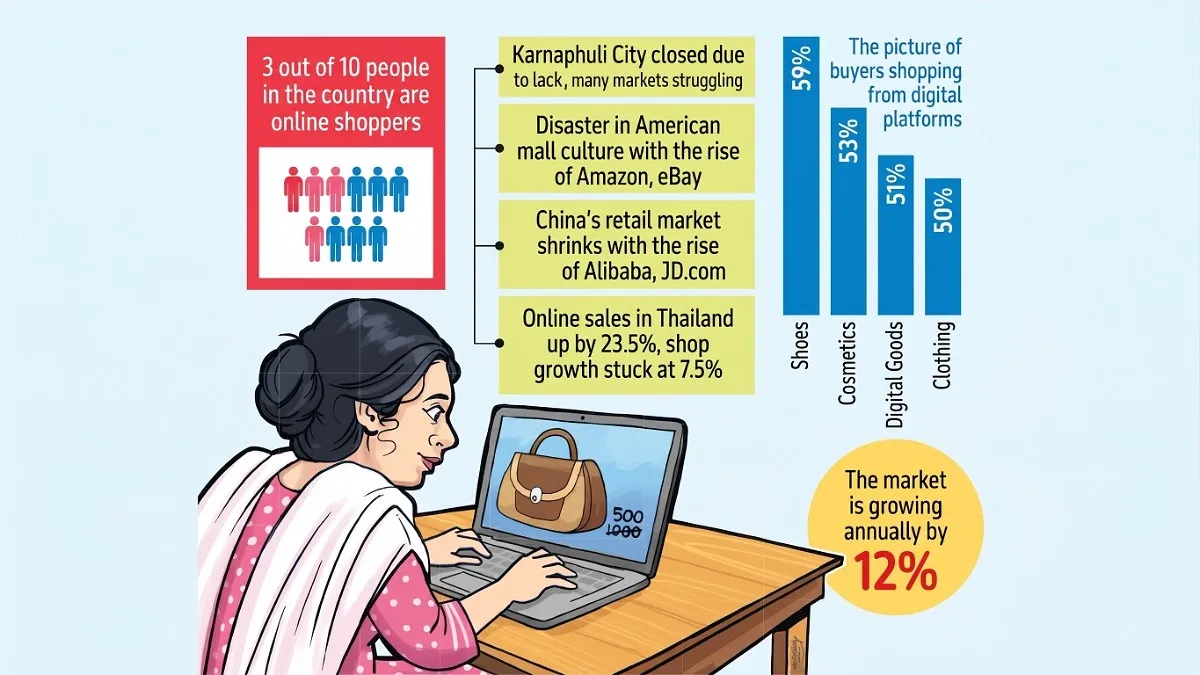
Even a few years ago, the corridors of Eastern Plaza on Elephant Road, Karnaphuli Garden City in Kakrail and Polwel Super Market in the capital would be bustling with shoppers on holidays. Over time, however, that familiar hustle and bustle has largely disappeared. Karnaphuli Garden City, once a renowned shopping destination, has already shut its doors due to a lack of customers. Silence has also descended on Eastern Plaza and older shopping malls in Malibagh and Mouchak. Sales at many of the capital’s prominent shopping malls have fallen by half.
The slowdown in sales at shopping malls and markets due to online shopping is essentially a local reflection of an inevitable transformation in the global economy. The impact of digital platforms has triggered a retail apocalypse in the United States. Experience-based shopping malls in China and traditional markets in Thailand have also faced a downturn. That global wave has now reached Bangladesh.
An analysis of a report by Payment and Commerce Market Intelligence (PCMI), an organization that provides data and forecasts on digital payments, fintech and e-commerce markets worldwide, shows that transactions through e-commerce platforms in Bangladesh are projected to reach nearly $13 billion by 2027, equivalent to more than Tk 1.5 trillion. The transaction volume stood at $9 billion in 2024. Online commerce is growing at an annual rate of 12 percent between 2024 and 2026. However, more than 50 percent of the population remains outside formal banking services, limiting access to digital payments. Despite this obstacle, three out of every 10 people currently shop online.
A study by the Centre for Policy Dialogue (CPD) projects that online shopping in Bangladesh will reach $9 billion in 2026, equivalent to more than Tk 1 trillion.
Asked about the situation, CPD Distinguished Fellow Dr Fahmida Khatun told Agamir Somoy that many people now prefer shopping online from home rather than visiting markets.
“At present, many people prefer shopping online from home rather than going to markets. This is affecting shopping malls. Customers find shopping through online platforms from home more convenient than visiting different shops. The growth of online commerce is leaving markets struggling with a shortage of customers,” she said.
She added that shopping malls in developed countries had responded to the situation by incorporating online platforms into their businesses.
“Customers are becoming more interested in shopping online than offline,” she added.
According to the PCMI report, cosmetics and beauty products are among the leading and most popular product categories in Bangladesh, with 53 percent of purchases taking place online. Ordinary consumers choose online platforms for 51 percent of their digital product purchases. Similarly, 50 percent of clothing purchases are made through digital platforms. In the footwear category, 56 percent of customers rely on online shopping.
In addition, 79 percent of customers choose online shopping because of lower costs. Four out of every 10 e-commerce shoppers said social media, online reviews and recommendations play an important role in helping them discover new products.
The report also noted that the convenience of payment systems is contributing to the growing popularity of online shopping, with 47 percent of customers citing it as a factor.
According to transaction statistics, cash on delivery accounts for 75 percent of the primary payment methods used in Bangladesh’s e-commerce sector. Digital wallets account for 11 percent, credit cards for 8 percent and debit cards for 6 percent.
The adverse impact of online shopping is now becoming increasingly visible in markets and shopping malls.
Mohammad Sarwar, owner of Tarunima Fashion at Eastern Plaza in Hatirpool, said business had been experiencing a downturn for several years.
“Compared with last year, the situation is even worse this year. Given the rate at which customers have declined, I am uncertain whether it will be possible to keep the business running,” he said.
Around the time Eastern Plaza in Hatirpool became a popular shopping destination, several other shopping complexes in Dhaka were also thriving. These included Alpana Plaza, Polwel Super Market and Karnaphuli Garden City Shopping Complex. Among them, Karnaphuli Garden City Shopping Complex in Kakrail closed last month. The others remain operational but are struggling. Shop owners claim that the business environment is no longer favorable. They say they are fighting to keep their businesses alive.
A senior leader of the Bangladesh Shop Owners Association, speaking on condition of anonymity, said proposals had even been submitted to the association to close several markets due to the downturn.
Asked about the reasons behind the business slowdown at these shopping complexes, relevant businesspeople said the expansion of online shopping had narrowed their business opportunities. They also blamed the sluggish state of the country’s economy for the decline in customer footfall.
Alpana Plaza, the first modern air-conditioned shopping mall on Elephant Road, has lost its former prominence amid growing competition.
Last Sunday afternoon, two sisters, Jharna and Nodi, who had come to shop there from Basila, said, “We don’t visit markets very often anymore. We buy many of the things we like from Facebook pages.”
Although Alpana Plaza does not attract many customers, the nearby Subastu Arcade remains bustling with shoppers. This is because the shopping complex is a wholesale clothing market where entrepreneurs involved in online businesses purchase their products.
Masudul Alam, chairman of AMT Global Company Limited in Bangkok, Thailand, told Agamir Somoy that Bangladesh’s online marketplace had experienced an explosion in growth. He said his company was directly shipping products to entrepreneurs involved in online businesses every week.
“The volume of products we send to Bangladesh has increased several times compared with before,” he said.
Asked about the situation, Bangladesh Shop Owners Association President Mohammad Helal Uddin said frequent changes in policies governing markets, shopping complexes and malls were often hurting the business.
“Sometimes markets are required to close at 7:00 pm and sometimes at 8:00 pm. Previously, whenever a shop became vacant in areas such as Mouchak or Malibagh, 10 entrepreneurs would rush to rent it. Now, many shops remain vacant, but there are no entrepreneurs interested in renting them,” he said.
The organization’s Senior Vice-President Rezaul Islam Montu told Agamir Somoy that they did not want any shopping mall to close.
“We do not want any market to shut down. The economic situation is reducing the number of customers at shopping malls. The impact of online marketplaces is also there,” he said.
Global situation
An investigation found that many developed countries had faced similar challenges before Bangladesh. In particular, the rise of Amazon and eBay dealt a major blow to America’s traditional mall culture.
Hundreds of shopping malls in the United States have turned into abandoned and ghostly buildings. Economists have described the phenomenon as a “retail apocalypse,” referring to the collapse of traditional retail businesses.
This year, several prominent shopping destinations and retail businesses have announced closures. They include San Francisco Centre in California, Lloyd Center in Oregon, MacArthur Center in Virginia, Livingston Mall in New Jersey and Crystal Mall in Connecticut. Saks Global, which includes Saks Fifth Avenue and Neiman Marcus, Eddie Bauer and Francesca’s have also announced closures. Earlier this month, The Children’s Place announced plans to close another 24 stores.
Meanwhile, the rise of Alibaba and JD.com has significantly reduced the size of China’s traditional retail market. The country has undergone extensive digitalization of its retail sector, forcing offline shopping malls to transform themselves into experience-based destinations to remain competitive.
In Thailand, the dominance of foreign e-commerce platforms, particularly Shopee, Lazada, TikTok Shop and Temu, has pushed traditional and local retailers into a multifaceted crisis.
While online sales in Thailand are growing at an annual rate of 23.5 percent, growth in physical stores has remained limited to 7.5 percent. Faced with the widespread popularity of online shopping, some traditional and mid-range department stores and markets in Thailand have permanently closed.
A major example is the historic and popular Tang Hua Seng Department Store in Bangkok’s Thonburi area. Despite serving customers for decades, the store was forced to close permanently after failing to withstand competition from e-commerce.
