
47th BCS Examination
Managing BUET Classes, Teaching Job, and BCS Preparation

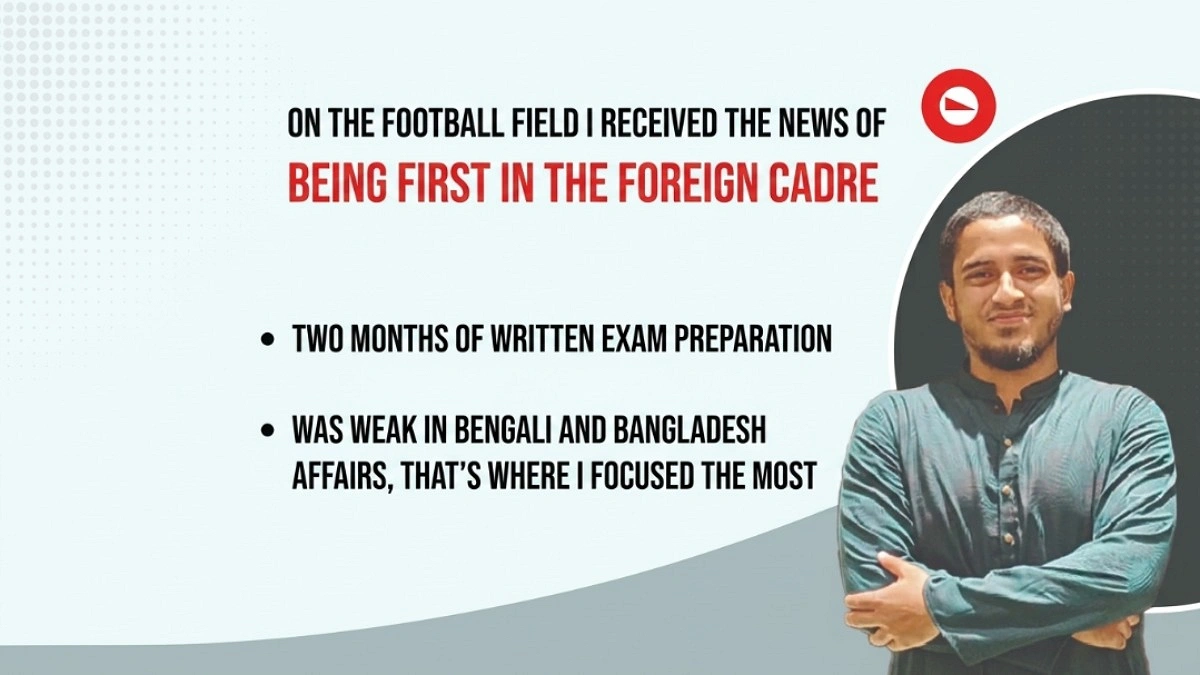
Graphics: Agamir Somoy generated by AI
A young man from a remote village in Netrokona dreamed of one day representing Bangladesh on the global stage. The journey was anything but easy. He pursued engineering at the Bangladesh University of Engineering and Technology (BUET), taught at the university, and simultaneously completed his master's degree—all while preparing for the Bangladesh Civil Service (BCS) examination.
With limited time but a clear goal, he chose the Foreign Affairs Cadre as his first preference, following his father's advice. Through disciplined study, effective time management, and unwavering determination, he achieved his dream.
Today, Tanvir Rahman has secured the top position in the Foreign Affairs Cadre in the 47th BCS examination.
In an exclusive interview with Agamir Somoy, he speaks candidly about his journey to success, preparation strategy, the challenges he overcame, his future plans, and his advice for aspiring candidates. The interview was conducted by Manir Hossain Roni.
Agamir Somoy: First of all, congratulations. How did you learn that you had secured the top position in the Foreign Affairs Cadre?
Tanvir Rahman: Thank you. On the day the results were published, I was on the football field playing a match. My younger sister called and told me that the results had been released. Around the same time, Fatin Ishraq, who ranked first in the Foreign Affairs Cadre in the 46th BCS, also confirmed the news. I had only hoped to be recommended for any cadre. I never imagined I would rank first in the Foreign Affairs Cadre.
Agamir Somoy: Tell us about yourself.
Tanvir Rahman: I am from Baghra village in Kalmakanda Upazila of Netrokona. My family consists of my parents, my two sisters, and me. I began my education at Baghra Government Primary School in my village. Later, I studied at Anjuman Adarsha Government High School and Mirzapur Cadet College. I earned my bachelor's degree in Computer Science and Engineering from BUET and am currently pursuing a master's degree in the same discipline. In addition, I have been working as a lecturer at BRAC University for the past year.
Agamir Somoy: Why did you choose the Foreign Affairs Cadre as your first preference?
Tanvir Rahman: Before applying for the BCS, I discussed my options with my father. He advised me to list the Foreign Affairs Cadre as my first preference. Initially, it was a family decision, but after learning more about the cadre, I became genuinely interested in it. Alhamdulillah, that dream has now come true.
Agamir Somoy: When did you begin preparing for the BCS?
Tanvir Rahman: I started preparing after entering the fourth year of university by practicing with question banks. Before I had even completed my final semester examinations, the notification for the 47th BCS examination was published.
Agamir Somoy: What was your preparation strategy?
Tanvir Rahman: To be honest, I didn't have any special strategy. Right after graduating, I joined BRAC University as a lecturer. That left me with very little time for long-term, structured preparation. Since the exam was approaching, I simply made the most of whatever time I had. I never expected such an outstanding result because my preparation period was quite short. The one thing I focused on consistently was regular study. I tried to study for two to three hours every day, and I believe that consistency became my greatest strength.
Agamir Somoy: How did you prepare separately for the preliminary, written, and viva examinations?
Tanvir Rahman: For the preliminary exam, I regularly took live weekly MCQ model tests. After each test, I focused less on my score and more on analyzing my mistakes, revising those areas repeatedly. For the written examination, I relied on various books, online resources, and AI tools. Before the viva, I joined a preparation group where senior candidates shared their experiences and discussed likely interview questions, which helped me organize my preparation effectively.
Agamir Somoy: Which books, notes, or resources helped you the most?
Tanvir Rahman: I had only about two months to prepare for the written examination. Instead of relying on others, I made my own concise notes. Since time was limited, I devoted comparatively less time to my stronger subjects—mathematics, English, and science. Instead, I spent more time on my weaker areas, including Bangla, Bangla literature, book reviews, international affairs, and Bangladesh affairs. Dividing my study time according to my strengths and weaknesses proved to be the most effective strategy for me.
Agamir Somoy: What was the biggest challenge during your preparation, and how did you overcome it?
Tanvir Rahman: This was my first BCS examination. At the same time, I had to balance a full-time teaching job, my master's studies, and BCS preparation. The biggest challenge was managing my time effectively. I played football regularly, discussed my preparation with seniors, and tried to stay positive. I believe that if you can manage your time well, a major part of the preparation becomes much easier.
Agamir Somoy: Was this your first success, or had you appeared in previous BCS examinations?
Tanvir Rahman: This was my first regular BCS examination. I first appeared in the 47th BCS. In the meantime, I also took part in the 49th Special BCS, where I was recommended for the Education Cadre in Information and Communication Technology (ICT) and ranked third on the merit list. However, my primary goal was always the Foreign Affairs Cadre, and I'm grateful that I achieved it.
Agamir Somoy: How did you stay motivated during periods of stress and discouragement?
Tanvir Rahman: I always placed my trust in Almighty Allah. Since I was simultaneously managing my job, master's studies, and BCS preparation, I didn't really have the luxury of sitting idle in frustration. Whenever I felt mentally exhausted, I prayed, spent time at the mosque, played football, or watched matches. Taking some time away from studying to do something I enjoy helped me stay mentally refreshed. That's how I remained positive throughout the preparation journey.
Agamir Somoy: What kind of questions were you asked during the viva? Do you remember any in particular?
Tanvir Rahman: The atmosphere at the viva board was very friendly. I didn't feel pressured from the beginning. Since I had a strong academic record, I was asked several questions related to teaching. In particular, they wanted to know why I had not joined—or been able to join as a faculty member at BUET and why I preferred the Foreign Affairs Cadre over an academic career. They also asked me a few questions related to my academic background and technical expertise.
Agamir Somoy: How important was your English proficiency in securing the top position in the Foreign Affairs Cadre?
Tanvir Rahman: English proficiency is important in almost every field today, and it is even more crucial for the Foreign Affairs Cadre. It is essential for international communication, research, information gathering, and even using artificial intelligence effectively. In my case, studying at a cadet college gave me a strong foundation in reading, writing, and speaking English, so I didn't need extensive additional preparation. Anyone aspiring to join the Foreign Affairs Cadre should place special emphasis on developing strong English skills.
Agamir Somoy: Who contributed the most to your success?
Tanvir Rahman: First and foremost, my parents and family. Without their love, sacrifices, and encouragement, this journey would not have been possible. I also received tremendous support and inspiration from my teachers, friends, seniors, juniors, and relatives. I consider this achievement the result of everyone's love, support, and prayers.
Agamir Somoy: How did your family and loved ones react after the results were announced?
Tanvir Rahman: I expected to be recommended for one of the cadres, but I never imagined I would rank first in the Foreign Affairs Cadre. I was surprised, and so were my family and friends—though in the happiest possible way. However, I had my master's examination the following day, so instead of responding to everyone's congratulations, I had to focus on preparing for that exam.
Agamir Somoy: As a future diplomat, which aspects of Bangladesh would you most like to highlight on the international stage?
Tanvir Rahman: Bangladesh's greatest strengths are its human resources, large consumer market, and young, productive workforce. We need to present these strengths more effectively to the world to attract greater foreign investment. At the same time, Bangladesh's economic progress, skilled workforce, and future potential deserve greater international recognition. Given the current global uncertainties, I also believe that strengthening economic diplomacy and adopting long-term strategies to safeguard our national interests are extremely important.
Agamir Somoy: What do you consider Bangladesh's biggest challenge in today's global diplomatic landscape?
Tanvir Rahman: At present, Bangladesh's biggest challenge is maintaining economic stability. A country's economy is closely linked not only to development but also to internal security, social stability, and its international standing. At the same time, the world is experiencing wars, geopolitical tensions, and growing competition for influence. In such a situation, maintaining strategic balance while protecting national interests and dignity through prudent foreign policy is Bangladesh's greatest diplomatic challenge.
Agamir Somoy: If given the opportunity, which country would you like to serve in as Bangladesh's ambassador, and why?
Tanvir Rahman: If I had the opportunity, I would like to serve in Saudi Arabia. It is one of Bangladesh's largest overseas labor markets, where a significant number of Bangladeshis find employment every year. The remittances they send home play a vital role in our economy. If I were posted there, I would work to improve the welfare of Bangladeshi expatriates, expand employment opportunities, and further strengthen bilateral relations between the two countries. As a Muslim, I also have a deep personal respect and emotional connection to Saudi Arabia.
Agamir Somoy: What do you think is the biggest misconception about BCS preparation?
Tanvir Rahman: To be honest, I don't want to make any definitive comments on that because this was my first BCS preparation experience. Those who have been preparing for years or have appeared in multiple BCS examinations have much more experience than I do. However, one thing I firmly believe is that sincere effort always pays off. Rather than being influenced by others or common misconceptions, it's far more important to follow your own plan and prepare consistently.
Agamir Somoy: If you had to start preparing for the BCS from scratch again, would you do anything differently?
Tanvir Rahman: In my case, there wouldn't have been much scope for major changes. With my job, master's studies, and personal life, it wasn't possible to study for more than three to four hours a day. However, there is one thing I would definitely do differently: I would take several written model tests before the written examination. Later, I realized that success in the written exam depends not only on knowledge but also on effective time management. Taking model tests beforehand would have helped me improve both my writing speed and time allocation.
Agamir Somoy: What message would you like to give to the young people of Bangladesh?
Tanvir Rahman: My biggest message is this: never stop moving forward. Success does not come to everyone at the same time. Some achieve it today; others may achieve it tomorrow. Don't compare yourself with others. Keep working consistently, believe in yourself, and always give your best. Sincere effort never goes to waste.
Agamir Somoy: Thank you for your time.
Tanvir Rahman: Thank you very much.
