
No fish in Brahmaputra, fishermen changing professions

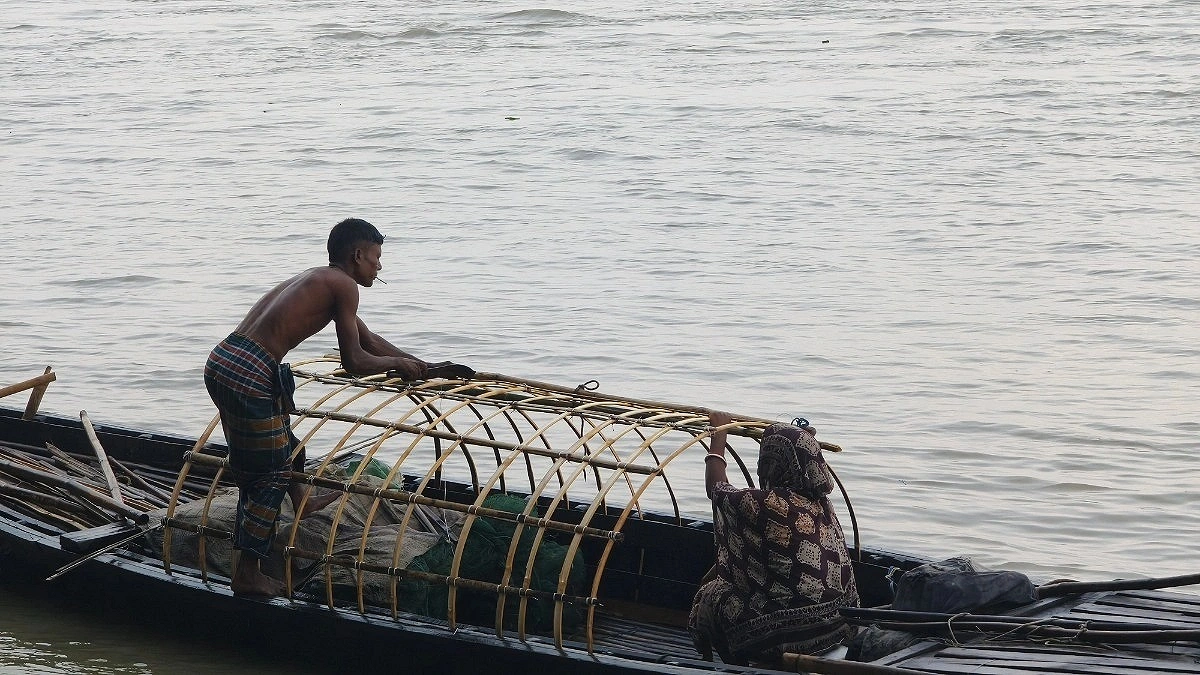
A fisherman repairs his own boat. Photo: Agamir Somoy
The once turbulent Brahmaputra River is now suffering from navigability problems. Sandbars have emerged across the river. Water depth has decreased and the number of fish has also declined. More than 100 fishermen living along the river in Kurigram are facing hardship. Many of them are turning to other occupations to support their families.
Those concerned say climate change and changing weather patterns have brought major changes to the river’s natural environment. This is disrupting fish breeding, movement and the food chain. The decline in the river’s navigability is also shrinking safe habitats for native fish.
Talking to local fishermen, it was learned that fish availability has declined alarmingly at various points of the Brahmaputra River over the past few years. Once fishermen’s nets would fill with various large native fish. Now even catching small puti or tengra fish after casting nets all day has become difficult. As a result, fishing families living along the river are constantly struggling with financial hardship.
The fishermen said the lack of fish in the river has made it difficult to repair their nets and boats and run their households. Many are spending their days by taking loans. Some are asking others for financial help. Others are being forced to take up jobs such as construction helpers, day laborers and rickshaw drivers to make ends meet.
During a visit to various river ports including Chilmari, many boats were seen lying idle. Some fishermen were weaving or repairing nets. However, there was no rush to take boats onto the river like before. Instead of the usual activity of fishing on the vast sandbars that have emerged in the river, silence now prevails.
Anjali of Jorgacha Fishermen’s Village said there are no fish in the river like before. It is difficult to run a household by selling the fish that are available. For this reason, many people are changing professions. Many fishermen from their area have moved to Dhaka in search of work.
She also said fishermen who hold cards receive a certain amount of rice as government assistance during the hilsa fishing ban. However, this assistance is not enough to support their families throughout the year.
Fisherman Sushanta said, “Since the time of our forefathers, everyone in our family has supported their households by fishing in the river. But now you can say there are almost no fish left in the river. Even after pulling the net all day, we cannot cover the cost of fuel. I am in trouble with my children. I have been forced to start doing other work to make ends meet.”
Another fisherman, Shonil, said fish could be caught whenever they cast a net in the river in the past. Now fish are no longer available like before. It has become difficult just to support a family. For this reason, many are giving up fishing and looking for other sources of income.
River activist Jahanur Rahman said regular and moderate rainfall is no longer occurring during the monsoon as it did in the past due to the effects of climate change. Sometimes there are prolonged droughts and at other times sudden floods occur at unusual times. This is disrupting the natural breeding cycle of fish.
According to him, rising temperatures are also changing the normal temperature of river water and the level of dissolved oxygen. As a result, many native fish species are dying. Many species are also losing suitable environments for spawning.
Jahanur Rahman further said that the river’s normal flow and ecosystem are being damaged as the river dries up and sandbars emerge during the dry season and excessive water flows occur during the monsoon. This is causing fish habitats and food chains to collapse. The river is losing depth due to insufficient water. As a result, deep and safe places needed for fish breeding are also declining.
According to data from the Bangladesh Meteorological Department, Kurigram recorded 521, 241 and 566 millimeters of rainfall in June, July and August respectively in 2023. In the same three months of 2024, rainfall was 1,131, 393 and 178 millimeters respectively. In 2025, rainfall was 374 millimeters in June, 296 millimeters in July and 286 millimeters in August.
From June to August this year, Kurigram recorded a total of 974 millimeters of rainfall. Of this, 473 millimeters was recorded in June, 378 millimeters in July and only 123 millimeters in August.
Weather and climate researcher Shamsuddhoa Soumik said that over the past two to three years, there has been a trend of sudden and short-lived floods instead of seasonal flooding. Continuous heavy rainfall for one to two weeks is needed for major seasonal floods in the river basins of the district. However, rainfall patterns have changed in recent years. The amount of rainfall that should occur at a particular time is no longer occurring. At the same time, excessive rainfall is occurring within a short period. The remaining time is marked by a lack of rainfall.
Experts and local fishermen have recommended declaring permanent fish sanctuaries in deep and suitable areas of the Brahmaputra. They have also called for banning fishing in these areas and stopping the use of illegal current nets and China duari nets. They also emphasized regular and planned dredging to restore the river’s navigability.
Experts have recommended increasing government VGF assistance for fishermen who change professions. They also suggested providing training in livestock farming, cottage industries and other livelihoods as well as loans on easy terms.
Chilmari Upazila Fisheries Officer Md. Amdadul Haque said fish breeding is being somewhat disrupted due to declining water levels in the Brahmaputra River and climate change. However, regular drives are being conducted to protect fish resources. During these drives, illegal current nets and China duari nets are being seized and destroyed. Various government training and assistance programs to create alternative sources of income for fishermen are also continuing.
