
Is firefighting the sole responsibility of the fire service?

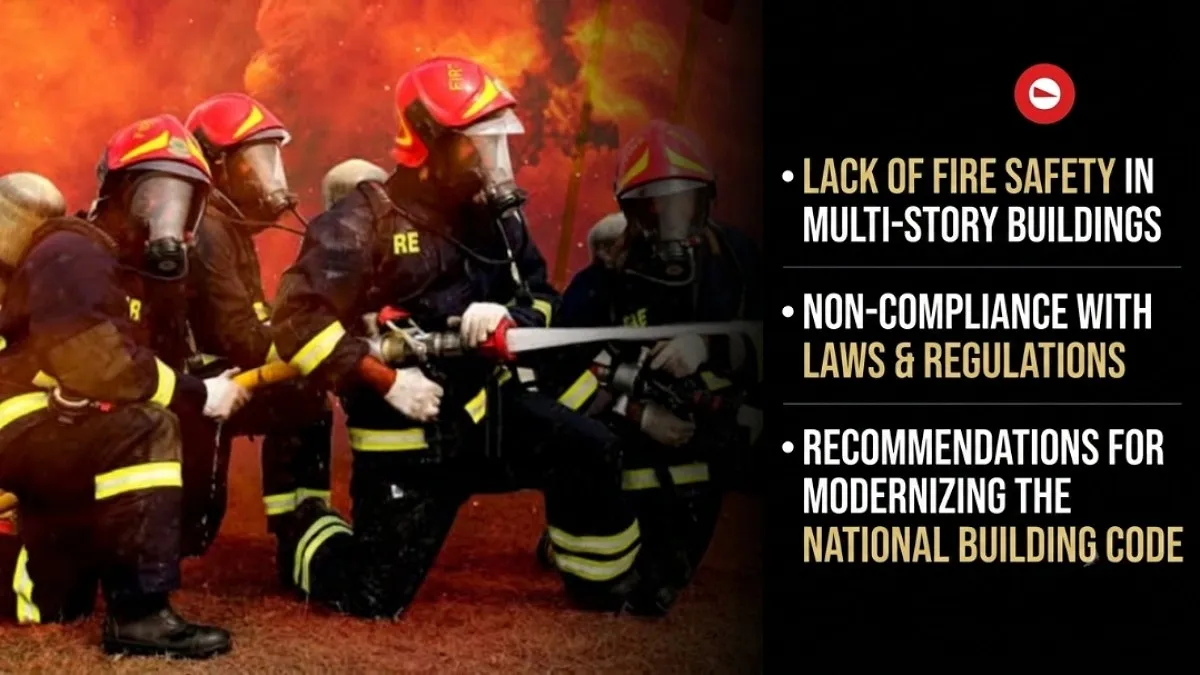
Graphics: Agamir Somoy
Most high rise buildings in the capital lack fire safety systems. Fire safety laws and regulations are widely ignored. Most buildings do not even have basic firefighting equipment. The recent fire at Al Baraka Tower has once again exposed this dangerous reality in the country’s real estate sector.
On the night of June 26, six Fire Service units rushed to Al Baraka Tower at 1:05 am to extinguish the blaze. However, firefighters faced severe difficulties because the building lacked its own fire safety system and water supply. After nearly two hours of exhausting efforts, the fire was brought under control at 3:08 am.
Kazi Najmuzzaman, Assistant Director of the Fire Service, who was present at the scene, said, “We did not find any firefighting system in the Al Baraka building. That means the building was constructed outside our policy guidelines. Besides, there cannot be any ‘L’ chamber in a high rise building, but there was one here.”
Agamir Somoy also spoke with Enamul Haque, Deputy Assistant Director of the Fire Service, Dhaka Zone 1, who was also working to extinguish the fire that night. He said this was not an isolated case but a common picture across most buildings in Dhaka.
He said, “Many buildings in Dhaka have no fire safety system. Even where such systems exist, they are often nonfunctional. Our biggest problems arise from narrow roads and goods stacked in front of buildings. In those situations, Fire Service vehicles cannot reach the front of the building.”
Without an in house wet riser or dry riser system in high rise buildings, firefighters face difficulties pumping water to the upper floors.
A visit to different areas of Dhaka, including Dhanmondi, Old Dhaka, and Mirpur, found that fire safety measures were completely absent in most buildings. In some buildings, fire extinguishers or equipment were available but were either unusable or out of service.
Jagannath University student Ujjwal Hasan has been living in Dhaka for four years. Sharing his experience, he said, “I first lived in Mirpur and later in two buildings in Old Dhaka. But I have never seen any fire safety system in any building. Instead, the rooftops of both buildings were always locked. If a fire breaks out, we would not even have the opportunity to take shelter on the roof.”
Expressing his frustration, he said, “Building owners have enough money to construct high rise buildings, but they do not have the money to install fire safety systems.”
Former Fire Service Director General Abu Nayeem Md. Shahidullah recalled that six people died this year in a building fire in Uttara because the rooftop was locked.
He noted that when a fire breaks out on one floor, smoke rises upward. As a result, residents on the lower floors can leave the building, but people on the upper floors often have no chance to come down. The only available safe space for them is the rooftop.
He said that if they can take temporary shelter there, the Fire Service can rescue them. He therefore advised building owners to keep rooftops open at all times.
He added, “The cost of installing the necessary fire safety measures is only about one percent of the total cost of constructing a 20 story building. But owners construct buildings unethically. Yet if they are caught by the authorities, they often have to pay fines much higher than that amount. This is not only unethical, it is also inhumane.”
A similar situation was found in a nine story building in Dholaikhal. The building had neither a fire riser system nor even a basic fire extinguisher. There was no arrangement to put out a fire in its initial stage. Agamir Somoy spoke with the building owner, Jamal Uddin.
He said, “Nothing like this has ever happened before. I always tell the tenants to be careful. However, after hearing about the fire, I have informed the shopkeeper, and he will send the equipment.”
Most buildings also lack fire alarms or smoke alarms. As a result, residents often remain unaware during the initial stage of a fire. Al Baraka Tower in Katabon, where the fire started on the 13th floor, also did not have a smoke alarm. Nabir Hossain, who lived on that floor, said he did not initially know that a fire had broken out. He was asleep at night. Later, his nephew called after hearing about the fire and woke him up. By the time he came out, he could not see anything because of the smoke.
Under existing laws in Bangladesh, ensuring fire safety in high rise buildings is a legal obligation. Section 4 of the Fire Prevention and Extinguishing Act, 2003, requires all commercial and high rise buildings to obtain a Fire Service fire safety clearance certificate before being occupied. Violations of the law are punishable by up to three years in prison, a fine, and the sealing of the building.
Similarly, under the Bangladesh National Building Code and the Building Construction Rules, 2008, high rise buildings are required to have fire lifts, emergency staircases with fire resistant fire doors, automatic sprinkler systems, dedicated water reservoirs for firefighting, and sufficient setback space around buildings to allow Fire Service vehicles access.
Brig. Gen. (Retd.) Abu Nayeem Md. Shahidullah said solving the problem requires collective efforts rather than action by a single party. He recommended modernizing the Bangladesh National Building Code and ensuring proper enforcement of the law. He also advised providing building security personnel with training on the use of firefighting equipment.
He emphasized, “The source of fires must be identified. Most fires originate from electrical wiring. Therefore, buildings should use high quality electrical wires, switches, and circuits, and the wiring should be inspected every year. Electrical devices should also be used according to the voltage capacity of each outlet.”
He believes, “If those responsible are given exemplary punishment, as is done in developed countries, the recurrence of such incidents will decrease. The government should not compromise when it comes to the loss of human lives.”
