
There is no environment to suppress media now: PM Tarique Rahman

Collected Photo
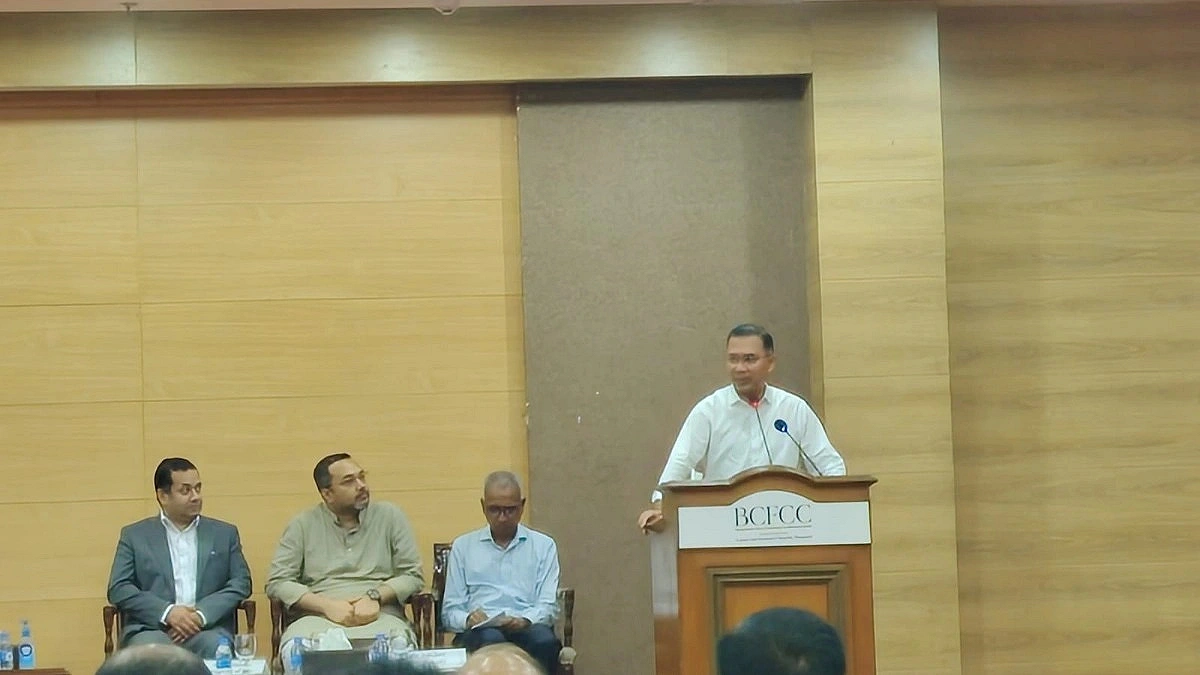
Prime Minister Tarique Rahman has claimed that the media is no longer being stifled in the country. He made this assertion on Tuesday afternoon during an exchange of views with journalists who cover BNP beat at the Bangladesh-China Friendship Conference Centre in the capital.
Rahman said, "Today is an important day for Bangladesh's newspaper industry. On this day, all newspapers in the country were once shut down. Only a handful—barely four—were allowed to operate. And from that point, today we are speaking with so many journalist brothers."
"This proves one thing: the stranglehold that was once placed on the press no longer exists. We have seen how all political parties in the country were abolished and replaced with a single party called BAKSAL. Later, when Shaheed President Ziaur Rahman took over the responsibility of running the country, he reintroduced multi-party democracy. At the same time, he lifted the restrictions on newspapers. What has happened since then, and to what extent—that has already come out through your own words," the Prime Minister added.
On June 16, 1975, the then-BAKSAL government revoked the publication and declarations of all newspapers in the country except for four state-run gazettes. In protest, media professionals have long observed the day as Black Day.
Since taking office on February 17, the Prime Minister has held exchanges with editors of national dailies and other journalists. Continuing that initiative, he met with CEOs and news chiefs of various television channels at the Secretariat yesterday. Today (Tuesday), he held discussions with BNP-beat journalists.
'The Mentality of Revenge Must Change'
The Prime Minister said, "When I said, let us try to change our own mindset a little—yes, what happened to me, if you take revenge now, will it become exactly as before? It won't. Can we move beyond that mindset and figure out what we can actually do for the country, for society, for the people? Whether we can or not is a secondary matter. At least we can try. Why not move forward with at least that mindset?"
During the exchange, the Prime Minister also emphasized the issue of drug addiction. "Everyone is concerned about one matter. We see news about it in the papers frequently—that drug problems have emerged among our younger generation. Perhaps it exists more or less worldwide. Now, how many people can you arrest, how many can you treat, how many can you counsel? There are limits to resources, capabilities, and capacity."
"So how else can we address this? There are other ways. We must address how to rescue the future generation from this problem. We must provide avenues for young people to burn their energy. We must give them scope," he added.
He posed a question, saying, "Wherever we look—in Dhaka city or anywhere else in Bangladesh—how many playgrounds do we actually see? Those who are now involved in drugs, or spending all day on social media, are participating—whether they understand it or not."
Noting a lack of social and religious values among the younger generation, the Prime Minister emphasized the need to address this issue starting from the school level.
Recalling the greenery of London, the PM said, "I really miss this now. Summer is coming. Like Bangladesh, there was a bird like the cuckoo. When one called out, another would respond in the evening. On days when I had no work, I used to walk just to listen to that song. One calls, another responds, and then another—an echo of the birds' calls. It was very beautiful."
'I Seek the Media's Cooperation'
"You can help me a great deal. The government cannot do it alone. Without your cooperation, I won't be able to understand whether a task is going well or poorly. With your cooperation, I will understand. You must also show the path to good work. That is, each of us must come forward. This cooperation is what I am asking of you. If you help, it will make the task much easier for me," Tarek Rahman told the journalists present.
The Prime Minister said, "We must save our environment, we must save the future generation—we must keep our children on the right track, by whatever means necessary. Whether through education, culture, or sports."
The exchange meeting was moderated by the Prime Minister's Deputy Press Secretary, Jahidul Islam Rony. Among those present were Information and Broadcasting Minister Zahir Uddin Swapan, State Minister Yaser Khan Chowdhury, Prime Minister's Adviser Mahdi Amin, Press Secretary Saleh Shibli, Speech Writer S.A.M. Mahfuzur Rahman, Additional Press Secretary Atiqur Rahman Rumon, Deputy Press Secretaries Hasan Shiplu, Sujan Mahmud, and Shahadat Hossain Swadhin, among others.
