
Bangladesh in red zone on 15 indicators including corruption in MCC assessment

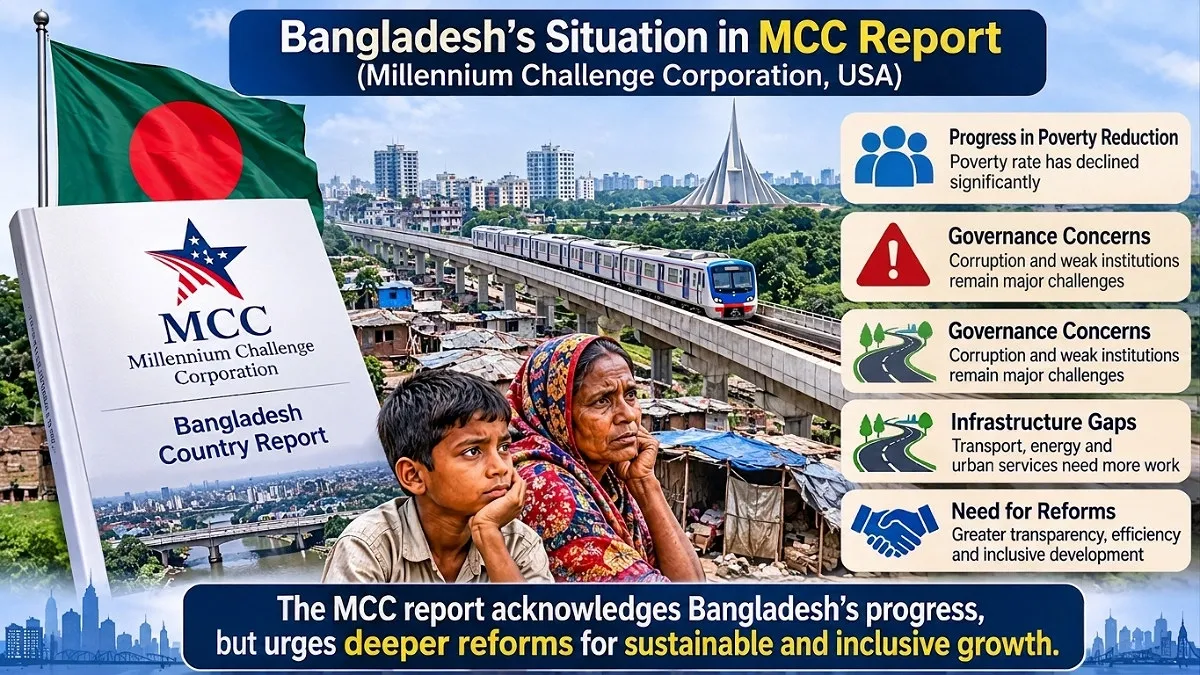
Representational image generated by AI.
Bangladesh remains behind as before in socio-economic and political spheres. Out of 22 indicators, 15—including corruption and child health protection—are in bad shape (red zone). The remaining seven are in good condition (green). Among these, improvement over last year has occurred only in "government effectiveness." These findings emerged from the assessment report of the United States' Millennium Challenge Corporation (MCC). It was published on the organization's own website last Friday.
Bangladesh has been in a rather precarious position in MCC assessments for several years. In this regard, neighboring India, Pakistan, Nepal, Bhutan, and Sri Lanka are far ahead. Only Afghanistan is behind. The United States includes a country in the "Millennium Challenge Fund" based on improvement in these indicators. Bangladesh is being deprived of that opportunity this year as well. However, the Economic Relations Division (ERD) has taken no initiative to change the position. According to experts, obtaining grants from the fund is not the main issue; the country's image is also of special importance in this connection.
The indicators in the red zone in the organization's FY2026-27 scorecard are—control of corruption, government accountability, effectiveness of regulatory agencies, trade policy, access to credit, entry into international markets, property and land rights, and equality of women and men in the economy. In addition, there are business startup, government spending on health, human resource development, protection of natural resources, child health protection, rule of law, and freedom of information.
On the other hand, the indicators in the green zone are—inflation control, employment opportunities, market competition, control of long-term diseases, female secondary education completion rate, personal freedom, and government effectiveness.
Kazi Shafiqul Azam, former Senior Secretary of the ERD, told Agamir Somoy that most of the indicators on which the MCC bases its assessment are linked to a country's good governance. In this regard, if Bangladesh can make progress in good governance, much better results in the assessment can be achieved. The government must pay special attention here. However, this matter is not only about receiving or not receiving grants; the country's image also depends on this score. Politics is also linked to this assessment. The ERD does not do much to improve the score. In fact, there is not much it can do. The Ministry of Foreign Affairs can take initiative to improve it—he added.
Sources in the Economic Relations Division (ERD) said that due to lagging behind in the US score, the substantial grant assistance from the US Millennium Challenge Fund (MCF) is not forthcoming this time either. A country is included in this fund based on improvement in the scorecard. After trying for several years, the relevant officials on the ERD side have now given up and withdrawn their hands.
Dr. Badiul Alam Majumdar, Secretary of Citizens for Good Governance (Sujon), told Agamir Somoy that improving these indicators is one of the challenges for the current government. Because a new government has been formed, the government effectiveness indicator, which was on last time's red list, may have moved to the green list this time. But how effective the government actually is is a matter to be seen. The government should take effective steps to address the challenges and improve this score.
How the Situation Has Been Over the Years
A review of MCC reports over the past few years shows that among 22 indicators, there has been slight improvement in the FY2026-27 score. This time 15 indicators are in the red zone, whereas in the 2025-26 report it was 16, and the 2024-25 report assessed on the basis of 20 indicators, where 17 were in the red zone. In FY2023-24 and FY2022-23, 17 indicators for Bangladesh were in the red zone.
Comparative Picture with Neighboring Countries
Bangladesh's score is behind all neighboring countries. It is only somewhat ahead of Afghanistan. In this regard, India has 8 of 22 indicators in the red zone. In addition, Nepal has 2, Bhutan 4, Sri Lanka 12, and Pakistan 13 indicators in the red zone. Afghanistan, which is behind Bangladesh, has 18 indicators in the red zone.
The user's supplementary explanation is broadly accurate: the Millennium Challenge Corporation (MCC) was established in 2004 to manage the Millennium Challenge Account, and its core purpose is to provide financial assistance to developing countries that meet specific governance, economic freedom, and social investment standards. The reason for conducting assessments is to determine which countries qualify for funding by scoring their performance across a set of indicators.
What is the MCC
The MCC is a U.S. government agency responsible for managing the Millennium Challenge Account (MCA) established by the U.S. State Department. Its core objective is to provide financial assistance to developing countries, with the aim of promoting economic growth and poverty reduction through good governance, economic freedom, and investment in people. The MCC provides assistance through two main programs:
Threshold Program: Typically provides grants ranging from $10 million to $40 million to countries that demonstrate commitment but have not yet met all standards, helping them improve policies and prepare for larger assistance.
Compact: Provides large-scale grants starting at $50 million to countries that fully meet the standards.
Why This Assessment
The MCC's annual assessment (scorecard) is the core tool for determining which countries are eligible to receive assistance. The assessment is based on a set of objective indicators covering three major categories: Ruling Justly (such as corruption control, rule of law, government effectiveness), Investing in People (such as health spending, child health, education), and Encouraging Economic Freedom (such as inflation control, trade policy, market competitiveness). Countries that perform poorly on a certain number of indicators (falling into the "red zone") are unlikely to be selected for funding. The assessment also directly affects a country's international image and credibility in governance.
