
Climate change reshapes agriculture as farmers struggle to adapt

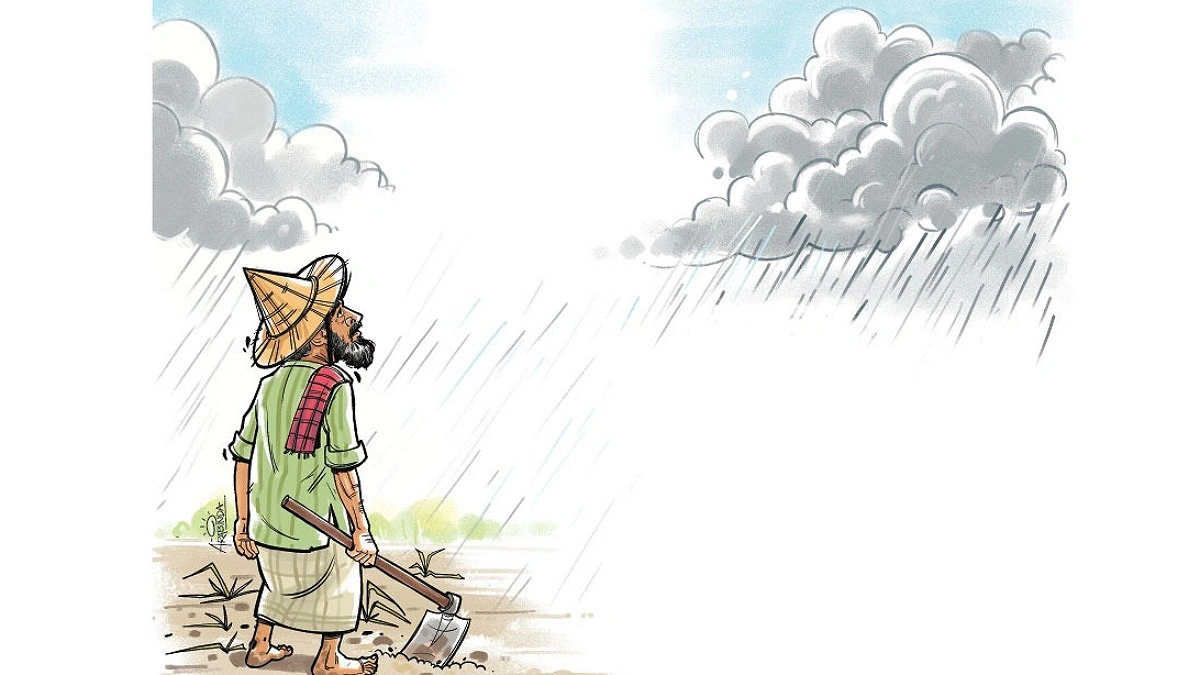
Photo: Agamir Somoy
Weather uncertainty is no longer confined to farmers’ fields alone, as changes are reshaping agricultural culture as well. Rising farming expenses are forcing many to abandon agriculture, fracturing rural agriculture-dependent families and impacting society and the economy.
Under these circumstances, experts advise that to adapt agriculture to changing climate patterns, agricultural planning must be revised immediately.
Innovating new rice varieties or crop strains alone will not suffice; determining which variety is needed for a specific region, when to plant, when to irrigate, and when to harvest must all be decided based on weather forecasts, effectively updating the agricultural calendar according to evolving weather characteristics.
A major portion of rice production in Bangladesh relies on the monsoon season. Aus rice accounts for around 8 percent of total rice production, while Aman rice contributes about 38 percent, meaning that around 46 percent of the country’s total rice is produced across these two seasons.
As a result, shifts in monsoon behavior pose a significant risk to rice production, a threat clearly reflected in recent weather patterns. While April is typically hotter, this year about 76 percent of rainfall occurred during April alone, preventing typical heatwaves.
On the other hand, in June, rainfall at the onset of the monsoon dropped by nearly 36 percent, followed by unusually heavy rainfall in a short span during July. Thus, the problem is not merely decreased rainfall, but rather when it rains and how much falls at one time.
Dinajpur farmer Jainal Abedin claimed that Aman seedbeds could previously be prepared using rainwater, but unseasonal rainfall now forces reliance on groundwater, which increases expenses without yielding former production levels.
He added that the weather once followed a predictable rule where droughts and rainfall could be anticipated, whereas current calculations no longer align, bringing frequent droughts, escalating costs, and disproportionate rice prices.
Sharing a similar experience, Azijar Rahman, a farmer from Kalirhat in number 4 Paltapur Union of Birganj Upazila, who is cultivating rice on nearly 8 acres of land this season, suffered an early setback due to erratic weather.
He said, “During the day I dropped seeds in the seedbed, and it rained at night. The seeds gathered in one place due to the rainwater. This caused damage right at the start.” Beyond rain, excessive heat is a major concern, causing rot in rice and increasing attacks by stem borers, against which pesticides are not always effective.
Niaz Md Farhat Rahman, chief scientific officer of the Agricultural Statistics Division at the Bangladesh Rice Research Institute (BRRI) and researcher on weather and climate change at the Agromet Lab, shared concerning observations.
He said, “In Bangladesh, rising temperatures, irregular rainfall, prolonged droughts, heavy rainfall, floods, flash floods, waterlogging, cyclones, and salinity in coastal areas are becoming major challenges to rice production and production stability.
“Under the influence of El Niño, risks regarding high temperatures, irregular rainfall, and uncertainty over water availability in Bangladesh’s agriculture may increase further.
“Especially during sensitive stages like flowering, pollination, and grain formation of rice, excessive temperatures may increase sterile grains, reduce grain weight, and heighten the risk of yield reduction.” Untimely heavy rain or prolonged dry spells disrupt the normal growth of Aman and Aus rice, increasing dependence on irrigation.
Because soil and weather conditions vary across Bangladesh, experts emphasize that a single rice variety cannot mitigate risks in all regions.
Flood-prone areas require water-submergence-tolerant varieties, drought-prone regions need low-water yield varieties, coastal zones require salinity-tolerant strains, haor areas need deep-water survival varieties, and late-planting yield varieties are also essential, requiring region-specific agricultural planning.
Although research on climate-resilient rice varieties is ongoing in Bangladesh and several varieties have been developed, yield achieved in research fields does not always replicate in farmers’ fields, highlighting the need for stronger coordination between research institutions, the Department of Agricultural Extension (DAE), and farmers.
To address climate-induced drops in agricultural yields, Mohammed Aminur Rashid, minister for Fisheries, Livestock and Agriculture, said the government is prioritizing research-based agricultural development to innovate new rice varieties.
Speaking at a meeting, he said, “In the coming season, BRRI Dhan-118 will be released for the haor region. This cold-tolerant rice variety will create opportunities for early planting and harvesting. As a result, farmers will be able to harvest crops before flash floods, significantly reducing losses.”
Md Rafiqul Islam, director of the Bangladesh Rice Research Institute (BRRI), added that work is underway to develop various stress-tolerant rice varieties to adapt to climate change.
He said, “Disasters are of two types - man-made and natural. While man-made disasters can be controlled or countered to some extent, humans have no control over nature. Therefore, to adapt to climate change, the institute is working to innovate tolerant varieties and new technologies.”
The institute is prioritizing loss reduction during threshing and drying, which requires increasing agricultural technology and mechanization.
Rafiqul explained that flooding during harvest time disrupts threshing and drying, increasing post-harvest losses, which the institute plans to counter using modern technology like dryers alongside improved agro-meteorological forecasting.
He expressed hope that coordinated efforts among departments can overcome weather adversity and drive agricultural expansion.
Meanwhile, Meteorologist Bazlur Rashid noted that while weather modeling and forecasting systems have significantly improved due to technology, global warming is altering normal weather patterns.
He said, “Due to global warming, major changes are coming to weather patterns. As a result, new types of extreme weather outside of what was seen before are being observed now. Through modeling, it is not being possible to capture all these changes in advance in every case.
“Not only that - the frequency or repetition of adverse weather is increasing. This is something we have to adapt to. We have brought many changes to nature. As a result of the amount of industrialization carried out in the name of development, carbon emissions have increased, affecting the weather.”
The impacts of weather changes extend beyond rice to affect jute, vegetables, fruits, fish, and livestock production. In some regions, excessive rain ruins vegetables, while in others, drought reduces yields, and coastal areas face rising salinity pressure. As a result, experts reiterate that comprehensive changes in agricultural planning are urgently needed.
