
Cox's Bazar Border
Conflict on the other side affects livelihoods on this side

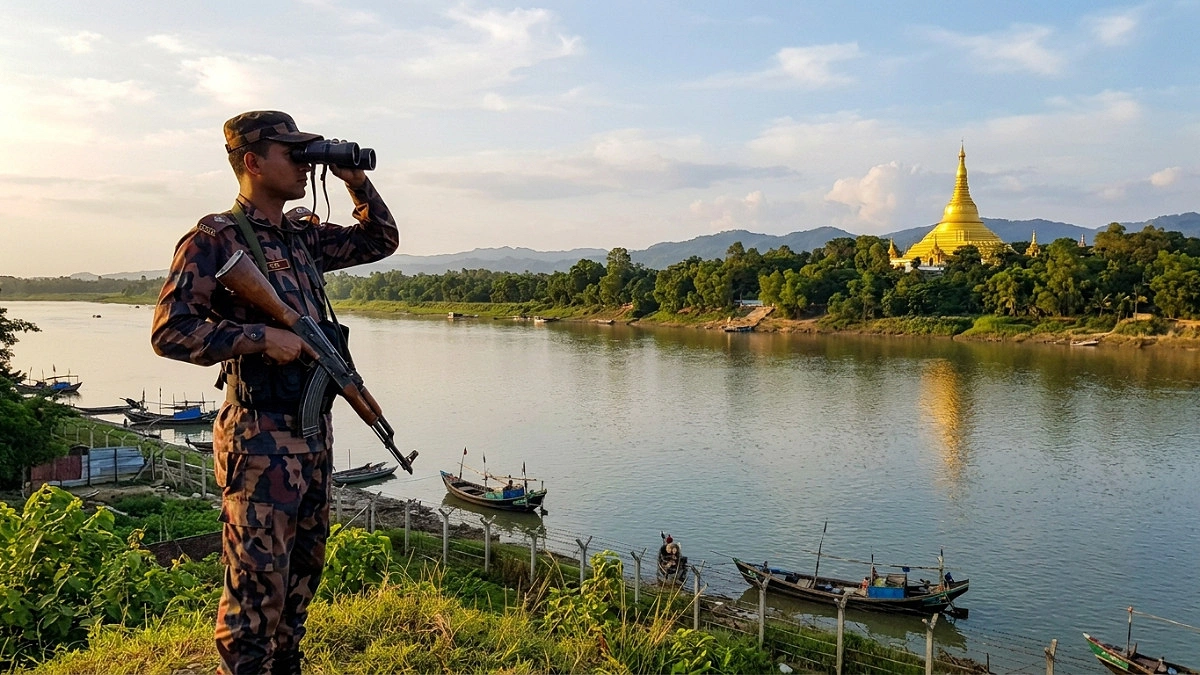
Representational image drawn by AI.
Around 7 in the morning, he had told his grandson that he would return with fish. He would bring back some snacks when he would return. Then Guramia (60) had gone to catch fish in the Naf River with his net. More than five months have passed. He has still not returned home.
According to the family members of this fisher family in Mogpara of Noapara in Sabrang, Teknaf, after his eldest son died, Guramia did not go to the river for nearly five to six months out of grief. Later, when the family fell into hardship, he started fishing again. Before that, for about a month, the family could not even manage rice properly. His grandson was crying for fish to eat. So that day, Guramia had gone to the river saying he would return with fish. Later, around 10 in the morning, the family learned that he had been taken away by members of the Arakan Army.
Guramia's daughter, Samsun Nahar, said while weeping, "Without father, our family has become crippled. We are passing our days in great hardship. I am waiting, hoping that father will return someday." The family members now remember most that morning—the man who left promising his grandson that he would return with fish never came back.
It is not only fishermen like Guramia who went to fish in the Naf River; the conflict on the other side of the border has also affected the lives and livelihoods of people in other professions across the entire Cox's Bazar border area. In the Techchi Bridge border area of Whykong, 12-year-old Huzaifa Afnan had gone out to play in the morning. The local residents had been terrified by the sound of gunfire since the previous night. When the sound subsided somewhat toward dawn, the situation seemed calm. It was on that hope that Huzaifa went out of the house. Suddenly, gunfire started again. A bullet coming from across the border entered beside his face and struck his head. He died on 7 February after being under treatment for 27 days.
Huzaifa was not on any side of the conflict. He was not even old enough to understand who was fighting across the border or why. Huzaifa's world was school, classmates, the courtyard of his home, and sports. A bullet from the border conflict brought that world to a halt.
434 fishermen detained in 20 months
Alongside the people of the land border, fishermen who go to catch fish in the Naf River and the Bay of Bengal are also at risk. Some have been shot, some have been detained, and some have been unable to return home for months.
According to information from the Teknaf Battalion of BGB, from 1 January last year to 19 August this year, 434 fishermen have been reported detained from the Naf River. They were accused of crossing the border to catch fish. Among those detained, 222 were Bangladeshi and 212 were Rohingya. During this period, 348 people were brought back to the country. Another 86 remain detained.
Fear of being chased as soon as they enter the river
According to local fishermen, if they go to catch fish in the border-adjacent areas of the Naf River and the Bay of Bengal, there is a risk of being chased by speedboats and detained at gunpoint. After detention, they are taken to the Maungdaw area. Local fishermen used to regularly fish in Naikhyangdia, Sita, and nearby areas of Shahparir Island. Now many are afraid to go there.
Gafur, president of the Shahparir Island Jetty Ghat, said that because fishing areas have shrunk due to insecurity, fishermen's income has also decreased. Many are now turning to alternative professions, including driving tomtoms.
Meeting of the Boat Owners' Association at Kayukkhali Ghat of Teknaf Municipality
Sajed Ahmed, president of the Boat Owners' Association at Kayukkhali Ghat of Teknaf Municipality, was saying that after the Arakan Army established control in Rakhine State, it has been obstructing fishing in the Myanmar part of the Naf River. He alleged that due to a food crisis, Bangladeshi fishermen's boats and goods are being looted.
Agami'r Somoy has spoken with several fishermen who returned after being detained by the Arakan Army. According to one of them, Mohammad Shafiq, they were on a fishing boat with six crew members within Bangladesh's territorial waters east of Saint Martin's Island. Suddenly, several members of the Arakan Army arriving in speedboats detained them at gunpoint and took them to Maungdaw. He claimed that they were detained there for about 10 months. During this time, they were made to work about seven hours every day. If they refused, they were beaten. They were given food only once a day.
He said, "Our boat, fishing nets, and food were taken away. When we returned home, we came back with only the clothes on our bodies."
Not only detention, there is also the risk of bullets
While fishing in the Naf River, there is not only the risk of detention, but incidents of being shot also occur. According to information from local fishermen and the administration from 2024 to 2026, at least seven people have been shot. One of them died while under treatment. On the evening of 22 May 2024, Md. Hossain Ali (50) was shot while fishing at the mouth of the Naf River in the Kharingaghona area of Whykong. He died on 28 May while under treatment.
Most recently, on 14 September, Md. Idris (55) was shot while fishing in the Naf River adjacent to Nazirpara. According to local fishermen, they were chased while fishing in Myanmar's territorial waters. When they tried to return, shots were fired. As a result, Idris was shot in the knee of his right leg.
Pressure of conflict on livelihoods
According to information from the Teknaf Upazila Fisheries Office, 10,683 fishermen are registered in the government list in the upazila. There are 1,532 registered boats. Besides these, there are another 2,000 to 3,000 unregistered fishermen. However, several leaders of the Teknaf Boat Owners' Association claim that the number of unregistered fishermen outside the government list is even higher. There are about 20,000 fishermen and around 2,000 small and large boats.
Mohammad Tayub, president of the Teknaf Upazila National Fishermen's Association, said that due to insecurity, many do not dare to go to the river. As a result, along with the fishermen's income decreasing, boat owners are also facing losses. If a fisherman is detained, not only does his income stop; the family dependent on him also becomes income-less. Again, if the fishing area shrinks, similar pressure falls on the entire fishing community.
For the coastal people of Teknaf, the Naf River is not just a border river; it is a source of livelihood. Generation after generation, they have caught fish in this river and the Bay of Bengal to run their families. But after the conflict on the other side of the border and the expansion of the Arakan Army's control, that picture has changed. Before entering the river, fishermen now have to think—where it is safe to go, which route carries less risk of being chased or detained, and whether they will be able to return.
Lt. Col. Md. Hanifur Rahman Bhuiyan, commander of the Teknaf Battalion of BGB, said that the issue of fishermen's security is being viewed seriously due to the border situation. He said, "Based on information received by BGB and communication with relevant levels, it is known that several fishermen have been detained by the Arakan Army at various times on allegations of entering Myanmar's territorial waters while fishing in the Bay of Bengal. Communication and coordination with relevant levels are continuing regarding bringing the detained fishermen back home."
Huzaifa had gone out to play that day. Guramia had gone to the river to bring fish for his grandson. Other fishermen had gone to provide food for their families. None of them had weapons in their hands, nor were any of them on any side of the border conflict. Yet they had to become victims of the conflict on the other side of the border.
