
Job today, gone tomorrow: 70 million private sector workers live with uncertainty

Graphics: Agamir Somoy
Hamidul used to live with his wife and three-year-old child in a small rented room costing Tk 5,000 in a narrow alley in Gazmahal, Hazaribagh, in the capital. He earned Tk 18,000 at the end of each month as an employee of Coda Film Company. Although he could not dream of a lavish life with his limited income, the family of three at least had the assurance of two meals a day of rice and lentils.
But everything came to a halt one morning. Without any notice, a single verbal statement took away Hamidul’s nine-year job. The brick and concrete walls of Dhaka suddenly became unfamiliar. Within just a month, uncertainty over paying rent and providing food for his child forced Hamidul to leave the city. Packing up nine years of life in the city, he quietly returned to his ancestral village home in Barishal. There, Hamidul is taking a high interest microloan and hoping to start an uncertain grocery store.
Amid the millions of people in Dhaka, Hamidul is not just a name. He is a living symbol of the lives of workers in the country’s informal and private sectors. Their labor keeps the wheels of the economy turning and plays a major role in achieving economic growth.
Around 70 million private sector employees and workers live with uncertainty like Hamidul. They remain in the labor market day after day but often have no specific appointment letters, pensions or annual salary increases. After retirement, everything including provident fund benefits depends on the wishes of the employer.
An investigation has found that a large number of employees of private organizations are not given formal appointment letters due to loopholes in labor laws. The sole purpose is to avoid legal obligations and keep the option open to dismiss employees without compensation at any time. Besides, even if employers dismiss workers at their discretion, employees often have no legal basis to seek compensation.
In private organizations, verbally agreed salaries are often not paid on time. Workers are deprived of proper overtime payments. When they go to the Department of Labour to file complaints, they often lack the documents required as initial evidence such as appointment letters or service records. As a result, workers are deprived of justice.
This reporter spoke with Fazlur, a pseudonym, from Ashulia in Savar. He has been working at a local garment factory for 17 years. He joined the job after completing higher secondary education because he needed to earn a living. However, he has spent a major part of his working life without an appointment letter.
Regarding salary increases, he said they depend on the employer’s wishes. Many people have worked for 15 years without receiving promotions. Although there is no provident fund benefit, Tk 200 is deducted from their monthly salaries in the name of health insurance. The situation is the same for around 8,000 workers there.
Fazlur expressed his frustration that if he loses his job, he does not have documentary evidence to take legal action. He will also have to enter retirement empty handed.
Disparity Between Government and Private Sector Employees
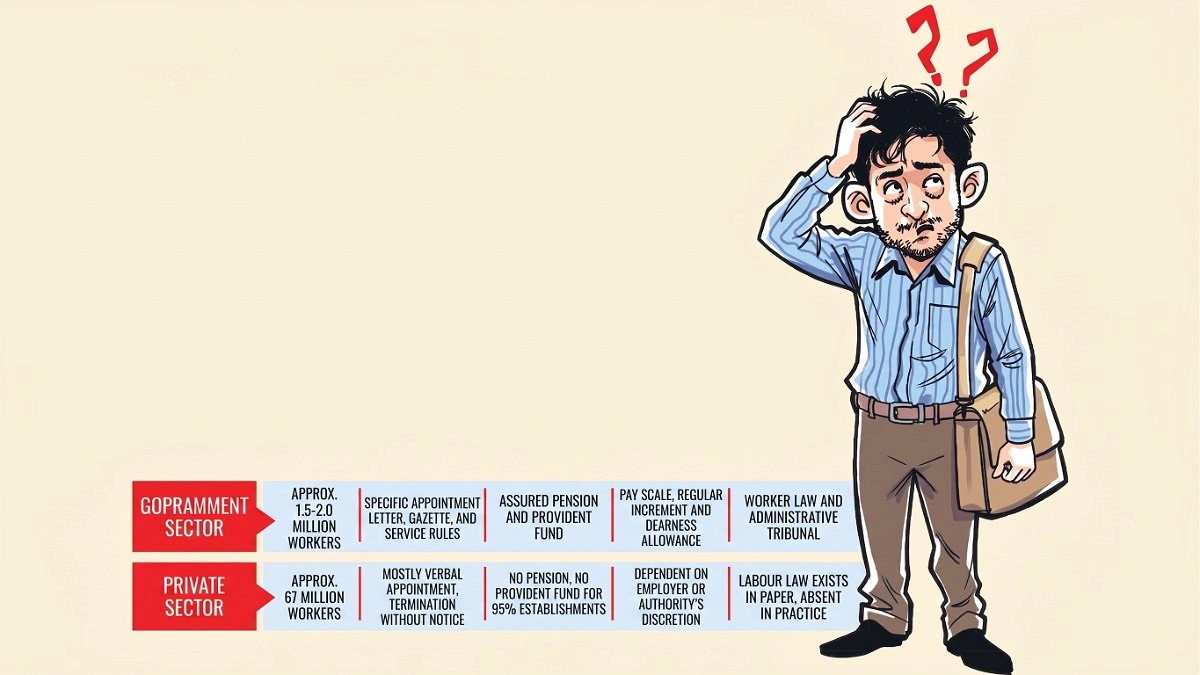
The differences in opportunities and benefits between the government and private sectors in the labor market are stark. A review shows that 1.4 million to 2.2 million government employees have a secure future. On the other hand, around 67 million private sector workers live with job insecurity.
Government employees have proper appointment letters, gazettes and established service rules. In the private sector, however, most workers have only verbal appointments and face the threat of dismissal without notice at any time.
In terms of future security, government jobs provide guaranteed pensions and provident fund opportunities. Private sector employees have no pension of any kind. Moreover, 95 percent of organizations do not have provident funds.
Not only that, government employees receive fixed pay scales, regular increments and provisions for dearness allowances. Salary increases for private sector employees depend entirely on the wishes of the employer or authority.
In terms of legal protection, specific laws and administrative tribunals are relatively effective for government employees. Although labor laws and regulations exist on paper for the private sector, they have little practical effect.
According to International Labour Organization rules, job security and social protection are fundamental rights of workers. While developed countries provide unemployment benefits, Bangladesh has no state backed social safety net for unemployment.
Implementation of Labor Laws and Expert Opinions
The Labor Act 2006, Labor Rules 2015 and EPZ Labor Act 2019 play important roles in protecting workers and ensuring their rights. Section 2, clause 65 of the Labor Act provides a broad definition of “worker.” Accordingly, most private sector employees are entitled to protection. However, they are not receiving the benefits because of the lack of proper implementation of labor laws and regulations.
According to the Bangladesh Bureau of Statistics (BBS), there are a total of 69,009,600 working people in the formal and informal sectors in the country. Of them, including 1.4 million government employees, 11,058,000 people work in the formal sector, accounting for 16 percent of total employment.
Meanwhile, 84 percent of people work in the informal sector, meaning 5,800,028 workers. All of them are private sector workers. Of them, 386,100 work in agriculture, 120,100 in industry and 262,034 in the services sector.
Mahbub Ahmed, former Alternate Executive Director of the Asian Development Bank (ADB) and former Senior Secretary of Finance, said, “The universal pension system needs to be strengthened to protect private sector employees. In the long term, social security can be ensured by bringing all private sector employees under a universal framework. Since there is no specific permanent pay scale for general employees, they have to operate within a market based and competitive system.”
Law Exists but No Implementation
Since independence, the government has set minimum wages for 47 private industrial sectors. On January 26, 2026, minimum wages were announced for the pharmaceutical and bakery, biscuit and confectionery industries.
On April 7, the final gazette was published for the iron foundry and engineering workshop industry. The final gazette for paint and chemical factories was published on June 9. The process of setting new wages for the ceramics and battery manufacturing industries is ongoing.
However, although the laws exist on paper, workers in most sectors are not receiving their benefits in practice. This was highlighted in research by the South Asian Network on Economic Modeling (SANEM).
The research said a large part of the informal sector lacks basic benefits such as written appointment letters, fixed working hours, paid leave and legal protection.
According to SANEM Executive Director Dr. Selim Raihan, there are major institutional shortcomings in making young people and workers suitable for the labor market according to market demand.
Labor Market in the Developed World
Developed countries have strict legal frameworks to ensure job security and social protection for workers. In developed countries such as the United States, United Kingdom, Canada and various European Union states, there is no scope for verbally hiring workers.
Before joining a job, a written contract is mandatory. It must clearly specify working hours, basic salary, specific designation, leave rules and other terms of employment.
A practical example can be found at Bar Olimpia in Rome, Italy. Rizvi Razzak, a resident of Mirpur in Dhaka, works there. He told Agamir Somoy by phone last Thursday that he has a specific written employment contract with the organization.
According to labor law, employees are generally not required to work more than 40 to 48 hours a week. Work beyond that is considered “overtime” or additional working hours. Under his contract, he receives an additional payment of 6 euros per hour.
He further said that a private organization cannot suddenly dismiss an employee there at will. In such cases, written notice must be given before a specified period or an equivalent amount of salary must be paid.
Even if an employee is dismissed illegally, affected workers have the legal right to file cases in labor courts and seek substantial compensation.
Developed countries have well established mandatory social security schemes for private sector employees. These include pensions, health insurance and unemployment benefits.
In addition, independent labor inspection teams regularly conduct surprise inspections of private organizations on behalf of the government. If irregularities are found in maintaining appointment letters, attendance records or paying wages regularly, strict fines and legal action are taken against the organizations concerned.
