Key questions about Gopalganj

Collected Photo
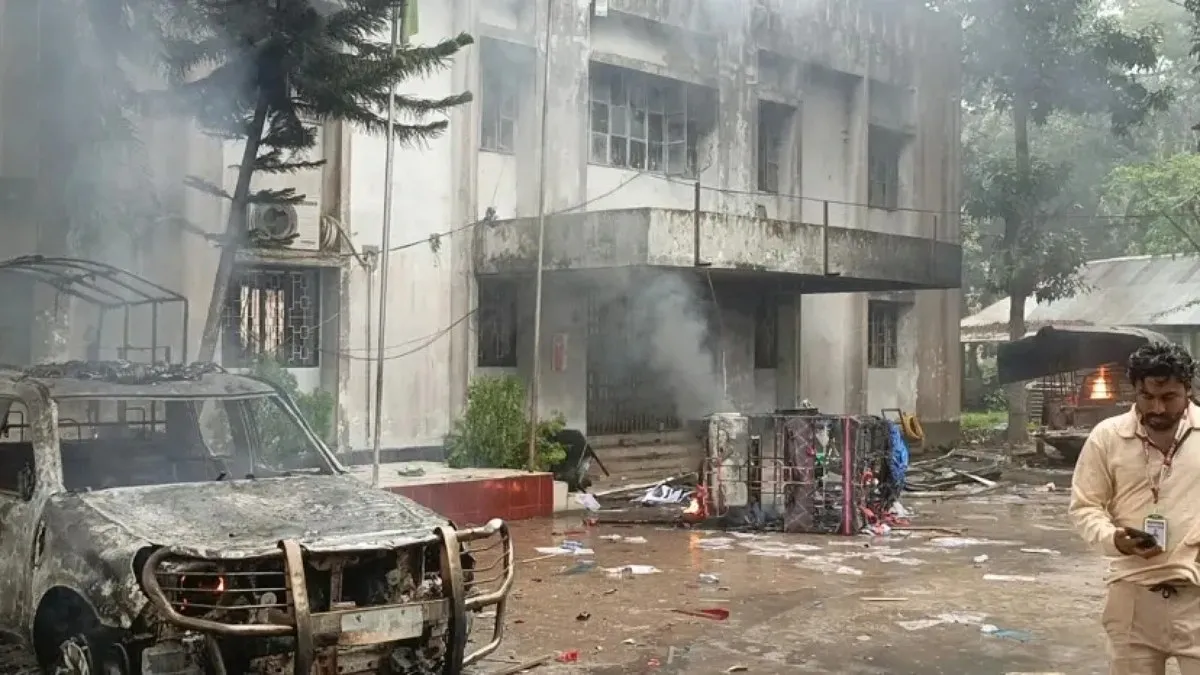
Recent incidents of violence and sabotage in Gopalganj are undoubtedly alarming. Attacks on government establishments, arson targeting police vehicles, the burning of police stations and vandalism are completely unacceptable. Those involved in such crimes must be brought to justice. The state is responsible for ensuring the safety of its citizens.
However, questions have arisen on another front. Can the actions of a few individuals affect the entire population of a district? Criminals must be brought to justice through the legal process. But how justified is it if innocent people are deprived of police services, security, transportation, financial transactions and development facilities as a consequence of those incidents? What does the law of the state say about this?
Several reports published in the media have recently highlighted some concerning developments regarding the situation in Gopalganj. Following the burning of Tungipara and Muksudpur police stations, their regular operations have yet to resume. Train services to and from Gopalganj have also been suspended. In addition, reports have emerged about the suspension of certain allocations to local government institutions. Many residents of the district have also complained about being unable to access mobile financial services.
Taken together, these developments raise questions about how much the daily lives of ordinary people in Gopalganj have been disrupted. Who is taking responsibility for ensuring their security and civil rights?
Police station operations disrupted: Who will ensure public safety?
The responsibilities of a police station go beyond filing cases and arresting criminals. They include ensuring public safety, responding to emergencies, receiving complaints, recording general diaries and maintaining law and order.
The burning of Muksudpur and Tungipara police stations is certainly condemnable. However, if the two stations remain unable to operate normally for an extended period, concerns about the safety of local residents are only natural.
Where will people go if they face theft, robbery, attacks, land grabbing or domestic violence? How quickly will police respond when called in an emergency? How are people being provided with the opportunity to file general diaries or criminal cases at police stations?
Senior Secretary of the Ministry of Home Affairs Manzur Morshed Chowdhury told the media that police personnel from the two stations are still working in Gopalganj. However, he did not specify when the stations would resume operations.
Muksudpur Upazila Nirbahi Officer Mahmud Ashik Kabir also said that renovation work on the two police stations had not yet begun and would take some time.
The presence of police personnel in the district does not necessarily mean that public safety has been ensured. People also need to know where police operations are being conducted, how complaints are being received and what alternative arrangements have been made to respond to emergencies.
The responsibility for burning the police stations lies with the perpetrators. However, restoring their normal operations as soon as possible is the responsibility of the state.
Another concern surrounding the situation in Gopalganj is access to mobile financial services. According to media reports, customers in different parts of the district have complained about difficulties sending and withdrawing money through bKash, Nagad, Rocket and Upay. Some customers have particularly reported problems using accounts opened with their national identity cards.
This is an extremely important issue for ordinary people. Mobile financial services are no longer simply a means of transferring money. They have become an integral part of everyday life.
Money sent by expatriates to their families, payments received by farmers, students’ educational expenses, medical costs for sick people and the earnings of daily wage workers are among the many things that now depend on mobile financial services.
If an account is suspected of being involved in an offence, action can be taken in accordance with the law. However, it must be ensured that innocent customers are not unnecessarily prevented from conducting financial transactions in the process.
Impact on transportation and daily life
The suspension of train services to and from Gopalganj is also causing significant hardship for ordinary people. Train services are not merely a means of transportation. They are connected to people’s employment, trade and commerce, medical treatment, education and family relationships.
Train services may need to be suspended temporarily if there are security risks. However, it is important to communicate how long such a decision will remain in effect, what steps are being taken to restore normal conditions and what requirements must be met before services resume.
Disrupting people’s normal transportation and communication indefinitely in the name of security cannot be a permanent solution.
What does the constitution say?
The Constitution of Bangladesh establishes the framework for governing the state while also guaranteeing citizens’ rights. The state has the authority to maintain security. However, that authority is not unlimited.
Article 27 of the Constitution states that all citizens are equal before the law and are entitled to equal protection under the law. Article 28 prohibits discrimination on the grounds of religion, race, caste, sex or place of birth. Article 31 guarantees every citizen the right to enjoy the protection of the law and to be treated in accordance with the law. Article 32 protects the right to life and personal liberty.
Meanwhile, Articles 59 and 60 establish the constitutional basis of local government institutions and outline their responsibilities and powers.
These provisions make one thing clear. The state’s responsibility is not limited to preventing crime. It must also protect citizens’ legal rights and ensure an environment in which they can lead normal lives.
Questions over the suspension of government allocations
Another source of concern among residents of Gopalganj is the reported suspension of allocations to local government institutions. According to reports published in various media outlets, a decision has been made not to release the third installment of funds under the Ministry of Local Government. This installment covers the period from January to March 2027.
However, the full government order, the amount of money withheld and the specific legal basis for the decision have not been clearly made public. Therefore, it would also be incorrect to claim that all government allocations to the district have been suspended.
There are provisions under laws and financial regulations that allow the suspension of government grants and development allocations. However, such decisions must also have specific reasons and a legal basis.
Sections 53, 73 and 76 of the Local Government (Union Parishad) Act, 2009, contain provisions concerning the funds of Union Parishads, government directives and the suspension of grants under specific circumstances.
However, taking action against an institution over irregularities and withholding allocations from all local government institutions across an entire district are two different matters.
The government must clarify under which legal authority the decision has been made. It must also disclose which institutions have had their funds withheld and how much money is involved. The government should explain how essential public services and activities required by ordinary people will continue.
Why should ordinary people bear the consequences of others’ crimes?
Suppose a few individuals in an area attack government establishments. Cases are filed against them. If their crimes are proven through investigation and trial, they can be punished accordingly. But what crime has a farmer, student, daily wage worker, businessperson or sick person from that area committed? What have women and children done wrong?
All residents of a district cannot be held responsible for the activities of a political party or group. Criminal responsibility cannot be determined by political affiliation, personal opinion or residential address.
If an individual or group engages in sabotage, specific legal action should be taken against those responsible. Security can be strengthened in areas where necessary. However, it must also be ensured that the consequences do not affect the fundamental rights and everyday services of innocent people.
Some urgent questions
In the current situation in Gopalganj, ordinary people deserve answers to several questions from the government.
First, when will the Muksudpur and Tungipara police stations resume full operations? What alternative arrangements are in place to ensure public safety and police services until then?
Second, what is causing customers’ complaints about mobile financial services? If any government or regulatory agency has issued instructions on the matter, what do those instructions say and how widely do they apply?
Third, what is the plan for restoring train services? Are steps being taken to resume transportation services quickly while ensuring security?
Fourth, which allocations to local government institutions have been suspended? For how long and under what legal authority?
Fifth, what plans does the government have to ensure that essential services for ordinary people, including healthcare, education, social security and local infrastructure development, are not disrupted?
These are not political questions. They concern people’s lives, security and civil rights.
The state has authority, but it also has a duty to be accountable
The state’s foremost responsibility is to ensure the safety of its citizens. Terrorism, sabotage and the destruction of public property must never be tolerated. However, disrupting the normal lives of ordinary people in the name of security cannot be acceptable either.
The state can take strict action against criminals. It can conduct investigations. It can take legally justified action against the bank or financial accounts of specific individuals. It can impose restrictions when necessary for security reasons. It can also suspend allocations to specific institutions if there are allegations of irregularities.
However, every such measure must have a legal basis and be justified by necessity and proportionality. Decisions must be transparent and subject to review.
What the people of Gopalganj need most now is a return to normal life. Their security must be ensured. Police stations must resume normal operations. Problems with mobile financial services and transportation must be resolved. Clear decisions must be communicated regarding development allocations.
The state must take firm action against criminals while also ensuring justice for innocent people. There is no contradiction between these two responsibilities. Rather, this is the true test of the rule of law.
Those responsible for crimes must face justice. But ordinary residents of an entire district must not be subjected to an unofficial punishment for those crimes. The strength of the state lies not in retaliation but in ensuring the safety, rights and justice of its citizens.