
A ‘postmortem’ of a postmortem center

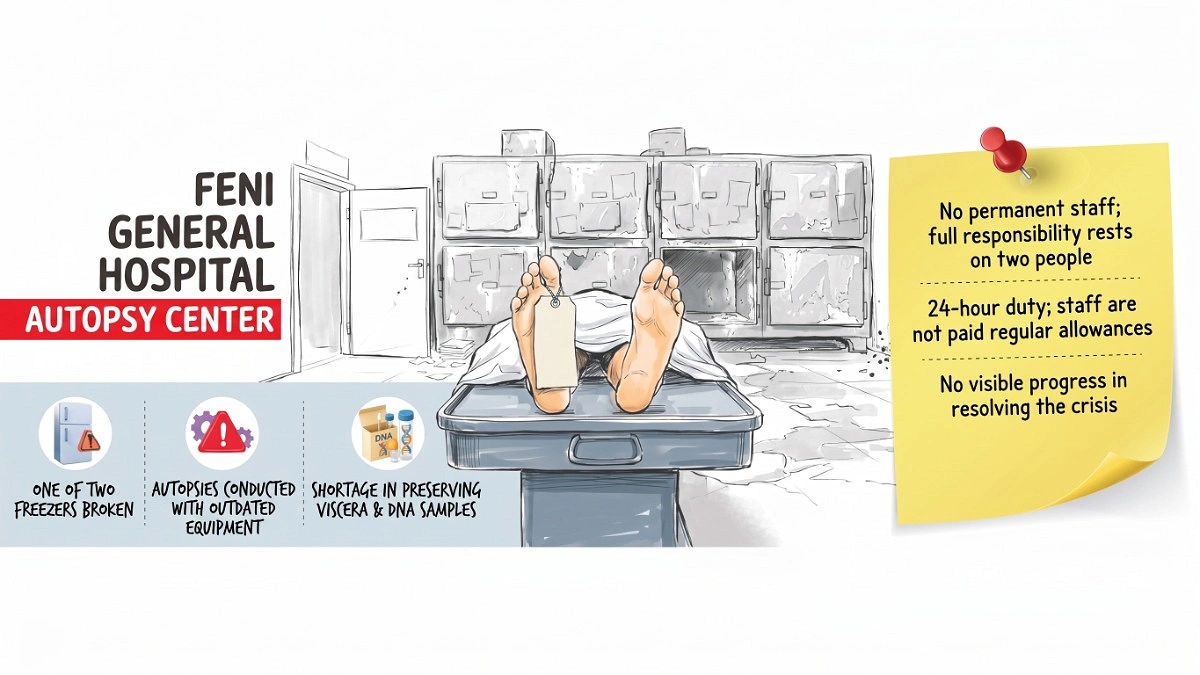
Graphics: Agamir Somoy
“Word came that they had taken her to the dissection room; last night, in the darkness of a Falgun night, when the fifth night’s moon had sunk, she had wished to die.” — Jibanananda Das.
After a suicide, murder or any other unnatural death, a body must be taken to a dissection room or morgue. The morgue where autopsies are conducted to determine the cause of death is now struggling with various crises. At the autopsy center of Feni General Hospital, one of its two freezers is out of order and the equipment is outdated. There are inadequate facilities for preserving important samples. With no permanent staff, the center’s operations depend on two outsourced workers. They are also frustrated by irregular allowance payments. The poor condition of the district’s only morgue is disrupting its normal operations.
Bodies regularly arrive at the morgue of Feni General Hospital. A significant proportion of them require autopsies. However, shortages of infrastructure and equipment compared with actual needs have left workers struggling to manage the workload. According to the staff, the morgue lacks the necessary equipment for conducting autopsies and preserving bodies. The absence of proper facilities for storing viscera and other parts of the human body also creates difficulties in preserving important samples. There are no facilities for preserving DNA samples for autopsy purposes either.
The morgue also has no permanent staff to manage its operations. Chief dom Abdur Rahim and assistant dom Amzad Hossain, both recruited through outsourcing, handle all the work. They have no fixed working hours. Whenever a body arrives, at any time of the day or night, they must receive it and arrange for its preservation.
Chief dom Abdur Rahim said the shortages at the morgue have made their work extremely difficult. Using old equipment to cut and examine bodies has become challenging. Better quality equipment is needed for this purpose. The air conditioning unit is also out of order, making their work even more difficult.
Alongside the staffing shortage, accommodation is another problem for him. Abdur Rahim said he somehow manages to live with his family in a small room within the hospital compound. Despite working at a critical facility like a morgue, staff members have no proper accommodation.
Assistant dom Amzad Hossain said, “They have to remain ready almost 24 hours a day. Police often bring bodies late at night. They then have to receive the bodies and arrange for their preservation in the morgue. However, they are frustrated because the pay is low compared with their responsibilities and they do not receive their allowances regularly.” As a result, they are also struggling to meet their families’ essential expenses.
The crisis at the morgue is not limited to the hardships faced by its workers. It is also affecting body preservation and the handling of important samples related to autopsies. With one of the two freezers out of order, preserving multiple bodies creates additional pressure. The problem becomes more severe when a body needs to be stored for several days.
Dr. Rokon Ud Doula, resident medical officer (RMO) at Feni General Hospital, acknowledged the various problems at the morgue. He said, “As there is no permanent staff, operations are somehow being managed with two outsourced workers. One of the two freezers is out of order. The absence of a viscera cabinet is also creating problems in preserving important samples.” He also said the morgue needs facilities for preserving DNA samples.
Hospital records show that before 1997, morgue operations in Feni town were conducted at the former Barapukurpar area owned by the Bhuiya and Pathan families near Trunk Road. Later, a new morgue was built on six decimals of land in the southwestern corner of the Feni General Hospital compound. However, despite the construction of the new facility, shortages of essential staff and equipment have persisted.
Minor and major accidents occur regularly on roads and highways. The morgue is relied upon to conduct autopsies on the bodies of people killed in these accidents.
Dr. Mobarak Hossain Dulal, acting superintendent of Feni General Hospital, said the morgue faces shortages of necessary equipment and staff. Written applications have been submitted to the higher authorities seeking solutions to these problems. He hopes the issues will be resolved in the future as government allocations for the health sector have increased.
However, no specific timeline has been provided for repairing the faulty freezer and air conditioning unit, purchasing the necessary equipment or resolving the staffing shortage.
