
New platform of seven parties
Hefazat seeks to cut off alliances to attract votes!
- Attempts to pull Bangladesh Khelafat Majlish and Nezame Islam Party out of Jamaat alliance
- Also seeks to get Jamiat out of its alliance with BNP
- Jamaat calls it an attempt to split the 11-party alliance
- Final decision on December 5

File Photo
An initiative to bring seven Islamic political parties affiliated with Qawmi madrasas under one umbrella has sparked fresh debate in the political arena. With the initiative and cooperation of Hefazat-e-Islam Bangladesh, a new alliance called “Like Minded Islamic Parties” has been formed. Its initial goal is to participate jointly in local government elections and consolidate the votes of Qawmi based parties in a single ballot box.
However, questions have arisen over whether the initiative for electoral understanding is also an attempt to alter the equations of existing political alliances.
In particular, the prospect of pulling Bangladesh Khelafat Majlish and Nezame Islam Party out of the Jamaat led 11 party alliance has come under renewed discussion. Although the parties agree on forming the new platform, they have yet to reach an understanding on leaving their existing alliances.
Bangladesh Khelafat Majlish and Nezame Islam Party say they will not leave the 11 party alliance. Meanwhile, Islami Andolan Bangladesh says that once the seven party alliance is finalized, there will be no scope for remaining in multiple alliances.
Jamiat Ulema-e-Islam Bangladesh has also said that if the parties currently in Jamaat’s alliance withdraw, it will reconsider its political relationship with the BNP. As a result, uncertainty has emerged over the future structure of the new platform and the political positions of the parties involved.
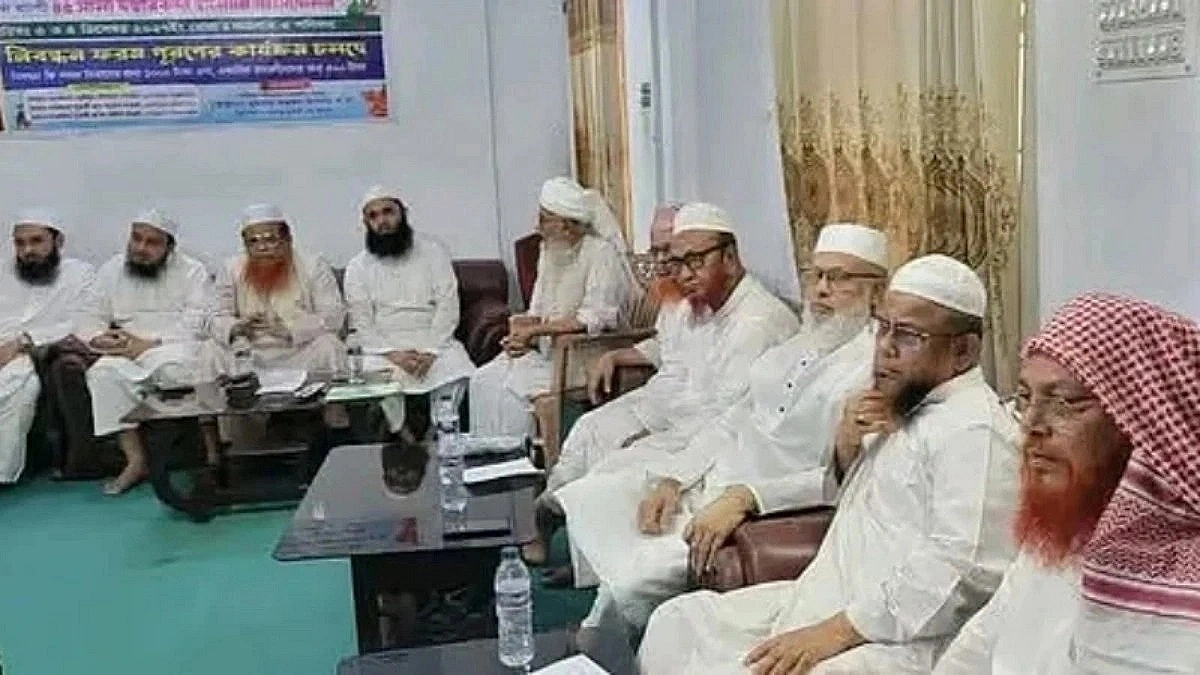
These issues were discussed at a meeting of the seven party liaison committee held Thursday at Makhjanul Ulum Madrasa in Khilgaon, Dhaka.
The meeting was chaired by Maulana Sajidur Rahman, secretary general of Hefazat-e-Islam Bangladesh. Three representatives from each of the seven parties and three Hefazat leaders attended.
Sources familiar with the meeting said discussions focused on strengthening coordination among the seven parties and determining future programs. However, no final decision was reached on leaving existing political alliances. The issue is expected to be discussed at the next meeting on December 5.
“We are still united in the Jamaat led 11 party alliance. Nezame Islam also supports the ongoing movement demanding implementation of the July National Charter and the verdict of the referendum. No decision has been made about leaving the alliance.”
Musa bin Izhar
Secretary General, Bangladesh Nezame Islam Party
The new platform comprises Islami Andolan Bangladesh, Bangladesh Khelafat Majlish, Khelafat Majlish, Jamiat Ulema-e-Islam Bangladesh, Islami Oikya Jote, Bangladesh Nezame Islam Party and Bangladesh Khelafat Andolan.
A 21-member liaison committee has been formed with three representatives from each party. Discussions are underway on strengthening coordination among the parties, working together on issues of shared interest and potentially participating in local government elections through mutual understanding.
Local elections are the new alliance’s target
Leaders involved in the initiative consider local government elections an important reason behind the formation of the new platform. Although Qawmi based parties belong to different political blocs in national elections, they want to create an opportunity to contest local elections together by leveraging their organizational strength and voter bases.
“The unity among Qawmi based parties before the election broke apart after the election. They have come together again with the aim of rebuilding that unity. However, forming a new platform does not mean leaving the old alliances.”
Maulana Jalaluddin Ahmed
Secretary General, Bangladesh Khelafat Majlish
Gazi Ataur Rahman, secretary general of Islami Andolan Bangladesh, told Agamir Somoy that all seven parties follow the Deobandi ideology and share similar views. Therefore, the initial goal is to bring the parties together and contest local government elections as an alliance.
However, the Islami Andolan secretary general objects to working within the new platform while remaining in existing alliances. He said, “Although no decision has initially been made to leave the alliances, ultimately, they will have to leave the other alliances. There is no scope for being in two alliances at the same time.”
He said such an arrangement would be inconsistent with ethical principles and would instead be a matter of ridicule. He expressed hope that all seven parties would leave their other alliances once their unity was finalized.
Maulana Jalaluddin Ahmed, secretary general of Bangladesh Khelafat Majlish, took a different position on leaving the existing alliances. He told Agamir Somoy, “The unity among Qawmi based parties before the election broke apart after the election. They have come together again with the aim of rebuilding that unity. However, forming a new platform does not mean leaving the old alliances.”
According to Jalaluddin Ahmed, discussions have not yet been held on whether the new platform will be a political platform or operate as a nonpolitical structure. These issues may be discussed at the meeting in December.
He also said that likeminded parties had united again in the interests of the country and its people.
Musa bin Izhar, secretary general of Bangladesh Nezame Islam Party, echoed the Khelafat Majlish secretary general’s position. He told Agamir Somoy, “We are still united in the Jamaat led 11 party alliance. Nezame Islam also supports the ongoing movement demanding implementation of the July National Charter and the verdict of the referendum. No decision has been made about leaving the alliance.”
Musa bin Izhar also said the party would participate in the long march scheduled for October 31, called by the 11-party alliance.
Tensions Over Conditions for Leaving Existing Alliances
The new seven party platform faces a challenge over whether its partners will leave their existing alliances. The relationship between Bangladesh Khelafat Majlish and Nezame Islam Party and the Jamaat led 11 party alliance is particularly significant.
Jamiat Ulema-e-Islam Bangladesh’s political relationship with the BNP is also part of this equation.
According to sources familiar with the meeting, Hefazat had previously put pressure on parties in Jamaat’s alliance to withdraw from it. Discussions have also revolved around the possibility that Jamiat could move toward ending its political relationship with the BNP if Bangladesh Khelafat Majlish and Nezame Islam Party leave the 11 party alliance. However, no final agreement was reached on the issue at Thursday’s meeting.
Maulana Sajidur Rahman, secretary general of Hefazat-e-Islam Bangladesh, said that parties belonging to other political alliances had agreed to leave those alliances and join the “Like Minded Islamic Parties” platform. He also said the seven parties would hold their next meeting on December 5.
However, his statement differs significantly from the positions expressed by leaders of the other parties. Bangladesh Khelafat Majlish and Nezame Islam Party continue to say they remain in the 11-party alliance. Jamiat has also maintained its previous position. As a result, doubts remain over whether an agreement has actually been reached on leaving existing alliances, as Hefazat claims.
The head of one party told Agamir Somoy on condition of anonymity that efforts had been underway for some time to persuade Maulana Mamunul Haque, amir of Bangladesh Khelafat Majlish, to leave the Jamaat led alliance. Those efforts had been unsuccessful because of his firm position.
The party leader claimed that if Mamunul Haque agreed, Jamiat could also have announced an end to its political relationship with the BNP. However, the leader said efforts on the matter were continuing.
Who will lead the political platform?
Hefazat-e-Islam’s role in forming the new platform has also drawn discussion. Hefazat leaders say the organization is not directly leading any political alliance. Instead, it is playing the role of a guardian or senior adviser in establishing unity among Qawmi based parties.
Muhiuddin Rabbani, nayeb-e-amir of Hefazat-e-Islam, said efforts to establish unity among political parties centered on Qawmi madrasas had been underway for a long time. The new platform involving seven parties has emerged as part of that process. He also said there was no basis for viewing it as a political alliance led by Hefazat.
On September 27, a meeting of representatives from the seven parties was held at Jamia Azizul Ulum Babunagor Madrasa in Fatikchhari, Chattogram, under the leadership of Hefazat-e-Islam Amir Allama Muhibbullah Babunagori. Thirty-five representatives from the seven parties and senior Hefazat leaders attended the meeting. A proposal for an organizational structure to unite the seven parties was presented.
According to relevant sources, the proposed structure included a condition that no party among the seven could independently form an alliance with any other Islamic or non-Islamic party.
It was proposed that, when necessary, the parties could reach an understanding with other groups in the broader interests of the country, its people and Islam, subject to approval from the seven party Majlis-e-Shura and advisory council.
The proposal also called for alliance leaders not to participate in meetings or rallies organized by any party considered to hold beliefs contrary to those of Ahlus Sunnah wal Jamaat.
However, the conditions have drawn objections from the parties. Some leaders of Bangladesh Khelafat Majlish, Jamiat Ulema-e-Islam Bangladesh, Nezame Islam Party and Khelafat Majlish believe that requiring central approval before forming alliances with other parties could limit their ability to make independent organizational decisions.
Several parties have also opposed the conditions related to religious beliefs. Hefazat’s objections to Jamaat’s beliefs have also prompted discussions about imposing conditions on parties that are politically allied with Jamaat before allowing them to join the new platform.
Jamaat says there is an attempt to split the 11 party alliance
Dr AHM Hamidur Rahman Azad, chief coordinator of the Jamaat led 11 party alliance and assistant secretary general of Jamaat-e-Islami, has alleged that efforts are underway to split the alliance through the new platform.
He alleged that the government wanted to break up the 11-party alliance. According to him, the alliance’s unity has increased public participation in its movement and boosted responses to its programs, putting pressure on the government. He believes the government is therefore trying to create political divisions by using Hefazat’s religious coalition.
“No matter how hard the government tries, the partners in the 11-party alliance remain in the alliance with full understanding of the situation,” Hamidur Rahman Azad said.
