
'Dwindling freedom of speech' concerns Nahid

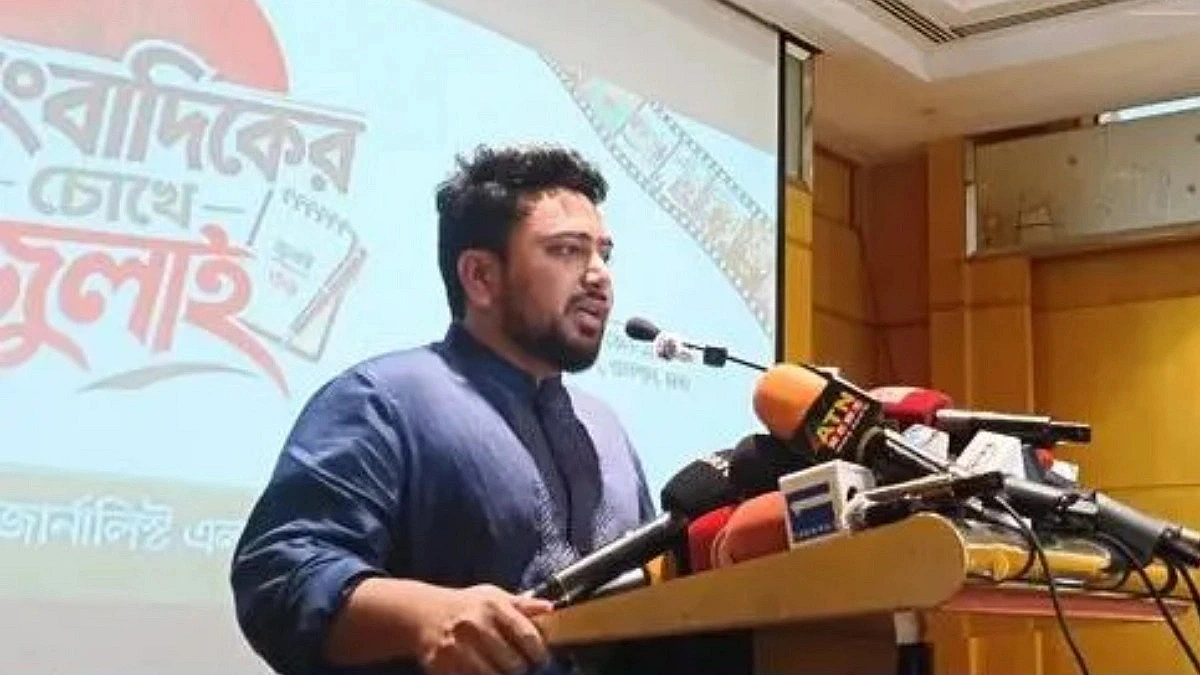
Nahid Islam addresses a discussion meeting titled ‘July Through the Eyes of Journalists’ in the city on Monday.
The current open environment in the country may be temporary and democracy and the right to free speech are gradually being constricted—such concern has been expressed by Nahid Islam, spokesperson of the National Citizen Party (NCP) and Member of Parliament.
In his view, peaceful and democratic protests are being portrayed negatively, paving the way for suppressing dissenting opinions and making arrests, which cannot be considered characteristic of a democratic state.
He made these remarks at a discussion titled "July Through the Eyes of Journalists," organized by the Democratic Journalist Alliance (DJA) at a five-star hotel in the capital. He spoke about the role of journalists during the July mass uprising, the current political situation, press freedom, and the safety of journalists.
Recalling the time of the July mass uprising, Nahid Islam said that journalists had to work under what can be deemed 'wartime' conditions. Field-level journalists, in particular, performed their duties under extreme adversity. He noted that their contribution was crucial to the success of the movement. He also mentioned that during the protests, a deep professional and emotional bond developed between organizers and journalists.
Expressing concern over the country's current political situation, Nahid Islam said that when any political party or ordinary citizen peacefully protests for basic rights such as gas and electricity, it is being labelled from the highest levels of government as "recklessness" or "bus vandalism." Through such negative propaganda, the path is being cleared to suppress dissenting views and make arrests.
Role of Field Journalists
Speaking about the role of journalists during the July movement, Nahid Islam said that although many journalists risked their lives to send reports from the ground, those reports were often not published or allowed to be published by their respective media outlets. At one stage of the movement, efforts were made to shut down or disrupt electronic media, social media, and international media.
However, he noted that even in that situation, many journalists went beyond professional duties and acted from a place of patriotism and humanity. Recalling his university days, Nahid Islam said that after shots were fired at protesting students, journalists carried the injured students on their shoulders and took them to hospitals by rickshaw. In his words, this was not just professionalism; it also contained patriotism.
Remembering the journalists killed and injured in the July mass uprising, Nahid Islam said that at least six journalists were killed and several hundred were seriously injured during that time. Many journalists still have bullet pellets lodged in their bodies. He also mentioned that while he was in charge of the Ministry of Information, he tried to look after the physical condition of the injured journalists and stand by them.
Frustration Over Failure to Implement Reforms
Nahid Islam also commented that the expectations of the people that had arisen in the post-uprising period could not be fully fulfilled. He said that he himself served as part of the government for seven months. However, the situation in the country at that time was highly abnormal. A large portion of the government's energy and attention was spent on stabilising the country.
He alleged that although an information and media reform commission was formed, its recommendations have not been implemented. He expressed frustration over the failure to implement various positive initiatives, including the proposed 'Journalist Protection Act' aimed at ensuring journalists' rights and safety.
Nahid gave a clear message that in a democratic state, the role of a strong opposition is extremely important. Ensuring opportunities for the opposition to freely express their views both inside and outside parliament is one of the hallmarks of a healthy democracy.
Condemnation of Attacks on Media
Nahid Islam also condemned arson and attacks on media outlets. He said that there may be disagreements with the policy or ideology of any media house, but attacks or arson on any institution for that reason are absolutely unjustifiable.
Towards the end of the discussion, he called on the current government to continue the initiatives taken by the interim government with the support of journalists. At the same time, he emphasised responsible journalism as well as responsible politics.
Expressing regret over not being able to exchange views sufficiently with journalists in the post-uprising period, Nahid Islam said that ensuring press freedom and professional safety for journalists should be a priority for everyone in building a new, non-discriminatory Bangladesh.
