
'In long term, no political business saleable on July's Legacy': Home Minister

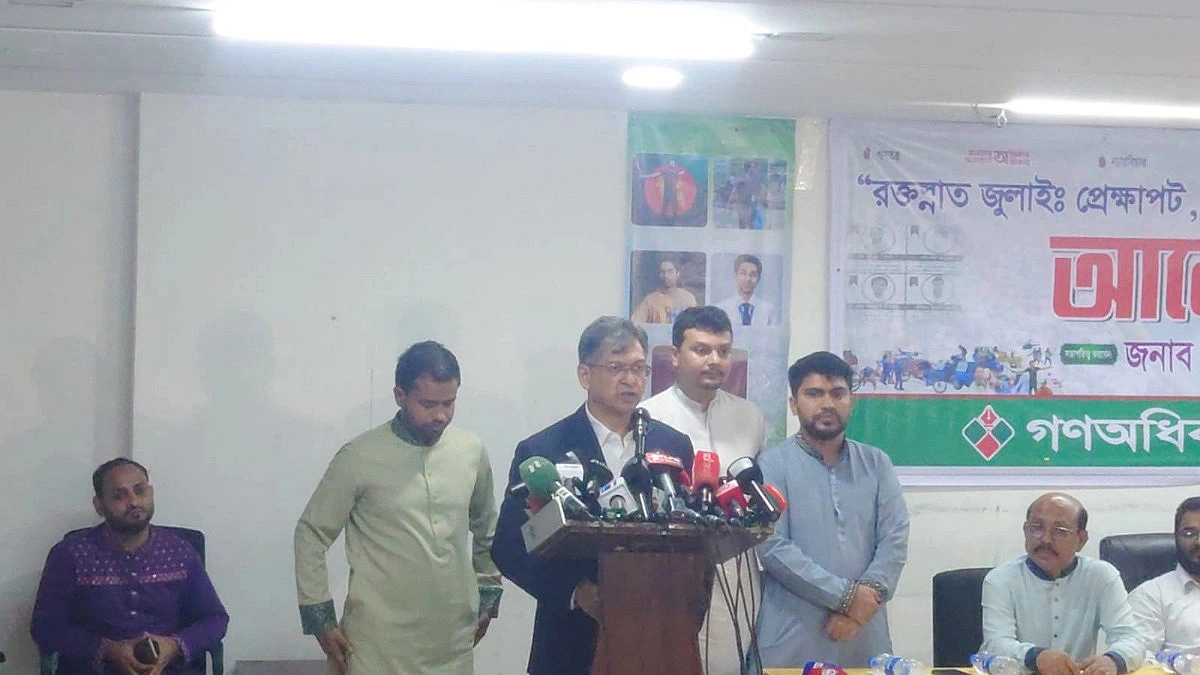
Home Minister Salahuddin Ahmed. Photo: Taibur Tanvir
July does not belong to any single person. My advice to those who have formed political organizations based on the spirit of July is that you cannot do politics for long just by selling the spirit of July.
The Home Minister said this today (Sunday) at a discussion meeting held at the Abdus Salam Hall of the National Press Club in the capital.
The discussion meeting, titled "Blood-Drenched July: Context, the Debt of Blood, and Which Path for Bangladesh," was organized by the Gono Odhikar Parishad (People's Rights Council).
In his speech, the Home Minister said, "They talk about the politics of a new settlement, but it is not right to go meet your Awami League friends who practice the politics of the old settlement."
Emphasizing the establishment of the rule of law, the Home Minister said, "A mob can never be justice; it can only be mob culture. We saw mob culture during the interim government's tenure. However, we will reform the legal framework to establish the rule of law."
He informed that the government will soon bring a "Prevention of Enforced Disappearance Act." Regarding the coordination behind the movement, Salahuddin Ahmed said, "There are many people behind the scenes who played a role in the uprising. Some of us were among them. But we never claimed credit. War happens on the battlefield; those who are at the forefront are the ones in the field. However, to conduct this war, policy formulation and coordination are necessary, and that is what we did. The 2024 student movement was organized through the quota reform and safe road movements. Hasina had the state machinery and foreign powers behind her, while we had the people of the country. The day Abu Sayeed was martyred, I was assured that this country would be liberated."
At the discussion, State Minister for Liberation War Affairs, Ishrak Hossain, said, "July 2024 was for people from all walks of life. Although it was an anti-quota movement, even a six-year-old child did not escape the clutches of autocracy."
Citing the report of the UN High Commissioner for Human Rights, he said that between July 1 and August 15, more than 1,400 people were killed in the student-public mass uprising. Many lost their eyesight, and many suffered amputations. Barbaric incidents such as burning bodies in Savar occurred, and snipers were used in various places to kill innocent people.
He said, "The 2024 uprising took place in continuation of '71. One is not opposed to the other. The people know which side each party was on from the very beginning of Bangladesh's history. There are no allegations of disappearances or murders against us. There may be disagreements and debates among us, but on the question of sovereignty, we are all united."
