
Dilara Choudhury: The government walks in the opposite direction

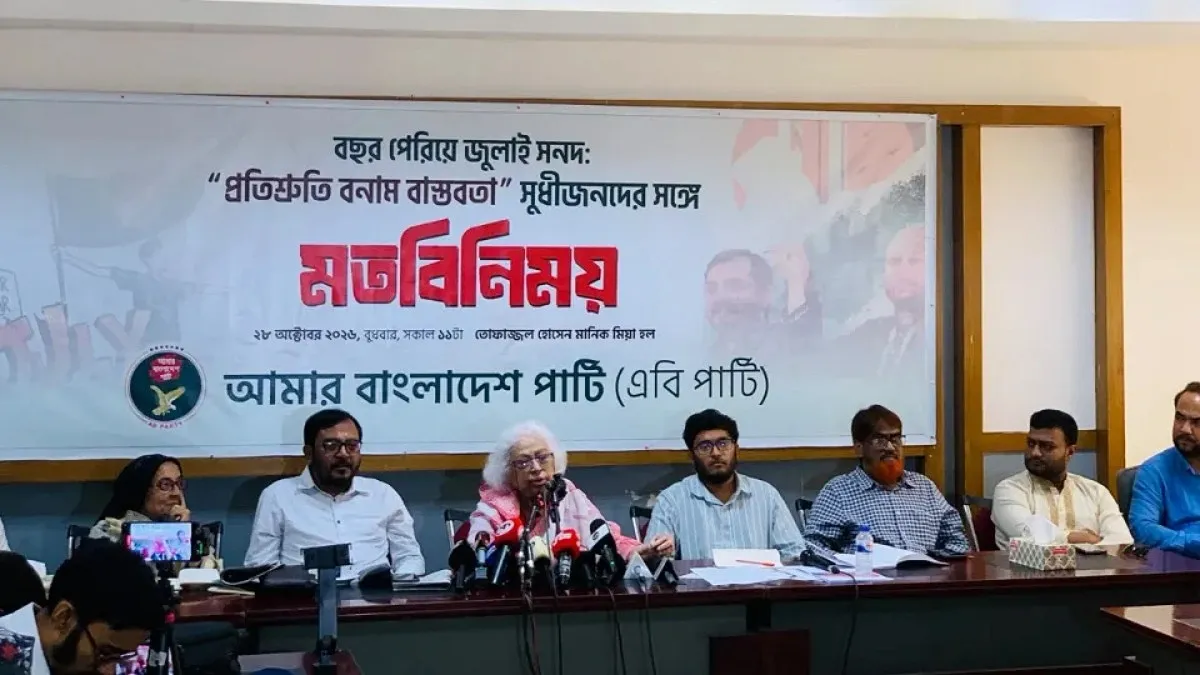
Political scientist Dr. Dilara Chowdhury spoke at a discussion meeting of the AB Party held at the National Press Club on Wednesday. Collected photo.
Political scientist Professor Dr. Dilara Choudhury has remarked that the government is walking in the opposite direction by forming a constitution amendment committee instead of a constitution reform council.
She made this remark on Wednesday at a dialogue titled "A Year After the July Charter: Promise vs. Reality," held at the Tafazzal Hossain Manik Mia Hall of the National Press Club. The event was organized by Amar Bangladesh Party (AB Party).
Dilara Choudhury expressed concern at the meeting that a tendency to deprive people of freedom of speech is being observed in the country. At the time, she also questioned the justification of filing a case against Major (retd) Akhtaruzzaman, an associate member of Jamaat.
Criticizing the Inspector General of Police's recent statement on crossfire, she said, "The Home Minister is also defending that statement."
Noting that the opposition party cannot play an effective role, she said, "It would be a wrong decision to engage in perfunctory opposition by merely waiting to come to power after five years."
The meeting was presided over by Mojibur Rahman Monju, chairman of Amar Bangladesh Party (AB Party). Barrister Asaduzzaman Fuad, general secretary of the party, and Sarwar Tushar, joint convener of the National Citizens Party (NCP), spoke as invited guests.
At the meeting, Barrister Asaduzzaman Fuad said, "Whenever the July Charter is mentioned, the government party---which is BNP--- says the people do not understand this charter. Yet the people want justice and reform. Even if the government wants to, it cannot give any law enforcement agency permission for extrajudicial killings or crossfire."
He said, "The crossfire and enforced disappearance incidents of the past have deeply wounded the people of the country. Implementation of the July Charter is essential to prevent the recurrence of such incidents and to ensure accountability of state institutions." He also mentioned that the trial process for the July genocide is weakening gradually.
At the meeting, NCP joint convener Sarwar Tushar said, "Arrests over comments on social media are creating concern about freedom of expression. Fresh controversy is also being created over the caretaker government system, which is increasing the risk of repeating past political crises."
In his presidential remarks, Mojibur Rahman Monju said, "We do not know in what language we can criticize, or what kind of program we can announce, so that ruling party leaders and activists will not get angered, will not abuse us, will not be ready to beat us, or will not think of putting us in crossfire. Again, our protest should not be seen as merely token opposition, and our role and political position as an effective opposition party should not be questioned. If anyone knows such language and programs, please let us know."He said, "The Liberation War did take place as a consequence of denying the people's verdict in the 1970 election. If the referendum's verdict is not implemented, the current government too may turn into a negative character in history like Zulfikar Ali Bhutto and Yahya Khan. This time the charter will be prepared first, then a mass uprising will occur; the next mass uprising will be built on that reality."Others who spoke at the meeting included Mashrur Fahim, organizer of Voice of Reform; human rights activist and columnist Amatullah Rubi; Hadiuzzaman Khokon, member secretary of AB Youth Party; Mohammad Prince, president of Chhatrapaksha; and Abdul Halim Khokon, convener of Dhaka Metropolitan South AB Party.
