
Why does Jamaat still call its alliance '11 parties' after two left?

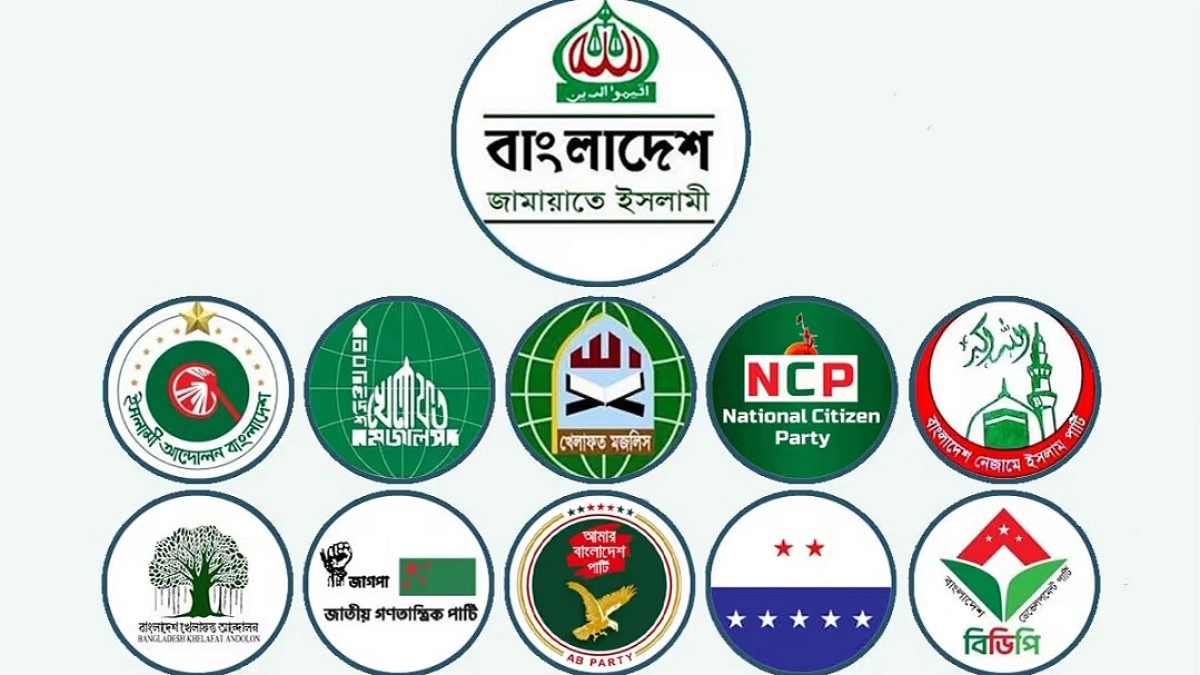
Representational image. Agamir Somoy graphics.
After the Bangladesh Khilafat Andolan and Khilafat Majlis effectively withdrew from the alliance, the 11-party unity led by Jamaat-e-Islami has now effectively become a 9-party coalition. However, the alliance is still using the banner of the '11-party unity' in various programs and press conferences.
Most recently, on Thursday night, a meeting of the liaison committee of the 11-party unity was held at the opposition leader's residence on Mintu Road in the capital. Although representatives of nine parties were present there, after the meeting, the alliance's coordinator and Jamaat-e-Islami's Assistant Secretary General, Hamidur Rahman Azad, referred to it as the '11-party program' while speaking to journalists.
Representatives of the LDP, JAGPA, Bangladesh Labour Party, Bangladesh Khilafat Majlis, National Citizen Party (NCP), Bangladesh Nezam-e-Islam Party, and BDP were present at that liaison committee meeting. No representatives of Khilafat Majlis or the Bangladesh Khilafat Andolan participated in the meeting.
Last February, ahead of the National Parliament elections, with the 'One Box Policy'—aiming to bring the votes of Islamist parties into a single basket—Jamaat, Islami Andolan, and several other religious-based parties formed a political front based on consensus. As the election approached, the parties also carried out joint programs demanding the implementation of the July Charter and state reforms. However, once the election schedule was announced, the alliance prioritized election preparations over agitation.
Later, when the National Citizen Party (NCP), Amra Bangladesh (AB) Party, and Liberal Democratic Party (LDP) joined the alliance, its membership rose to 12. However, due to disagreements over seat distribution and political understanding, Islami Andolan left the alliance and participated in the elections independently under the 'hand-fan' symbol. After that, Jamaat declared the 11-party unity with the remaining parties.
However, during the election itself, discomfort arose among the allies regarding leadership, political strategy, and the future course of action. After the elections ended, that discomfort gradually became public.
The biggest blow came on July 25. On that day, at the third general session of the central Majlis-e-Shura of Khilafat Majlis, held at the IDEB auditorium in Kakrail, Dhaka, a unanimous decision was made to sever all ties with the 11-party alliance.
