
Bangladesh has the highest share of arable land

Graphics: Agamir Somoy
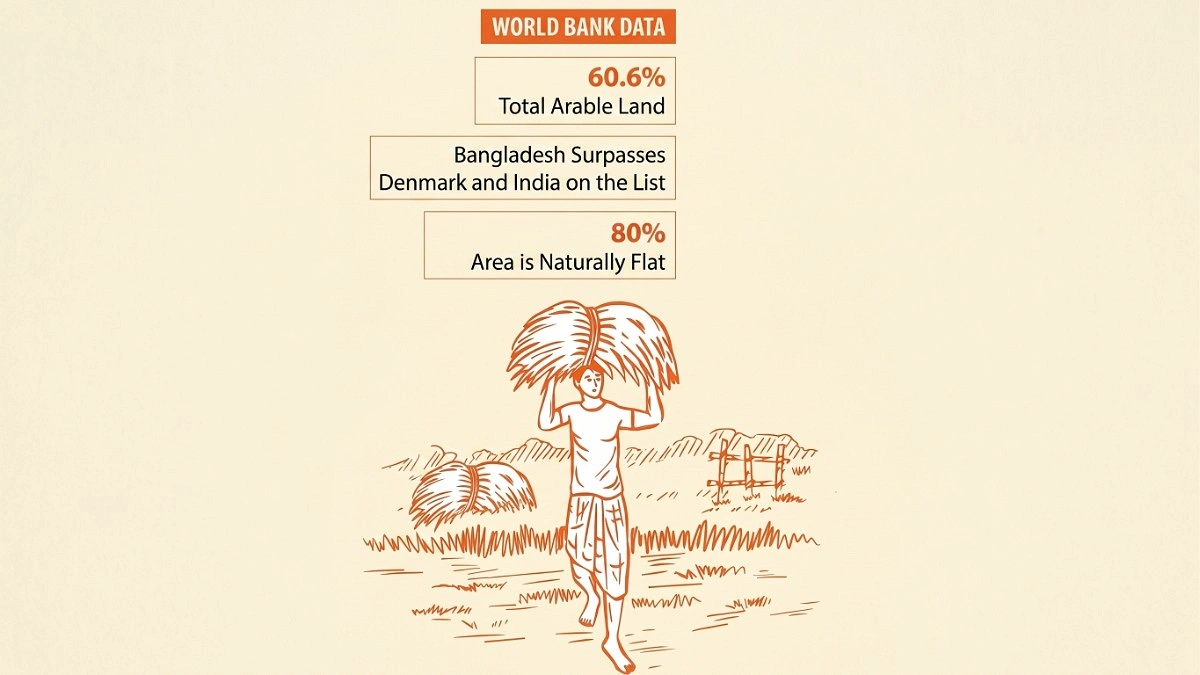
Bangladesh ranks 94th in the world in terms of geographical area. However, despite its relatively small size, Bangladesh ranks first in the world in terms of the share of arable land relative to its total land area. About 60.6 percent of the country’s total land is arable. These findings were published in a ranking prepared by international media outlet Visual Capitalist using World Bank statistics.
It said geographical size is not the only measure of a country’s agricultural fertility. Denmark ranks second after Bangladesh in terms of the share of arable land. About 59.1 percent of its land is arable. Moldova ranks third with 56.8 percent of arable land. Ukraine ranks fourth with 56.8 percent. India ranks fifth with 51.8 percent of its total land area being arable.
The study said larger countries generally appear to have more agricultural land. However, when calculated as a proportion of a country’s total area, Bangladesh ranks first ahead of all the world’s major countries. While much of the land in developed countries is covered by deserts, mountains or ice, about 60.6 percent of Bangladesh’s territory is directly suitable for cultivation.
Bangladesh is not the only country with a high share of arable land. Several other South Asian countries also have significant amounts of arable land. In addition to India, 39.3 percent of Pakistan’s land is arable. The country ranks 13th globally. Sri Lanka has 22.2 percent and ranks 47th. Nepal has 12.6 percent and ranks 80th. Afghanistan has 12 percent and ranks 85th. The other countries among the top 10 in the world by share of arable land are Burundi with 51.4 percent in sixth place, Togo with 48.7 percent in seventh, Rwanda with 47 percent in eighth, Hungary with 45.4 percent in ninth and Gambia with 43.5 percent in 10th place.
The report said Bangladesh is primarily the world’s largest active delta formed by the Ganges, Brahmaputra and Meghna River basins. For thousands of years rivers flowing down from the Himalayas have carried billions of tons of mineral rich sediment every year. This has naturally made the country’s soil highly fertile and suitable for crop production without artificial chemicals.
Countries such as China, Russia and Australia are vast in area. However, much of their territory consists of mountain ranges, plateaus or permanently ice-covered regions. As a result, large portions of their total land remain unused. In Bangladesh, nearly 80 percent of the country is naturally flat plain land. As a result, most of the country’s soil can be brought under cultivation. Because of Bangladesh’s tropical monsoon climate, there are no major climatic obstacles such as severe winters or prolonged snowfall. Adequate sunlight and regular rainfall keep agricultural land active throughout the year. As a result, growing multiple crops on the same land in a year or “multi cropping” is naturally easier. Bangladesh may be small in geographical area, but in terms of resource density this land is one of the world’s unique wonders.
However, this achievement also comes with major challenges, including population pressure, urbanization, industrialization, climate change and the risk of losing agricultural land. Therefore, protecting arable land means not only protecting agriculture but also safeguarding future food security.
According to the report, having a high percentage of arable land does not necessarily mean that a country has more agricultural land or produces more food. Since the ranking measures arable land as a share of national territory, large countries fall behind in relative terms even when they cultivate vast areas. Therefore, the world’s leading food supplying countries and countries with the highest share of arable land are not necessarily the same.
South Asia is particularly known for its extensive river systems and fertile plains. This is especially true around the Ganges Brahmaputra and Indus basins. According to the International Water Management Institute, these transboundary water systems are central to agricultural productivity in the region. Agriculture is also deeply connected to the economies and livelihoods of the region. For example, small farms are widespread in India. Irrigation and intensive farming support agricultural activities across vast areas. The opposite situation is seen across much of the Middle East. According to a report by the Arab Land Initiative, 92 percent of the Arab region is extremely arid. Water scarcity and land degradation place additional pressure on agricultural areas. As a result, countries with limited rainfall depend on irrigation and groundwater, technology and food imports to bridge the gap between domestic production and consumption.
