
Sylhet no. 10 well
Water and sand emerging instead of gas
- Production halted just 10 months after launch
- Plan underway to drill adjacent Sylhet 10X well
- If successful, gas reserves to increase by 106 BCF
- Daily production of 40 million cubic feet for the first five years and 35 million cubic feet for the next five years planned

Collected Photo
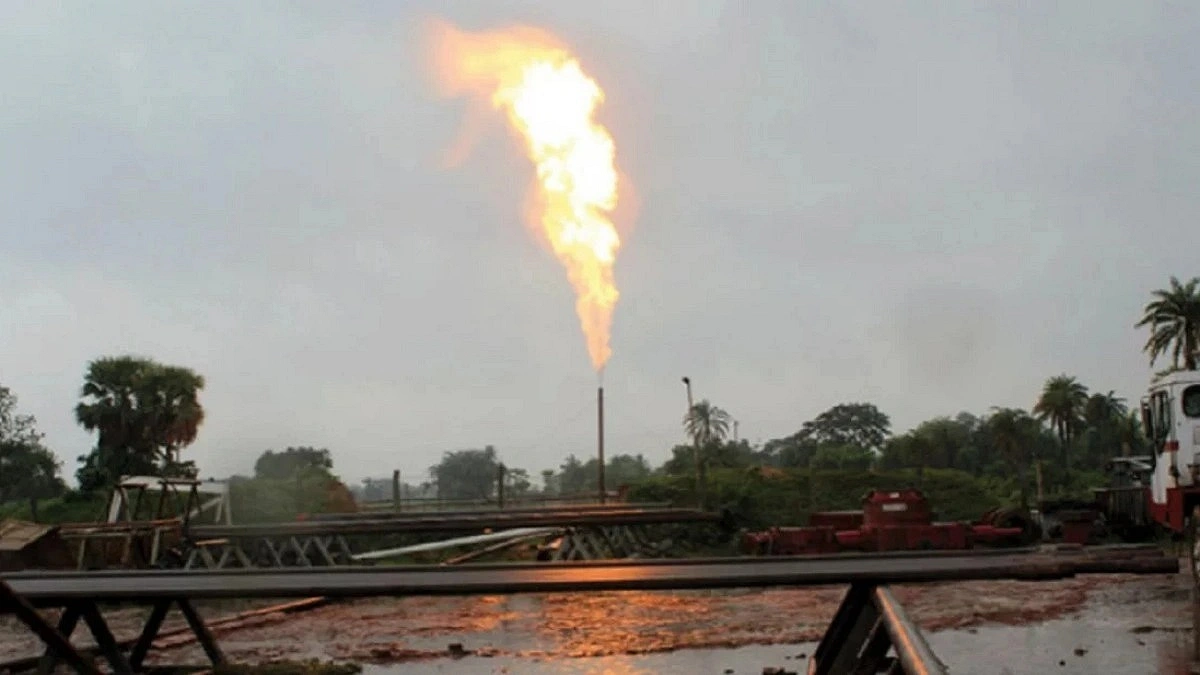
After the Sylhet 10 well was drilled, a major pipeline was constructed and gas production began. However, just 10 months later, complications emerged. Water and sand started flowing from the well along with gas. At the same time, pressure in the well declined, forcing the authorities to suspend production.
In response, an initiative has been taken to drill a new well named Sylhet 10X adjacent to the existing one. Officials hope that if successful, the combined reserves of Sylhet 10 and Sylhet 10X will reach 106 BCF of gas. The plan is to produce 40 million cubic feet of gas per day during the first five years and 35 million cubic feet per day during the following five years.
However, questions have been raised over why water and sand began emerging from the well so quickly despite extensive surveys and testing. Was there a flaw in the survey, or was it caused by another technical or geological factor?
Speaking to Agamir Somoy, Sylhet Gas Fields Limited Chairman Abul Monsur Md. Fayez Ullah said, “There is always uncertainty in gas wells. We have to work with such uncertainties. We will have to deal with similar situations in the future.”
“There has been extensive discussion about Sylhet No. 10 well. Two attempts were made to restore the well. In the end, it may never become operational again,” he added.
Sources said the initial cost of the Sylhet No. 10 exploratory well drilling project was estimated at Tk 2.021 billion. Under the first revised proposal, the cost was increased to Tk 5.17 billion. A second revised proposal has now been submitted to the Planning Commission seeking to reduce the project cost to Tk 4.79 billion.
The original project duration was from October 2021 to December 2023. It was later extended twice until June 2026. Most recently, the project timeline was further extended until 2028. From the project's inception through June 2025, Tk 2.4588 billion had been spent, with physical progress reaching 71.7 percent. The project is being implemented by Sylhet Gas Fields Limited under the Ministry of Power, Energy and Mineral Resources.
Project officials said China's Sinopec International Petroleum Service Corporation was awarded the drilling contract for Sylhet No. 10 well. The company completed the well completion work on February 7, 2024. A nearly 10 kilometer long, 4 inch diameter high pressure gas gathering pipeline was then constructed from the well to the Haripur Gas Field processing plant. Gas production from the well began on April 27, 2025, after completion of the pipeline.
After nearly 1 BCF of gas had been produced, a significant amount of water and sand began flowing from the well. At the same time, wellhead pressure dropped. As a result, gas production from the well was suspended on February 11, 2026.
Meanwhile, China's CNPC Chuanqing Drilling Engineering Company Limited has been awarded the contract to drill the new Sylhet 10X well. The company drilled the well to a depth of 3,340 meters starting in December 2025.
Four Drill Stem Tests, or DSTs, were conducted at the well. The tests indicated the potential for producing 8 to 9 million cubic feet of gas per day. About 19 barrels of condensate were also found for every million cubic feet of gas.
Based on these findings, the project has set a target of producing 1 BCF of gas from the Sylhet 10 well and a total of 29 BCF from the Sylhet 10X well over 10 years at an average daily production rate of about 8 million cubic feet.
Project sources said that under the ongoing project, a turnkey contract was signed with the drilling contractor for Sylhet No. 10 well worth US$150,956,220 excluding VAT and income tax, along with Tk 121.957 million. The contractor has already been paid US$15,465,323, equivalent to Tk 1.801237 billion at an exchange rate ranging from Tk 110.00 to Tk 121.56 per US dollar.
Under the contract, 50 percent of the demobilization payment was to be made after the drilling rig and other re exportable equipment were removed from Bangladesh. However, the rig used at Sylhet No. 10 well was later deployed at Sylhet No. 11 well. As a result, no demobilization payment was required.
Against the payments made so far, Tk 219.667 million has been paid as VAT and Tk 96.316 million as income tax.
Separately, a contract worth US$16,842,944 was signed with the contractor for drilling operations at the Sylhet 10X well. So far, US$12,321,712 including VAT and income tax has been paid. This amounts to Tk 1.5437 billion.
Officials said the remaining payment may increase because of the depreciation of the taka against the US dollar. Therefore, future cost estimates have been calculated at an exchange rate of Tk 126 per US dollar. Based on that rate, the estimated cost of drilling operations for the Sylhet 10X well, including VAT and income tax, stands at Tk 2.113423 billion.
The second revised Development Project Proposal, or DPP, estimates total expenditure of Tk 4.3526 billion for materials, engineering services, civil works, mobilization, demobilization and drilling operations. This is about Tk 89.8 million lower than the first revised DPP.
Meanwhile, the project had included provisions for constructing a 7 kilometer long, 6 inch diameter high pressure pipeline for the Sylhet 10X well. However, because production from the Sylhet 10 well has been suspended, it has been decided that gas from the new well will be transported to Haripur through the existing pipeline connected to Sylhet 10. Following the recommendation of the technical committee, construction of a new pipeline is no longer necessary. As a result, project costs are being reduced.
At the Project Evaluation Committee meeting of the Planning Commission, Project Director Engineer Abdul Kader Bhuiya said spending on consultancy services had also declined because costs for hospitality, accommodation, transportation and other expenses for foreign consultants were lower than expected. The total estimated consultancy cost for both wells, including VAT and income tax, is Tk 106.76 million, which is Tk 33.84 million lower than the original DPP. He said these factors were behind the proposal to reduce the total project cost in the second revision.
Earlier, Professor Anu Muhammad, an economist and one of the leaders of the Oil, Gas and Port Protection Movement, told Agamir Somoy that Bangladesh should carry out oil and gas exploration through its own institutions.
He said, “Although exploration involves risks, we must build that capacity. Even internationally, no company can guarantee one hundred percent success.”
