NCP in turmoil: Is the dream of a new political order fading?
Alliance with Jamaat and Lack of Transparency in Decision-Making
Departure from the Spirit of the Uprising and Tensions Over Women’s Leadership
Rakib Hasan
শেয়ার করুন:
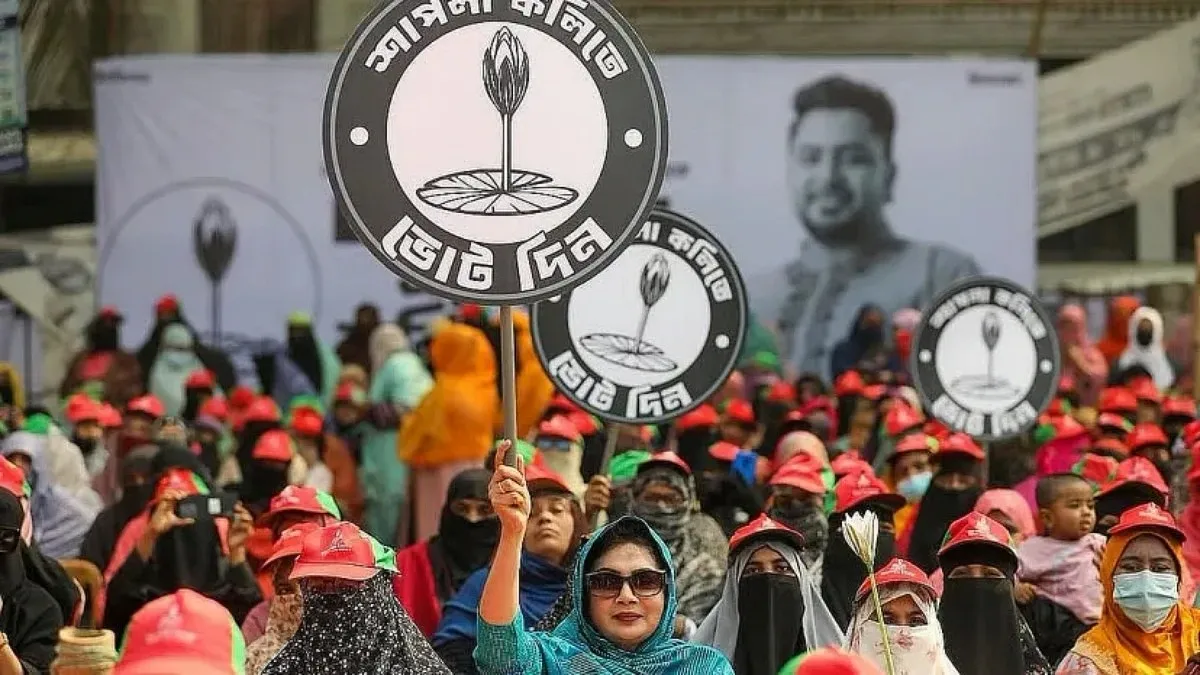
Is the NCP really falling apart? Or is it facing the growing pains of a new political party? File Photo
Is the National Citizen Party (NCP) really heading toward a
split? Or is it facing the challenges that naturally arise during the
development of a new political party? Recent developments within the party have
brought these questions back into focus. A series of resignations, leadership
disagreements, unease over its alliance with Jamaat-e-Islami, and
organizational weaknesses have placed the party in a difficult position.
The resignation of NCP Joint Convener Samanta Sharmin on
November 5 has particularly reignited the debate. She is not just another party
leader but also a familiar face from the NCP’s founding period. Her departure
has brought longstanding internal disagreements back into the spotlight.
However, the key question remains: Is the NCP really falling
apart, or is this a normal phase in the development of a new political party?
To understand the situation, it is necessary to examine the reasons behind the
resignations, the leadership’s position, the political equation, and the party’s
future prospects.
How the resignations began
The NCP was launched in February 2025. A section of young
people who had played leading roles in the July 2024 mass uprising formed the
party. Their promise was to establish a new political order beyond the
conventional political culture.
Initially, the party attracted interest from young people as
well as individuals from different professional and social backgrounds.
However, it failed to sustain that interest for long.
In late December 2025, the NCP decided to join an electoral
alliance or understanding led by Jamaat-e-Islami. The decision triggered major
disagreements within the party. On January 3, 2026, The Daily Star reported
that at least 18 senior and second-tier leaders had resigned from their party
positions or withdrawn from electoral activities within 11 days. This was the
NCP’s first major organizational setback. Since then, at least 43 leaders from
the party’s central, district, and metropolitan units have resigned.
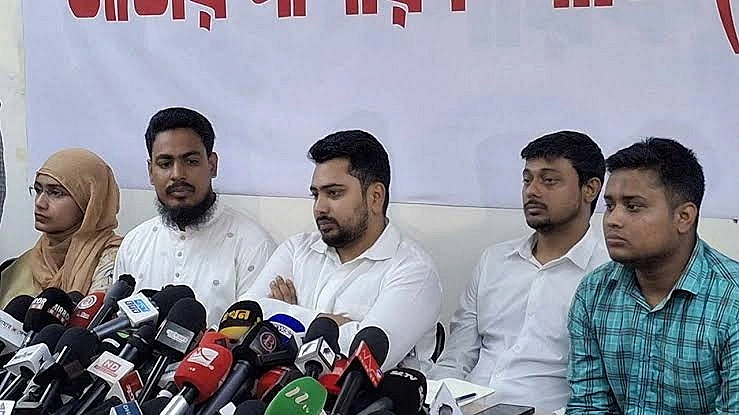
Former NCP leader Tasnim Jara on the same stage with NCP
leaders. Photo: Collected
Why have leaders resigned?
An analysis of the statements made by those who resigned
reveals several clear reasons. The first is the electoral alliance with
Jamaat-e-Islami. Many NCP leaders believed that the new political force
emerging from the July mass uprising had fundamental ideological and political
differences with Jamaat.
Their question was: Why did a party that promised a new
political order outside the existing political system eventually return to
conventional alliance politics?
Tasnim Jara, Tajnuva Jabeen,
Mir Arshadul Haque, Arif Sohel, Azad Khan Bhashani, and several other leaders
opposed the decision. Some resigned while others decided to contest the
election independently.
From the beginning, however, the NCP leadership described
the alliance with Jamaat as an electoral understanding rather than a political
merger. This explanation failed to resolve the internal disagreements
completely.
NCP Convener Nahid Islam described the alliance decision as
one made based on the majority’s opinion. He said that differences of opinion
were normal in a political party and that efforts would be made to convince
those who disagreed through discussions.
The party’s spokesperson, Asif Mahmud Shojib Bhuyain, also
said that several leaders had left the party because of the alliance decision.
However, he added that the party’s doors remained open to them.
Another reason that subsequently emerged was the lack of
transparency in decision-making. Resigning leaders alleged that the opinions of
all members were not properly considered when important decisions were made.
Before the alliance with Jamaat, 30 central leaders had also
submitted a memorandum to Convener Nahid Islam expressing their objections.
However, the NCP’s top leadership remained firm on joining the Jamaat-led
alliance. This raised questions about democratic practices within the party.
Another major issue was the perceived departure from the
spirit of the July mass uprising. Many former party leaders believe that the
NCP was not established merely to become an electoral party. It was founded on
expectations of state reforms, the elimination of discrimination, and changes
to the political system. They allege that these objectives have gradually taken
a back seat as winning seats in elections and power calculations have become
more important. Statements made by former leaders in various media reports
following their resignations largely reflect this position.
Another issue has been raised by recently resigned leader
Samanta Sharmin. It concerns the lack of adequate opportunities for women in
leadership positions. Samanta alleged that although women played an important
role in the July mass uprising, their proper representation in the party’s
leadership and decision-making processes had not been ensured.
She also alleged that the central committee had been
reconstituted without holding regular party councils. According to her, this
weakened internal democracy.
The party’s ideological identity has also remained unclear.
Initially, the NCP presented itself as a centrist, inclusive, and
reform-oriented political force. However, its alliance with Jamaat raised
questions about its political position. Many believe that the alliance has
weakened the party’s independent identity.
Samanta Sharmin alongside Nahid and Akhtar at an NCP
party programme. Photo: Collected
Why is Samanta Sharmin’s resignation significant?
Samanta Sharmin’s resignation cannot be viewed as just
another departure. After resigning, she said that she had spent nearly a year
trying to change the party’s political position. She opposed the alliance with
Jamaat and proposed alternative political strategies.
She also raised questions about women’s participation in
leadership and internal democracy. According to her statements, however, the
top leaders showed little interest in changing their positions on these issues.
There is another important aspect to the development. On
October 23, Samanta was demoted from Senior Joint Convener to Joint Convener in
the reconstituted central committee. She was also excluded from the 16-member
Political Council. She left the party on November 5. This means that her
resignation was driven not only by opposition to the Jamaat alliance but also
by dissatisfaction with the leadership structure and her position within the
party.
Her resignation sparked fresh discussions in political
circles. The issue has drawn reactions not only from within the NCP but also
from prominent political figures outside the party.
On the night of November 5, former NCP leader Dr. Tasnim
Jara published a post on Facebook praising Samanta Sharmin’s political
activities and personality. Tasnim Jara wrote, “There is no shortage of people
who speak in politics. But there are very few who listen attentively to
ordinary people. Samanta is one of them.”
She further wrote, “Even when someone approaches her amid
her busy schedule, Samanta stops her work to listen. She goes to people to
understand their lives and stand beside them.”
The most significant part of Tasnim Jara’s remarks was her
statement that Samanta Sharmin’s political journey still had a long way to go.
She said that there should be a bigger place for people like Samanta in the
country’s politics. Her comments can be seen as an expression of personal
respect and political support for Samanta. At the same time, they have sparked
further discussions about the political future of leaders who have left the
NCP.
On November 6, former adviser to the interim government
Mahfuz Alam also responded to the issue in a Facebook post. His comments
focused on the smear campaigns circulating on social media against Samanta.
Mahfuz Alam said that spreading propaganda against those who
played important roles in forming the National Citizen Committee from the
liaison committee of the Anti-Discrimination Student Movement and later
expanding it was condemnable.
He further said that many of those who had helped build the
party’s foundation had left because of the alliance. He said they deserved
gratitude because their day-and-night efforts had helped the party establish an
organizational structure. If gratitude could not be expressed, he added, people
should at least remain silent in the interest of political coexistence and
healthy political practices.
It would not be accurate to say that Mahfuz Alam directly
criticized the NCP leadership in his remarks. However, his call to recognize
the contributions of the party’s founding organizers and stop spreading
propaganda against those who had left carries political significance.
The nature of Tasnim Jara’s and Mahfuz Alam’s statements was
different. Tasnim Jara focused on Samanta’s personal qualities and political
future. Mahfuz Alam emphasized the contributions of the founding leaders and
the importance of showing them political courtesy.
However, there is one common element in both statements.
Both acknowledged the political contributions of Samanta Sharmin.
This raises a major question for the NCP: How will the party
leadership handle political disagreements with those who played important roles
in building the organization?
Disagreements are not unusual for a new political party.
However, when important organizers leave following internal disputes and
allegations of smear campaigns against them emerge, questions also arise about
the party’s political culture.
Samanta Sharmin’s resignation is therefore not merely the
departure of an individual leader. It has once again raised questions about the
NCP’s founding unity, political position, and internal democracy.
The reactions of Mahfuz Alam and Tasnim Jara indicate that
Samanta Sharmin’s resignation is no longer just an internal matter for the NCP.
The party’s founding political circle, leadership conduct, and commitment to
establishing a new political culture have also become part of the discussion.
Meanwhile, the NCP faces new challenges following the
national election. In the February 12, 2026, national election, the NCP won six
seats. Securing parliamentary representation is certainly an achievement for
the party. However, winning six seats alone does not make a party a strong and
independent political force.
Following the election, differences between the NCP and
Jamaat over their relationship and local government elections have come to the
forefront.
Media reports have indicated that the two parties have
developed tensions over seat-sharing arrangements in local government
elections. According to these reports, the NCP wants to expand its
organizational activities and place greater emphasis on its independent
political programmes. Differences have also emerged over mayoral positions in
Dhaka North, Dhaka South, Cumilla, and Mymensingh. However, NCP leaders have
denied speculation that the party is leaving the alliance. They have described
the reduction in joint programmes as a strategic decision.
Several important issues have also emerged from political
analysts’ assessments of the NCP’s future.
Zobaida Nasreen, a professor at the University of Dhaka and
political analyst, believes that maintaining a long-term relationship with
Jamaat could undermine the NCP’s prospects of developing into an independent
political party. In remarks to a media outlet, she said that public
expectations of the new party were no longer as high as before. She also
pointed to a lack of clarity regarding the party’s ideological position.
Political analyst Altaf Parvez believes that young people
need to organize themselves again if they are to preserve the political
aspirations of the July mass uprising. In other words, the potential created by
the unity of the movement could be lost if it cannot be transformed into a
political organization.
Abdul Latif Masum, a former professor of the Department of
Government and Politics at Jahangirnagar University, told Al Jazeera that the
NCP had limited prospects of emerging as a strong and independent third
political force. Organizational weaknesses and internal divisions are major
obstacles. However, he said the party still had potential if it could clarify
its position and strengthen its organization.
These assessments make one thing clear. The NCP’s crisis
cannot be fully understood if it is viewed merely as a personal dispute. It is
also linked to political ideology, organizational capacity, and the credibility
of its leadership.
To put it directly, the NCP has not formally split yet. Its
leadership remains in place, it has parliamentary representation, and its
political activities are continuing. However, signs of internal divisions are
evident.
Three factors are particularly important in assessing the
risk of a split.
First, there is a leadership crisis. A section of the
founding leaders has left the party. As a result, the party risks losing
leadership experience and political diversity.
Second, there is ideological division. It is still unclear
what kind of political party the NCP wants to become. Will it emerge as a
centrist and reform-oriented political force? Or will it pursue long-term
political arrangements with religion-based political forces? The party now
needs to provide a clear answer to this question.
Third, there are organizational weaknesses. A political
party cannot survive by depending solely on a few well-known leaders. It needs
a strong organizational structure at the district, upazila, union, and ward
levels. Regular party councils, transparency in leadership selection, and
proper consideration of members’ opinions are also essential. Weaknesses in
these three areas could lead to further divisions in the future.
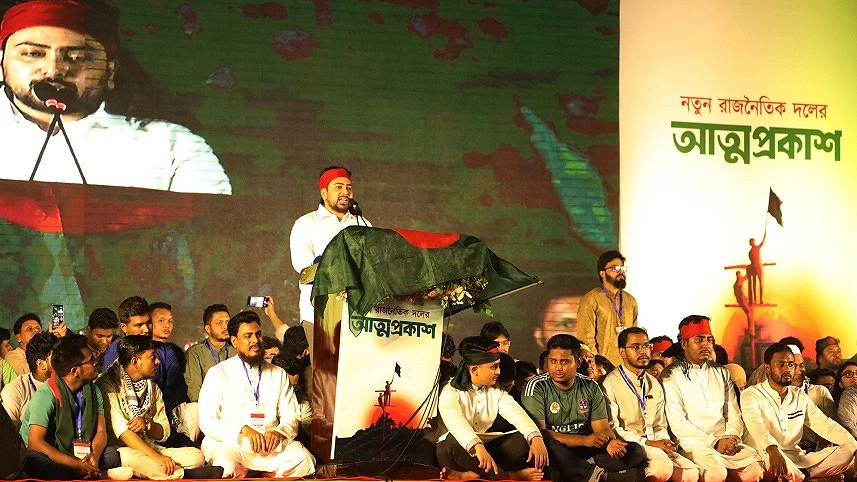
Speaking at the launch ceremony of the NCP. Photo:
Collected
What lies ahead for the NCP?
The NCP still has an opportunity to rebuild public support
if it can clarify its ideology and political position. In particular, it could
regain acceptance among young voters, reform-minded people, and those
disappointed with conventional politics.
However, if the party fails to resolve disagreements within
its leadership, ideological differences, and organizational dissatisfaction,
more leaders could leave. In such a situation, the party might survive in name
but lose much of its political influence.
The NCP must remember that the popularity of a movement and
the management of a political party are not the same thing. During the 2024
movement, people with different views, beliefs, and political positions united
around a common demand. However, managing a political party requires more than
the popularity of a movement. It requires a clear ideology, credible
leadership, democratic decision-making, and a strong organizational structure.
The NCP was established with the dream of becoming an
alternative to conventional politics. People also expected the party to
introduce a new political culture. However, while trying to fulfill those
expectations, the party is struggling to manage disagreements within its own
ranks.
Samanta Sharmin’s resignation is the latest manifestation of
this crisis. The earlier departures of prominent leaders, including Tasnim Jara
and Tajnuva Jabeen, were also significant setbacks for the party.
However, it would be premature to conclude that the NCP’s
political future is over. Its six parliamentary seats have provided it with a
political platform. The party can use this platform to redefine its identity.
To do so, however, its leadership must first identify its
mistakes, limitations, and areas of disagreement. It must view differing
opinions as political assets rather than treating those who disagree as
opponents.
Ultimately, the biggest question facing the NCP is whether
it was formed merely to survive in power politics or to establish something
genuinely new in Bangladesh’s political landscape.
The answer to this question will determine whether the NCP
emerges as a strong and independent political party or loses much of its
potential shortly after its establishment.