95.6% of battery rickshaw drivers lack licenses: BRAC

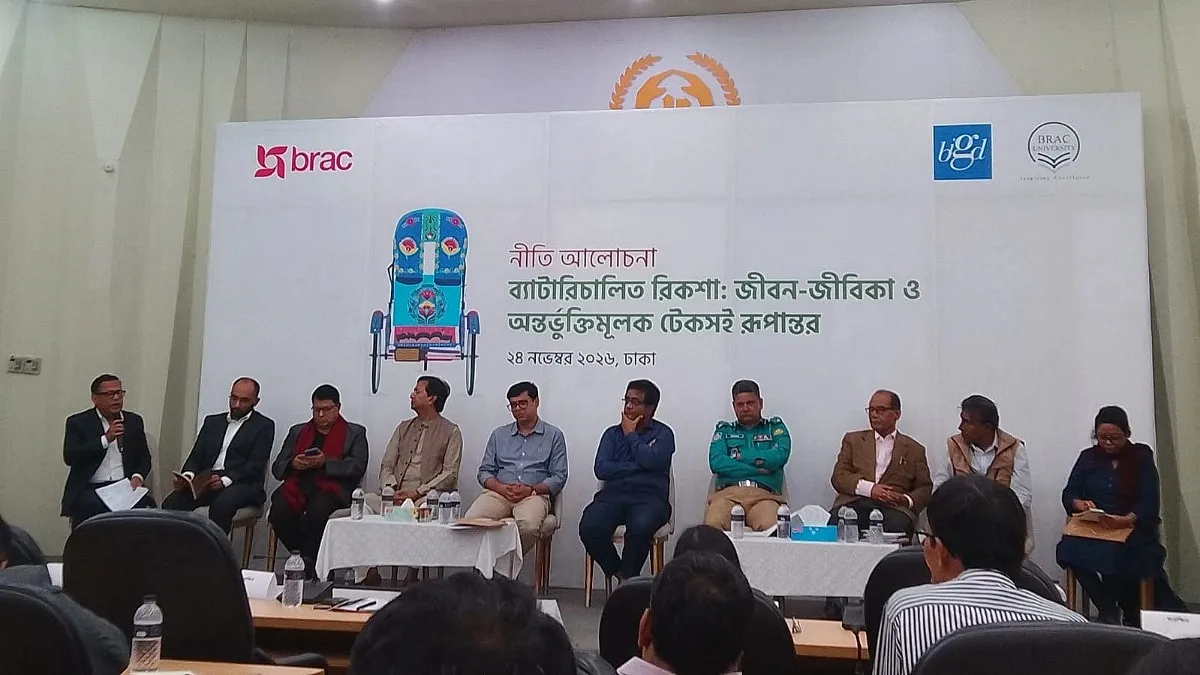
Photo: Agamir Somoy
BRAC said 95.6 percent of battery-powered rickshaw drivers do not possess any license or permit. Among them, 78.2 percent operate rented rickshaws.
Moreover, if their income ceases, 61.9 percent of drivers’ families lack the capacity to sustain one week’s household expenses.
BRAC made these remarks on Tuesday in a summary of a study published at CIRDAP in Dhaka. The research, titled “Battery-Powered Rickshaws: Life-Livelihood and Inclusive Sustainable Transformation,” detailed various dimensions of drivers’ lifestyles, income, working environment, and safety.
The study revealed that an average of 38.6 percent of drivers’ earnings is spent on rickshaw rent. In the single month prior to the survey, 26.7 percent of drivers were involved in a road accident at least once.
According to the report, garages play a critical role in managing battery-powered rickshaws. Drivers rely heavily on garages to rent vehicles, charge and replace batteries, carry out repairs, and receive assistance during accidents.
However, unregulated electricity usage alongside the unsafe production and recycling of old lead-acid batteries poses significant risks to the environment and public health.
Dhaka North City Corporation (DNCC) Administrator Md Shafiqul Islam Khan Milton said, “In reality, far more battery-powered rickshaws are operating on the streets than mentioned in the study. We will come up with a policy soon so that everyone’s suffering is reduced.”
Meanwhile, Dhaka South City Corporation (DSCC) Administrator Md Abdus Salam added, “Whether rickshaws are for the need of employment or solving the unemployment problem, or for the convenience of public movement, is something we must decide. If we can settle this, half of the problem will be solved.”
Taking into account drivers’ livelihood protection, road safety, and environmental risks, the study recommended formulating an integrated and sustainable policy for battery-powered rickshaw management.