


Dr. Titumir
Padma barrage to add 1 percent to GDP
- Padma barrage to feature seven modern townships and hydropower

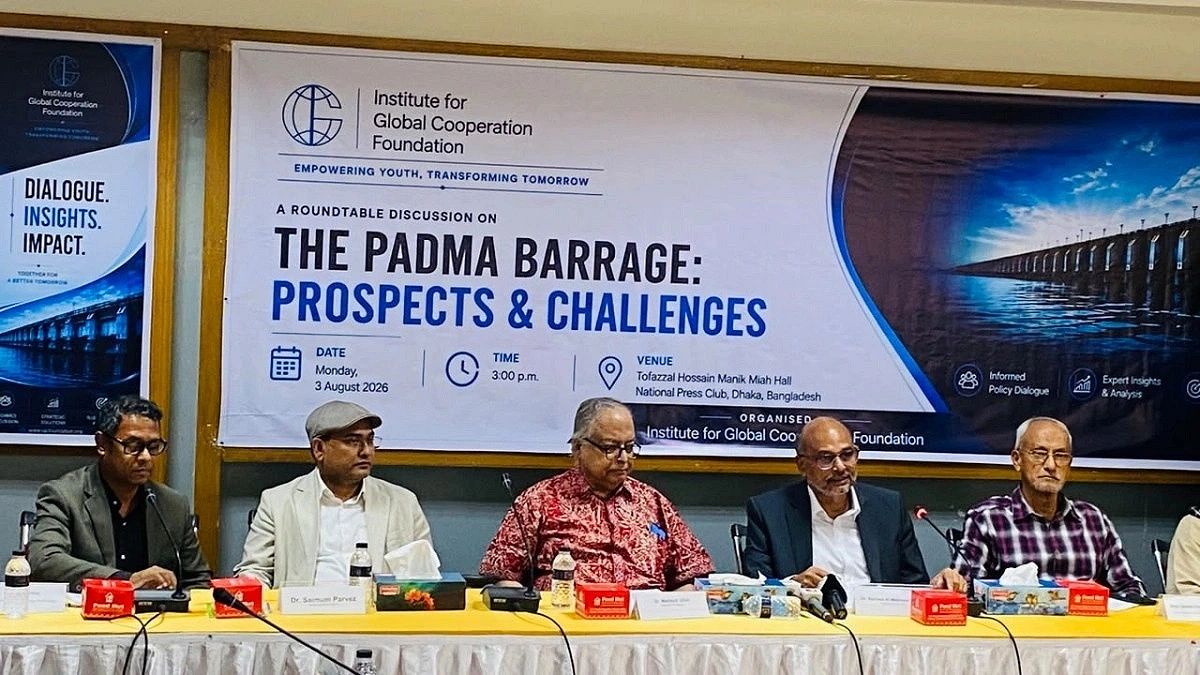
Photo: Agamir Somoy
The government’s adviser, Dr. Rashed Al Mahmud Titumir, said, “The under implementation Padma Barrage project will bring a transformative change to the country’s overall economy. It will make a positive contribution of about 0.5 percent to 1 percent to the national GDP.”
He made the remarks on Monday while participating in a roundtable discussion titled “Padma Barrage: Prospects and Challenges,” organized by IGC at the Tofazzal Hossain Manik Mia Hall of the National Press Club.
At the event, Dr. Titumir explained in detail various historical and structural aspects of water resource management in river basins. He said, “Although many plans and discussions on water resources have taken place at different times, the country’s actual realities and the needs of its people have not always been given priority. The first fundamental and integrated initiative in Bangladesh’s water resource management began in 1977 during the tenure of martyred President Ziaur Rahman. The international arrangements made at that time and initiatives such as river and canal dredging laid the foundation for the country’s sustainable water resource management.”
Dr. Titumir said the current government has redesigned and transformed the Padma Barrage project instead of viewing it as merely a conventional brick-built infrastructure, aligning it with the country’s environment and the needs of its people. Under the leadership of Prime Minister Tarek Rahman, the plan places the highest priority on the shared wellbeing of people and nature.
Highlighting the project’s benefits, Dr. Titumir said, “The Padma Barrage will remove accumulated silt from the river and bring new momentum to the irrigation system. It will permanently eliminate waterlogging in various regions, including Bhobodoh in Jashore, while also contributing to groundwater recharge, preventing increased salinity, and controlling arsenic contamination. In addition, hydropower will be generated around the barrage, and seven planned modern townships will be developed along the banks of the Padma, which will significantly enhance the country’s economic dynamism both directly and indirectly.”
Referring to international river basins, he said, “Because of about 942 water control structures upstream, Bangladesh, as a downstream country, has to endure various challenges. To address those challenges and protect the local environment and ecosystem, a project like the Padma Barrage will play a unique role.”
The event was moderated by Professor Dr. Bulbul Siddiqi and was attended by academics, environmentalists, strategic analysts, and media professionals.

