
Illegal Sand Extraction Threatens Tk 1.68 Billion Muhuri Sluice Gate
- Illegal Sand Extraction Underway at Six Locations
- Previously Controlled by the Awami League, Now Allegedly Under BNP Influence
- Four Wind Power Project Towers Also Facing Increased Risk

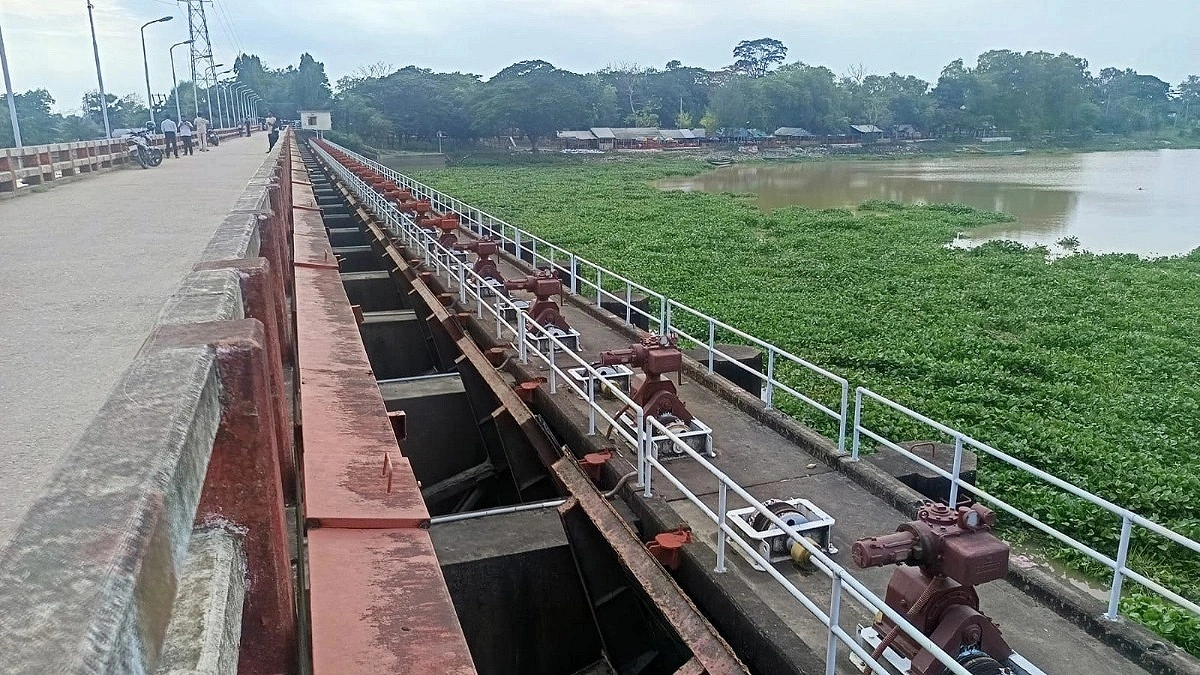
The Muhuri Sluice Gate. Photo: Agamir Somoy
The Muhuri Regulator, also known as the Muhuri Sluice Gate, was built in 1984 at a cost of Tk 1.68 billion to provide irrigation to agricultural lands, regulate the river, and control water flow from the Feni River. Located in the Thak Khwazer Lamchi mouza of Sadar Union, the structure has played a vital role for four decades in supporting agriculture and other activities across a vast area, including Sonagazi and Mirsharai.
During the monsoon season, the sluice gate retains rainwater and runoff from upstream hills. When flooding becomes a concern, the water is released into the Bay of Bengal. The stored water is later used to irrigate extensive farmland in the two upazilas. However, illegal sand extraction is now taking place within just 300 to 400 yards of the regulator, putting the costly infrastructure at serious risk.
Dr. G.M. Sadiqul Islam, a professor in the Department of Civil Engineering at Chittagong University of Engineering and Technology and an infrastructure expert, said sand extraction should only be carried out after a proper assessment of river siltation. “The process should be conducted through government institutions. If reckless and unregulated sand extraction continues, there is a significant risk that major structures could collapse or become severely endangered at any time,” he said.
A visit to the site found at least 10 dredging machines operating along a half-kilometer stretch in the Thak Khwazer Lamchi area south of the Muhuri Sluice Gate. Several bulkhead vessels were also present. Sand is being collected on the vessels and later piled up at local depots before being transported by pickup trucks and larger vehicles to various destinations.
The last official lease for sand extraction in the area was granted in 2023 to Messrs Rana Enterprise for the Balurghat section south of the Muhuri Project at an annual fee of Tk 7.5 million. Under that lease, the royalty rate was approximately Tk 5 to Tk 6 per cubic foot of sand. However, no lease has been issued since 2024.
According to individuals involved in sand extraction, the cost of extracting sand in the Muhuri Project area ranges from Tk 15 to Tk 18 per cubic foot, while it is sold for Tk 25 to Tk 30 per cubic foot. A pickup truck carrying 100 cubic feet of sand is typically charged Tk 3,000. Operators say they can extract between 4,000 and 4,500 cubic feet of sand each day.
Picture: Agamir Somoy
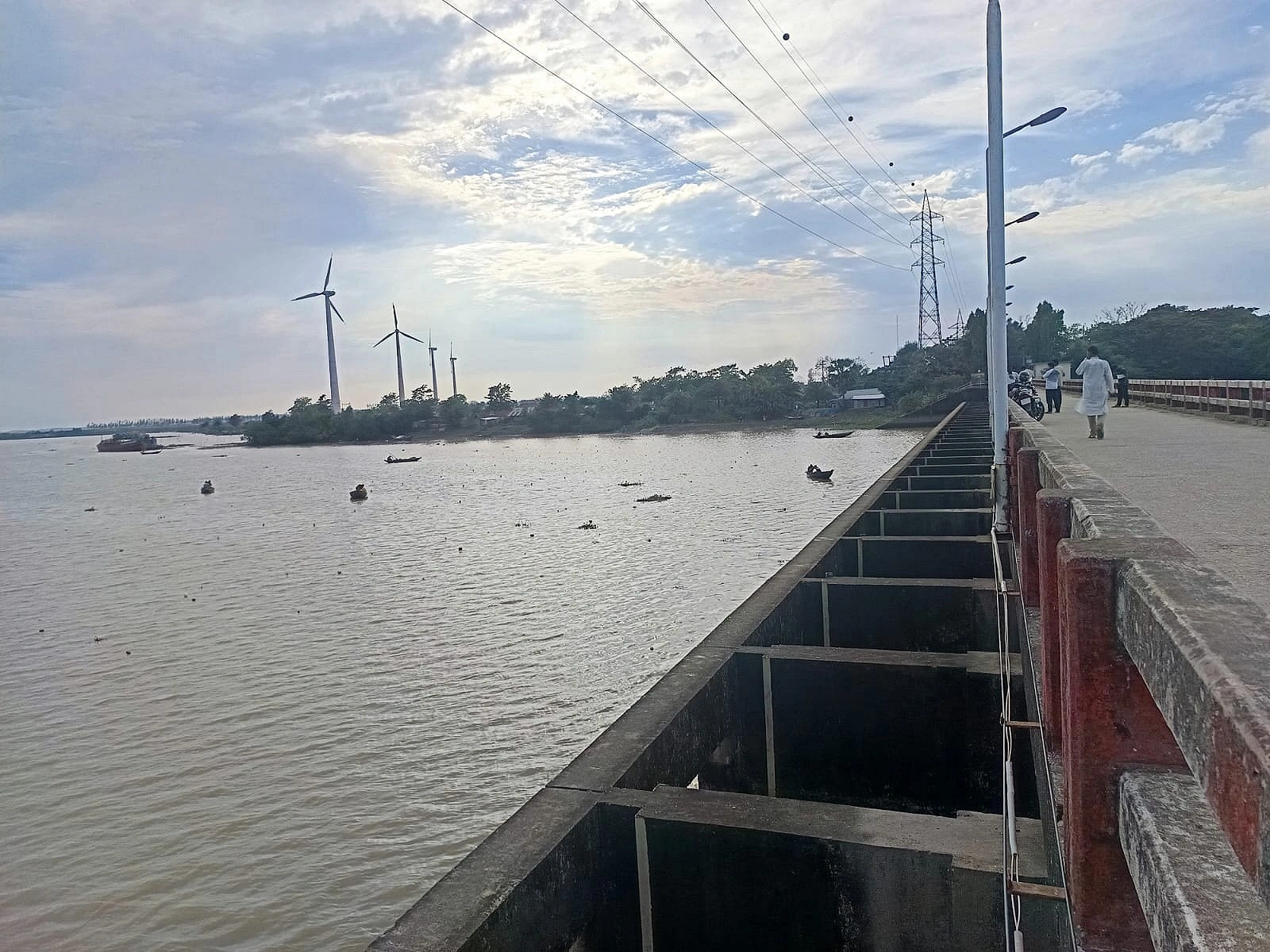
Four Wind Power Towers Also at Risk
The illegal extraction of sand is threatening not only the Muhuri Regulator but also four towers of the country’s first wind power project. The project was established in 2003 by Nebula Techno Solution to harness coastal wind energy. Although the facility is currently inactive, there are growing concerns that continued sand mining could damage its towers at any time.
A visit to the sand extraction sites found that the RCC road connecting the Muhuri Regulator to the wind power project has been severely damaged due to the constant movement of heavy vehicles transporting sand.
Environment Minister Abdul Awal Mintu said he plans to discuss the issue with the Water Resources Minister.
During a recent visit to Sonagazi, he told journalists, “Regardless of who is involved in the illegal extraction of sand, the administration has been instructed to take legal action against them. No sand extraction will be allowed in this area.”
However, allegations persist that local administration officials are aware of the activities and may be benefiting from the revenue losses caused by the unauthorized operations. Sonagazi Upazila Nirbahi Officer (UNO) Regan Chakma denied the allegations, saying, “No lease has been issued for sand extraction in that area. The administration regularly conducts operations against illegal sand miners.”
Critics, however, question how large quantities of sand continue to be transported daily by pickup trucks if enforcement operations are being carried out effectively.
Previously Under Awami League Control, Now Allegedly Controlled by BNP Leaders
According to eyewitnesses, a group of 25 to 30 individuals led by former Sonagazi Amirabad Union BNP Organizing Secretary Sajol Haque Sohel, former Union Parishad member and BNP leader Tajul Islam, known as Taju Member, Jubo Dal leader Alauddin Mintu, and Sonapur-based Jubo Dal leader Enamul Haque Shahin are currently operating the sand extraction points. Some local residents also allege that Sonagazi Upazila Jubo Dal Convener Khurshid Alam Bhuiyan is connected to the syndicate.
Khurshid Alam denied the allegations, saying, “I have no partnership in this business and am not involved.” He did, however, acknowledge that BNP leader Sohel and Jubo Dal leader Mintoo are engaged in the sand trade.
BNP leader and former Union Parishad member Tajul Islam admitted involvement, saying, “There are several extraction points and stockpiles here. I am responsible for one of them. The site beneath Tower No. 2 of the wind power project is under my control.”
Meanwhile, Sajol Haque Sohel claimed, “We bring sand from Kumira and sell it here. Mostly mud is dredged from this area, so sand is not always available.”
Several local residents, speaking on condition of anonymity, said the sand extraction points were previously controlled by leaders of the Awami League but are now dominated by BNP-affiliated individuals.
According to local accounts, after the Awami League came to power in 2009, the extraction sites were controlled by Rahim Ullah, president of the Jeddah chapter of the Awami League in Saudi Arabia and a resident of Sonapur Union in Sonagazi. His influence reportedly increased after he was elected as an independent member of parliament from Feni-3 in 2014.
Three years later, control allegedly shifted to Rafiqul Islam Khokon, general secretary of the Sonagazi Upazila Awami League and former mayor of Sonagazi Municipality. He, too, was eventually replaced.
In 2018, the sites reportedly came under the control of Ruhul Amin, president of the Sonagazi Upazila Awami League. Amin is currently on death row in Chattogram Central Jail after being convicted in the widely discussed Nusrat murder case.
Local residents said sand extraction activities were largely suspended during the tenure of the interim government. However, they claim the situation changed after the BNP came to power in February this year, when BNP leaders allegedly took control of the extraction sites and resumed operations.
