Bangladeshi migrants pay world’s highest costs, wait longest to recover

Graphics: Agamir Somoy
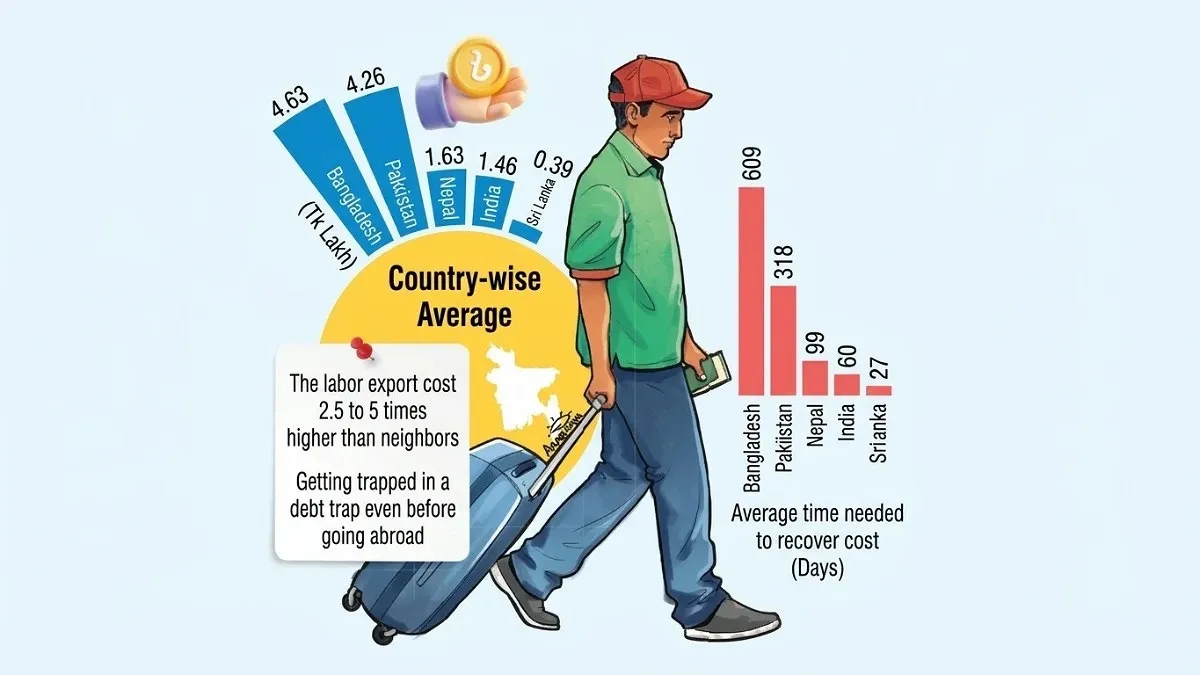
Bangladesh ranks highest in migration costs, and Bangladeshi migrant workers also take the longest time globally to recover these expenses. The average cost for a Bangladeshi worker to go to Malaysia stands at Tk 5.44 lakh.
In contrast, Sri Lankans travel to Malaysia for only Tk 1.27 lakh, meaning Bangladeshi workers pay 4.28 times more. Compared to Nepal and Pakistan, this expense is two and a half times higher.
While India lacks a reliable national average cost for the Malaysia route, official government regulations said Indian agents can charge a maximum service fee of ₹ 20,000, which equals around Tk 29,400. Aside from this service fee, Indian workers bear their visa, airfare, and miscellaneous costs; overall, Bangladesh’s labor export cost is more than five times higher than that of India.
In total, labor export costs from Bangladesh are two and a half to five times higher than those of neighboring countries. Workers from Bangladesh travel abroad to sell their labor after purchasing visas, work permits, and airline tickets at exorbitant prices compared to all neighboring nations.
Outside South Asia, the Southeast Asian nation of the Philippines also exports manpower, but its migration expenses are significantly lower than those of South Asian countries. Worldwide, labor power export does not occur from a large number of countries.
In addition to having the highest migration expenses, Bangladesh also ranks number one globally in terms of the time required for workers to recover their spent migration costs.
This comparative picture emerged from an analysis of reports from the United States-based labor rights research organization Verité, Nepal’s National Statistics Office, the International Labour Organization (ILO), Sri Lanka’s Institute of Policy Studies (IPS) 2026 report, the High Commission of India in Kuala Lumpur, and ILO reports in Pakistan.
According to ILO guidelines, migration expenses are evaluated using the Recruitment Cost Indicator (RCI). The RCI measures how many months of earnings a migrant worker requires to recover their initial recruitment costs.
In 2025, the Asian Development Bank Institute (ADBI), the Organization for Economic Co-operation and Development (OECD), and the ILO jointly published a report titled “Labor migration trends in Asia: Fair recruitment, training and development”.
The report said average migration costs for Bangladeshi workers are the highest among South Asian nations. A Bangladeshi worker requires an average of 14 months and 18 days to recover their recruitment expenses.
If the worker is low-skilled, it takes 20 months and 6 days of their wages to recoup the cost. In comparison, a worker from Nepal takes 4 months and 9 days to cover this cost. Workers in India require the exact same duration of 4 months and 9 days. Sri Lanka requires even less time at 3 months and 18 days, while Pakistan takes 10 months and 18 days.
The ILO report highlights that excessive migration costs in Bangladesh trap millions of workers in debt traps even before they step foot abroad.
In September, Abdullah Al Mamun, 23, a young man from Chhandhara Union in Phulpur, Mymensingh, registered with the Bureau of Manpower Employment and Training (BMET) to prepare to go to Malaysia. Agencies and sub-agents in Dhaka are demanding Tk 6-6.5 lakh for standard placements.
For positions at major Malaysian superstores such as NSK, 99 Speedmart, or Mydin, demand fees exceed Tk 7 lakh. Mamun told Agamir Somoy that in 2024, he paid an advance of Tk 4.50 lakh to a sub-agent, yet ultimately failed to travel abroad. He shared that if he travels to Malaysia this time, he will be forced to take out loans at exorbitant interest rates.
According to domestic migration experts, an average of 10 lakh Bangladeshi workers going abroad each year face this exact predicament, even though the national economy heavily relies on remittances sent by expatriates.
According to the International Organization for Migration (IOM) 2026 Migration Report, Bangladesh is the seventh top remittance-earning country in the world. Bangladesh Bank data indicates that in the FY 2025-26, Bangladesh received $35.56 billion in remittances - the highest figure in the country’s history - amounting to around Tk 4,37,000 crore.
Under the 2021 bilateral Memorandum of Understanding (MoU) between Bangladesh and Malaysia, the official cost ceiling for sending workers to Malaysia was set at Tk 78,990.
However, Verité’s 2024 research revealed that the actual average cost paid by Bangladeshi workers reached Tk 5.44 lakh. The report revealed that collusion between Bangladeshi and Malaysian intermediary syndicates utilized fake job quotas and forged documentation to siphon off hundreds of millions of money.
As a result, many workers who traveled through legal channels arrived in Malaysia only to find that no actual jobs existed.
Expatriates’ Minister Ariful Haque Choudhury said the government fixed a maximum cost limit of Tk 1.54 lakh per worker through private recruiting agencies for Malaysia this year. Nevertheless, reports from the field indicate that due to grassroots sub-agents and a syndicate of 25 approved recruitment agencies, workers are being coerced into contracts ranging between Tk 6 lakh and Tk 7.50 lakh.
A resident of Savar seeking employment in Malaysia informed Agamir Somoy that he finalized a contract with a sub-agency for Tk 6.50-7 lakh based on prevailing market rates. Having completed his medical examination last week, agency representatives told him that his official employment contract would formally cite the government-fixed cost of Tk 1.54 lakh.
Anisa Air International is one of the 25 agencies listed under Malaysia’s Foreign Worker Centralised Management System (FWCMS).
Md Rabby Chowdhury, managing partner of the company, told Agamir Somoy that various sub-agents bring in worker demand, perform MyGram registrations, and arrange medical checks. When questioned about high migration costs, he said, “If bringing the demand letter costs more money, then businessmen will fix costs accordingly.”
State Minister of Expatriates’ Md Nurul Hoque previously characterized Bangladesh’s migration costs as “cutthroat” during discussions with Agamir Somoy in July and August.
When asked about the matter at his office on Monday, he added, “A committee has been formed to reduce migration costs. Although government costs are fixed for each country, they are not observed and are not regularly updated. We are working on these issues.”
Data from IOM Bangladesh reveals that migration costs inflate drastically due to village-level sub-agents or middleman rings, recruitment syndicates, and informal visa trading between destination-country Kafils and local agencies.
The organization’s report details that around 59.5 percent of total migration expenses go directly into the pockets of intermediary middlemen. Of the remaining funds, 15-20 percent covers airline tickets and government fees, while the rest is spent on medical and institutional processing.
Ahsan Ullah, 43, a victim of these middleman networks from Bhomra in Satkhira, shared that he paid Tk 4.50 lakh in installments to a person in Narsingdi by mortgaging land and taking out high-interest loans to travel to Malaysia.
However, due to a fake visa, he was unable to migrate in 2024. Ahsan Ullah said, “Working as a daily laborer in Satkhira, I get Tk 300 for half a day and Tk 500 for a full day. Now, should I pay the loan interest, run my household, or send my children to school? I can’t even provide them proper clothes or two meals a day.”
Tasneem Siddiqui, executive director of the Refugee and Migratory Movements Research Unit (RAMRU), said, “The previous government was connected to the Malaysia syndicate from the highest level. The present government has not been able to stop it either; rather, many new people have joined.
“Unless the government takes a strict stance, this extra cost will not stop. While expatriates send remittances, it is high time to investigate the ‘reverse remittance’ or money laundering taking place under the guise of extra expenses.”