
36th July: The unfinished promise of state reform

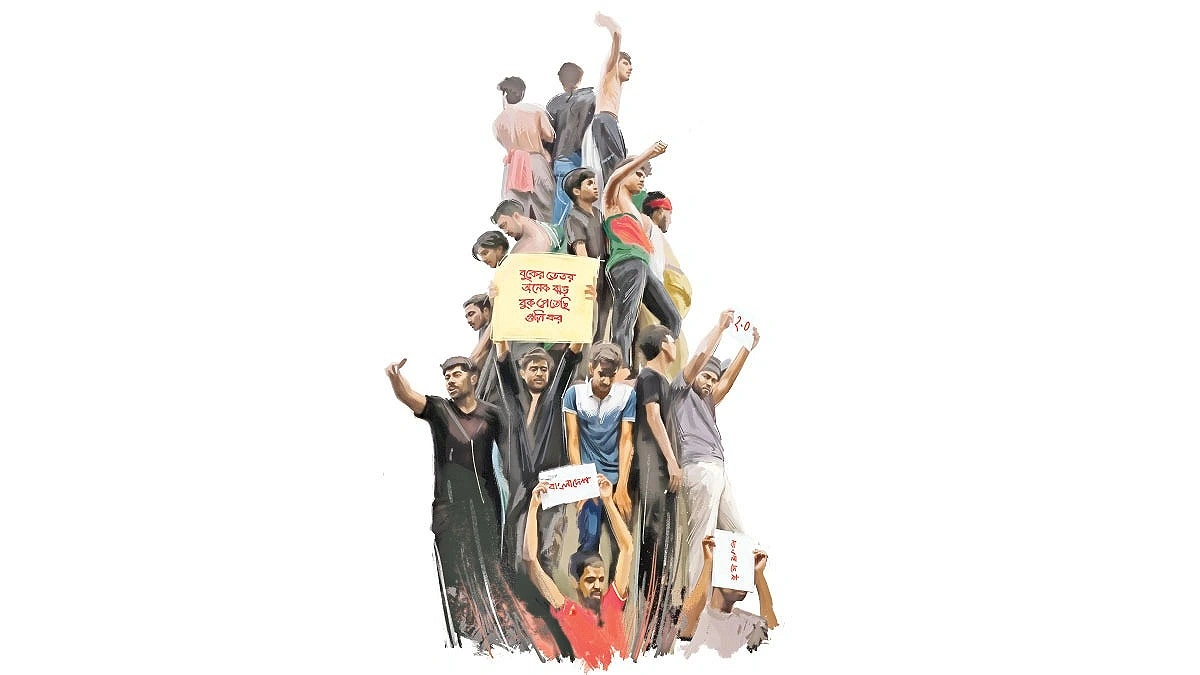
Graphics: Agamir Somoy
July Mass Uprising 2024, which began with the demand for quota reform in government jobs, quickly transformed into a student-mass uprising. People from almost all walks of society - from university and school students to laborers, rickshaw pullers, teachers, doctors, businessmen, and parents - stood side by side.
Initially, the demand was for the reform of the quota system, but as the movement expanded, questions regarding the character of the state, governance, accountability, and civil rights came to the forefront. At one stage, the movement was no longer limited to a single demand; it became a mass aspiration to rebuild the state.
The uprising succeeded at the cost of hundreds of lives, thousands of injuries, and permanent disabilities for many, ending a long-standing regime. However, this victory gave birth to even greater expectations, as people believed the method of state governance would finally change.
They hoped for the establishment of the rule of law, effective measures against corruption, a more accountable administration, an end to the culture of political violence, and visible changes in the standard of living for ordinary people.
July movement originated from the question of equality, with the demand to eliminate discrimination in state benefits as its foundation, but over time, it expanded into discussions about the fundamental structure of the state.
Why should one wait years for justice? Why should there be political influence on the administration? Why would corruption take root at every level of the state? Why would common people remain helpless before market syndicates? Hundreds of thousands of people took to the streets to find answers to these questions.
Looking back at those expectations two years later, the picture is not straightforward. While almost everyone views the fall of the autocracy as a historic achievement, many movement organizers, members of martyrs’ families, injured fighters, analysts, and ordinary citizens feel that the implementation of state reform is much slower than expected.
For many, July was not just a movement to change a government; it was a historic opportunity to redefine the relationship between the state and its citizens. This is why people did not leave the streets despite knowing the risk to their lives.
They believed that through this sacrifice, a more just, accountable, and non-discriminatory Bangladesh would be born. Nafis remains a symbol of that belief; even after two years, his study table is arranged just as it was, with books left exactly where they were.
His mother occasionally dusts them but changes nothing in the room, believing her son did not give his life for any political party but dreamed of a better state by standing against injustice. He found it impossible to stay home while bullets were being fired at students and the public.
Today, she still waits to see if the dream her son carried to the streets will one day become a reality. This is not just Nafis’s story; countless families of the July martyrs carry similar questions.
Meanwhile, many of the injured are still struggling with long-term medical treatment, rehabilitation, and the uncertainty of livelihoods. Some could not return to university, some lost their jobs, and others are trying to adjust to a new reality with permanent physical disabilities.
The price of the mass uprising is not found only in the number of martyrs; that price is paid every day by the countless people who survived.
Mosharraf Hossain, the father of July uprising martyr Meherun Nesa Tanha, told Agamir Somoy that their biggest regret after two years is that the trial for the killings has not been completed.
He said, “The dreams and expectations for which their children sacrificed their lives remain largely unfulfilled even now.” There is no answer as to why there is such a gap between expectation and reality.
Evaluations differ among student leaders on the front lines, political analysts, and even those involved in state governance following the uprising.
However, one point is clear in almost everyone’s statements: the fall of the autocracy was a major political event, but the path to transforming that event into state reform has become much more difficult and complex than expected.
Abdur Rahim, a student of University of Dhaka who played a role in the July movement, believes that there has been a gradual shift away from the original goals of the mass uprising. According to him, the discussions on state reform that brought people to the streets have been replaced over time by power equations, elections, and political positioning.
As a result, the questions that were most important during the movement are no longer at the center of the national discussion.
Ayesha Khanam, an employee of a private organization who took to the streets with her daughter in July, said they had no expectation of personal gain. They thought a safe, accountable, and non-discriminatory Bangladesh would be built for their children.
But two years later, she feels that in many cases, the old political culture is returning. Various discussions have also emerged regarding the role of the students who led the mass uprising. Many believe that a portion of those who people looked to as symbols of change have subsequently become part of power politics.
Various controversies, allegations, and incidents of compromise with political realities have also impacted the expectations of the general public.
Asif Mahmud, one of the coordinators of the Anti-Discrimination Student Movement and a former adviser, believes that placing the entire blame for the incompleteness of July on the student leadership would be an oversimplification of reality.
His view is that after the mass uprising, there was an opportunity to build a national consensus with political parties for necessary state reforms. Although discussions were held with political parties on important issues, including the formation of the Advisory Council, the expected national unity did not happen.
A section of the parties prioritized the question of power over the expectations of the people. As a result, many of the reforms that could have been implemented quickly have been delayed.
Shadik Kayem, the VP of Dhaka University Central Students’ Union (DUCSU), also believes there is still a large gap between expectation and achievement.
He said, “It was not possible for everyone who had the opportunity to play an important role in state governance or the political process after the movement to perform that historic responsibility properly.”
Personal and party interests have, in many cases, overshadowed national interests. People’s expectations regarding the July Charter, the spirit of the mass uprising, and necessary state reforms have not yet been fully realized.
Political analyst Ainul Islam believes that people’s expectations naturally rise significantly after any mass uprising, but solving problems rooted deep within the state is not possible overnight.
He said, “The real question is, is the state walking on the right path? If that journey itself becomes uncertain, then people’s frustration will increase further.”
Mohammad Tanzimuddin Khan of the International Relations Department at University of Dhaka, who was on the front lines of the July movement, also believes that expecting radical change in just two years is not realistic.
However, he added, “People at least wanted to see a clear direction - which way the state is heading, what the roadmap for political reform is, and how the spirit of the mass uprising is taking institutional form. Many of those answers are still not clear.”
