
Two government offices at odds over sand research center
- Employment opportunities for 1.5 million people could be lost
- The project is estimated to cost around Tk 9 billion

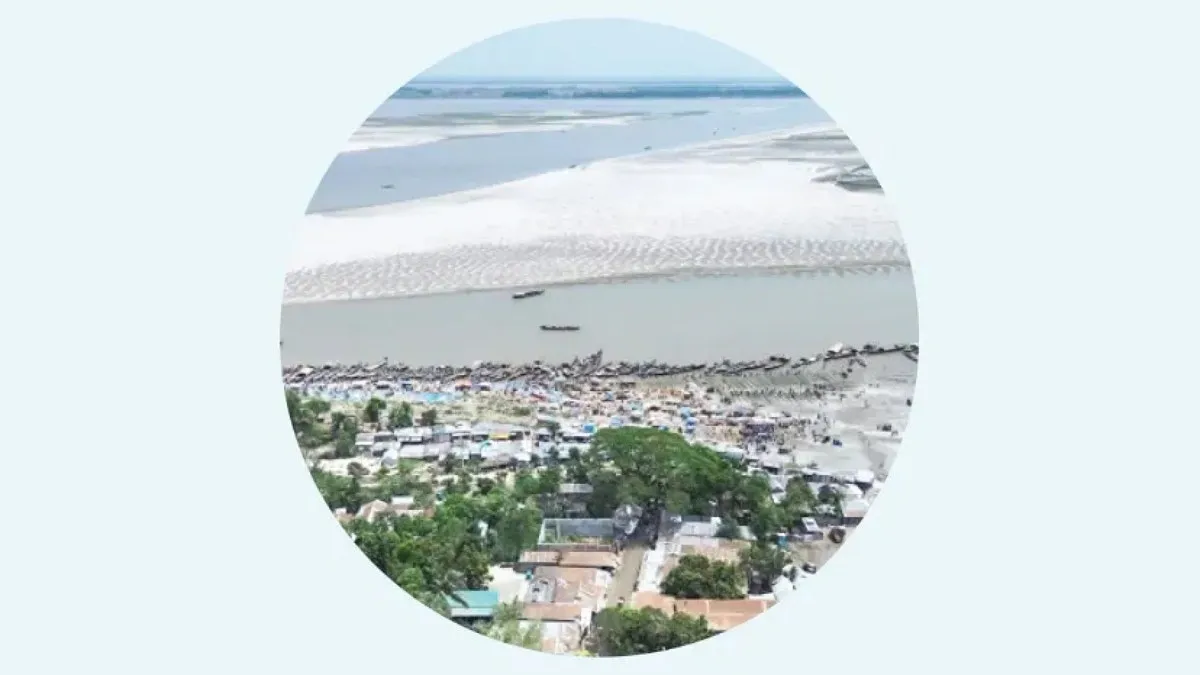
Photo: Agamir Somoy
Vast potential for valuable mineral resources lies hidden in the sand of the Brahmaputra River. To tap this potential and develop Kurigram into a major hub for mineral research, processing and technology driven industries, the Geological Survey of Bangladesh (GSB) had taken an initiative to establish a sand research and processing center for the first time in the country at an estimated cost of around Tk 9 billion.
If implemented, the project could generate substantial employment, attract domestic and foreign investment and open the door to new industries. However, eight years have passed without the initiative making any headway. Although assessments of the proposed land’s suitability and viability have been completed, conflicting opinions from the Ministry of Power, Energy and Mineral Resources and the Kurigram district administration have created complications. As a result, uncertainty has emerged over the future of the promising project.
Those involved in the project expect that properly identifying and processing mineral resources in the sand of the Brahmaputra and Jamuna river systems could help develop new industries in the country. Minerals such as ilmenite, zircon, magnetite, rutile, garnet and quartz have various industrial applications. These minerals are used in paints, plastics, ceramics, metals, electronics, medical equipment and other sectors. Developing research and processing capabilities could therefore reduce import dependence while creating new export opportunities.
According to the GSB’s plan, a pilot research plant has been proposed on 15 acres of land in Chilmari upazila of Kurigram. A research center has also been proposed on 10 acres in the Tograihat area of Rajarhat upazila.
The Public Works Department has already completed the land survey and feasibility assessment for the project and sent its report to the relevant authorities. The plan includes establishing an internationally recognized mineral sands research hub, conducting research and processing rare earth elements, using artificial intelligence and automation based technologies, and setting up a geological big data center. Research on high purity quartz and nuclear grade zircon is also planned.
The proposed project documents state that the initiative could create opportunities for long term mineral based industrialization, enhanced technological capabilities and employment generation. Those concerned believe the project could create employment opportunities for approximately 1.5 million people, both directly and indirectly, if implemented. The documents also highlight the potential to generate annual revenue of up to $10 billion.
However, the extent to which these projections can be realized will depend on detailed mineral surveys, laboratory based analysis, economic studies, environmental assessments and investment plans.
Complications arose following a meeting of the relevant ministry. The minutes of a meeting held by the Energy and Mineral Resources Division on July 19 stated that a report from the Kurigram deputy commissioner’s office had expressed the view that the government’s returns would not be substantial compared with the project’s estimated implementation cost.
However, the district administration says it did not submit any such report. Instead, it had previously sent information and data on potential sites for the project to the relevant authorities.
Kurigram Deputy Commissioner Annapurna Debnath said information about potential land for the sand research center had been sent to the authorities during the tenure of her predecessors before she assumed office. However, she said her office had not submitted any report expressing the opinion attributed to the deputy commissioner’s office in the July 19 meeting.
Abdullah Al Faruk, executive engineer of the Kurigram Public Works Division, said the GSB had proposed the project because of the potential for valuable and rare mineral resources in the Brahmaputra basin. He said the assessment of the proposed land’s suitability and viability had been completed and a report had been sent to the relevant authorities.
Dr. Sohel Rana, deputy director (geology) of the GSB, said sand in the Brahmaputra and Jamuna rivers is naturally replenished. Utilizing this sand could create opportunities to extract and process quartz, heavy minerals and light minerals. This could increase domestic investment opportunities, foreign currency earnings and employment prospects for local residents.
Local development activists are also disappointed by the uncertainty surrounding the project.
Shafiqul Islam Bebu, president of the District Development and Implementation Council, said work on the project had not even begun, yet negative opinions were being expressed about its costs and benefits. He said the project could play an important role in the national economy if implemented on the basis of proper research and planning. He urged the government to take effective action promptly.
Meanwhile, Disaster Management and Relief Minister Asadul Habib Dulu said he was unaware of the disagreement between the ministry and the district administration when asked about the conflicting opinions. However, he assured that any complications surrounding the establishment of the sand research center would be resolved.
