
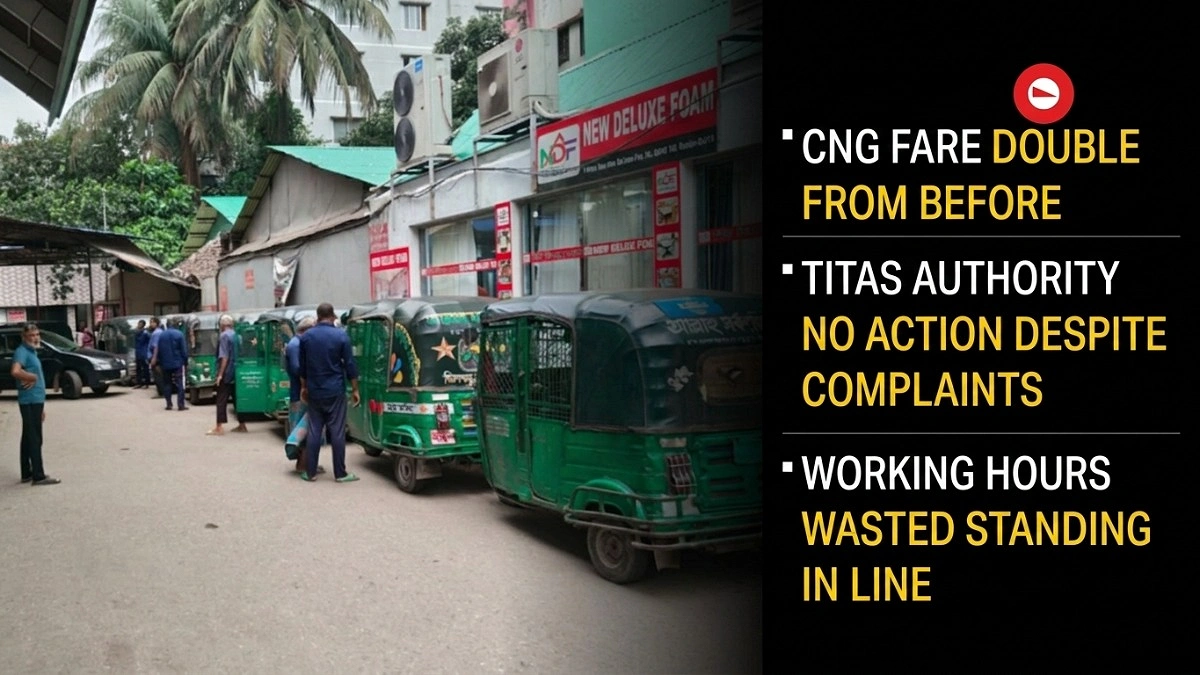
‘I have never seen such a gas crisis in Dhaka in the past 15 years’
- ‘The gas crisis has thrown off the balance between my income and expenses’
- Drivers forced to wait in line for hours for gas
- Passengers forced to pay higher fares

Graphics: Agamir Somoy
Drivers are facing severe difficulties as gas pressure at CNG stations in the capital and across the country has dropped. They are being forced to wait in line for two to three hours to get the gas they need. Even after waiting, they often have to leave with less gas than they require. As a result, drivers are losing working hours and income, while passengers are being forced to pay higher fares.
Mohammad Aibor Hossain, a driver who had been waiting for a long time at a CNG station in the capital, said, “After standing for two to three hours, I get only 100 taka worth of gas. What can I do with that little amount? With 100 taka worth of gas, I can travel only 30 to 40 kilometers. Then I have to stand in line for two to three hours again for gas. If there is no pressure, how can the pump operators provide gas?”
“I have been driving a CNG in Dhaka for more than 15 years. I have never seen this kind of crisis. It is the government’s responsibility to solve these problems.”
Having to spend several hours every day waiting in line for gas is reducing the time drivers can spend earning money. Many are coming under financial pressure as they struggle to cover their daily vehicle rental payments, fuel costs and household expenses. At the same time, there are allegations that passengers are being charged higher fares by taking advantage of the crisis.
Mohammad Hanif came to Dhaka from Kishoreganj and has been driving a CNG for the past six years. He said the gas crisis has also thrown off the balance between his income and expenses. He said, “We cannot do anything because there is no pressure. I do not own the vehicle. I have to pay 1,200 taka a day to rent the vehicle. I have to stand in line for two to three hours. How will I pay the rental and what will I take home?”
Hanif said that although some stations have relatively higher gas pressure, he cannot go there because of the long lines. He said, “The pumps where the pressure is higher also have longer lines. I came to this pump because the line was shorter. After coming here, I found that there is no pressure.”
“Because of the crisis, I have been paying 320 taka for a fare that used to cost around 160 to 180 taka for almost the past month.”
Asad Mia, who has been driving a CNG for a long time, said he had never seen such a situation before. He said, “I have been driving a CNG in Dhaka for more than 15 years. I have never seen this kind of crisis. It is the government’s responsibility to solve these problems.”
Highlighting the loss of working hours while waiting in line for gas, he said, “I lose around three to four hours every day standing in line for gas. Who will compensate me for the income I could have earned during that time? These are the government’s responsibilities. What are they doing?”
People involved in operating CNG stations have also said that low gas pressure is creating problems for them. Mohammad Rakibul Islam Rakib, manager of Citizen CNG and Petroleum Filling Station, said, “We provide gas depending on the pressure. There has been no pressure since 10 AM today. So we have kept the station closed.”
Regarding keeping the station closed for long periods, he said, “We cannot store gas. We have to provide gas when the pressure comes. We have informed the Titas authorities. What else can we do?”
Drivers are being forced to wait in long lines because of low gas pressure at CNG stations.
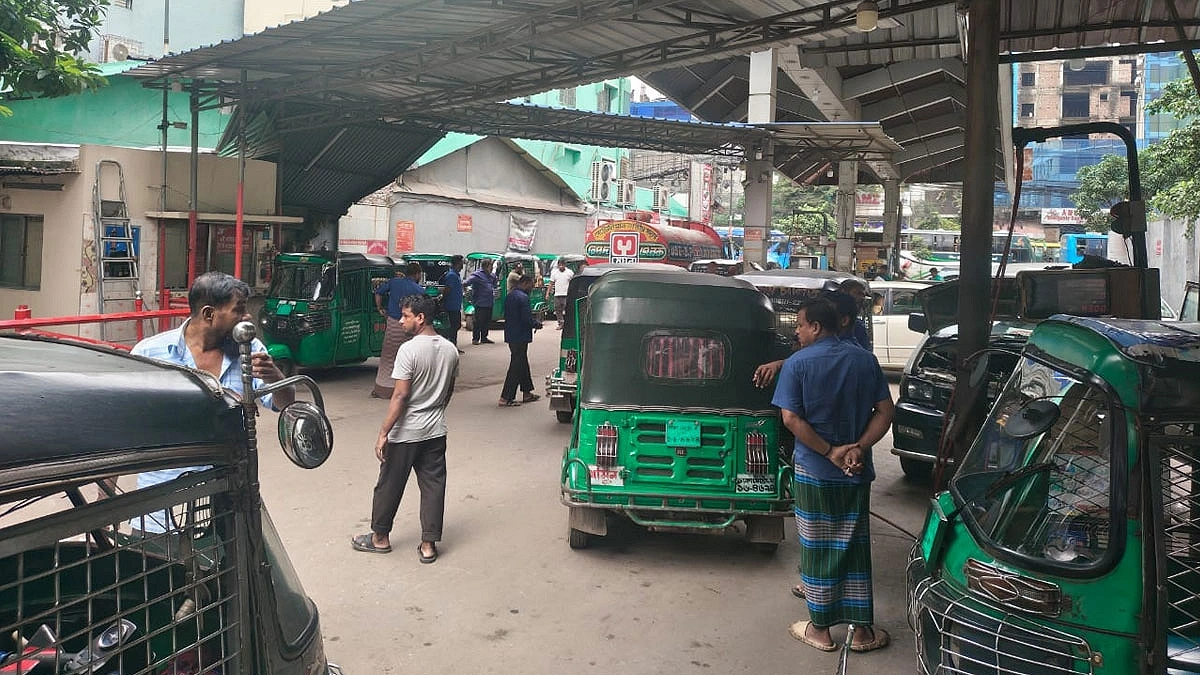
Sajib Khan, administrative officer and chief accountant of Makkah CNG Refueling Station, said, “If we have sufficient gas pressure, we have no problem providing gas. There is no way to store gas. Drivers who regularly get gas know that we cannot provide enough gas because there is no pressure.”
He said Titas supplies the gas. “We have informed them several times because of the crisis. The lines of vehicles will not end until the government solves this problem,” he said.
Mohammad Abdul Baset, a private sector employee, said, “Ordinary passengers like us are having to pay higher fares because of the CNG crisis in the country. Our salaries are still the same as before. But now we have to pay almost twice the previous fare for CNGs. It is the government’s responsibility to deal with such crises. But the money is coming out of my pocket.”
Another CNG passenger, Nazma Begum, said, “We have to use CNGs regularly to go to work. Because of the crisis, we have been paying higher fares for almost the past month. I had to pay 320 taka to travel from Mirpur 10 to Farmgate. At other times, it used to cost 160 to 180 taka.”
If the gas supply situation is not brought back to normal quickly and sufficient pressure is not ensured at the stations, the crisis could worsen further. CNG drivers have also called for a quick solution to the loss of their working hours while waiting in gas lines and the impact this is having on passenger fares.
