
International day for disaster risk reduction today
Disaster displacement causes Tk 12 billion in losses
- More than 21 million people displaced between 2008 and 2025
- Cyclones, storm surges and floods account for 91% of losses
- Annual average loss of nearly Tk 12.44 billion

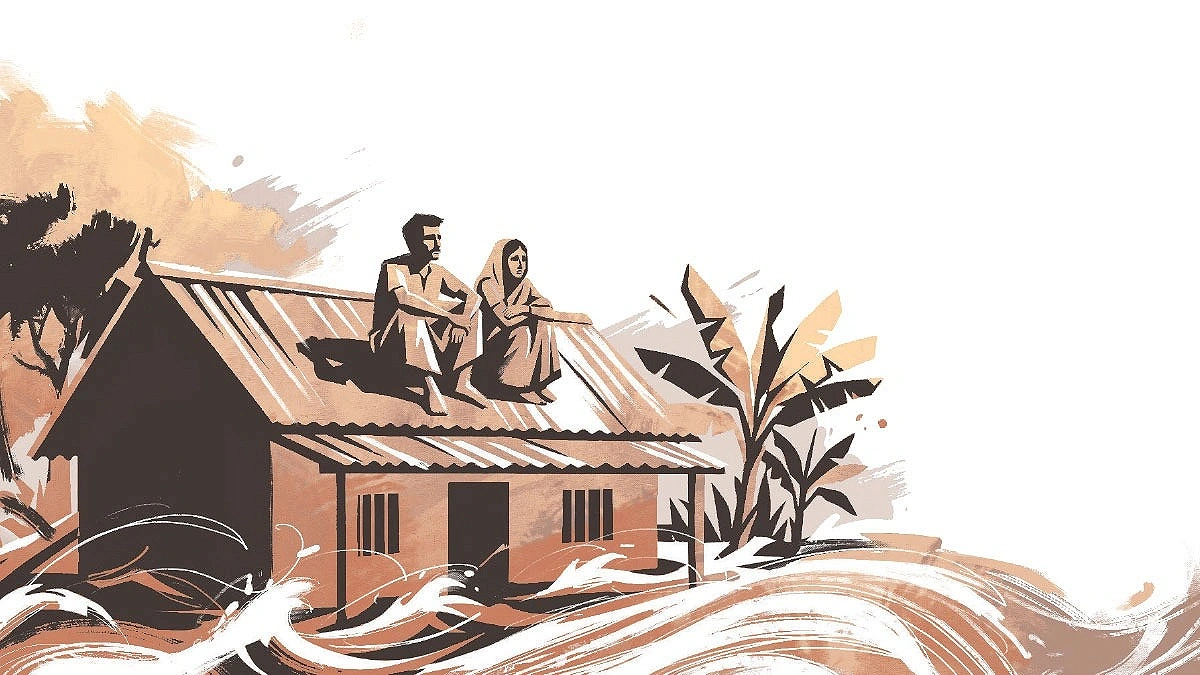
Graphics: Agamir Somoy
The livelihoods of people living along the Sundarbans depend on collecting fish, crabs and honey from the forest. However, cyclones and storm surges damage roads and homes. Fish farms are flooded and livestock suffer losses. The storms eventually subside, but the scars of disasters remain for a long time.
Sujayet Hossain, also known as Manik Mollah, a resident of an area adjacent to the Sundarbans in Burigoalini Union of Shyamnagar in Satkhira, said, “Ninety nine percent of our people depend on the Sundarbans. During storm surges or cyclones, road damage is the biggest problem. When roads break down, fish farms are flooded. Ninety five percent of the homes in this area are made of temporary materials. They collapse during storms and rain. Before we can fully recover from one disaster, another strikes.”
The situation described by Sujayet Hossain appears to be reflected in a research report. A new study has found that more than 21 million people were internally displaced in Bangladesh due to natural disasters between 2008 and 2025. More than 91 percent of these displacements were caused by cyclones, floods and storm surges. Over these 17 years, displacement resulted in the loss of approximately 89,000 “life years” in the country, with an average annual monetary value of nearly Tk 12.44 billion.
The study was jointly conducted by the Internal Displacement Monitoring Centre (IDMC), an international monitoring and research organization, and the Refugee and Migratory Movements Research Unit (RMMRU), a nongovernmental organization working on migration issues. The study, published in July, was funded by the European Union and the Swedish International Development Cooperation Agency (Sida).
Against this backdrop, International Day for Disaster Risk Reduction is being observed today, Tuesday. This year’s theme, set by the United Nations Office for Disaster Risk Reduction (UNDRR), is “Resilience Starts at Home,” meaning preparedness and the capacity to cope with disasters must begin at home.
The United Nations Office for Disaster Risk Reduction says the impact of disasters is first felt by homes and families. Therefore, reducing disaster risks requires a focus on safe, sustainable and disaster resilient housing as well as family preparedness.
Which disasters cause the greatest losses?
Disaster reports generally focus on the number of displaced people and damage to homes and infrastructure. However, the consequences of disaster displacement extend beyond damaged homes. They have long term effects on livelihoods, education, health, safety and people’s ability to maintain their normal lives.
The IDMC and RMMRU study assessed the combined effects of disruptions to housing, livelihoods, essential services and social connections following displacement. It also examined how long people’s living standards remain reduced. The study estimated that the loss of quality of life associated with disaster displacement was equivalent to 89,000 life years.
The study further found that cyclones and storm surges accounted for 59 percent of the total humanitarian losses, amounting to approximately Tk 12.2 billion. Floods accounted for 32 percent, or around Tk 6.7 billion. Together, cyclones, storm surges and floods accounted for 91 percent of total humanitarian losses. The remaining disasters accounted for 9 percent.
According to the study, the five largest disasters accounted for approximately 31 percent of total humanitarian losses. Nearly 70 percent of the remaining losses resulted from repeated small and medium scale displacement events. Many families in coastal areas, river islands and riverbank communities face another disaster before they can fully recover from the previous one.
Ashek E Elahi, convener of the Satkhira District Climate Council, said deaths caused by disasters had declined significantly. However, damage to homes, livestock and other assets had not decreased at the same rate.
Speaking to Agamir Somoy, he said, “The government provides money when homes are damaged at different times. However, losses could be reduced if vulnerable people in coastal areas were rehabilitated and their homes made disaster resilient in advance instead of providing that money after a disaster. Therefore, investment in shelters, Ashrayan housing projects and housing rehabilitation must be increased to reduce disaster risks. This would reduce losses of assets and livestock.”
Poor people suffer the most
The study surveyed 1,749 displaced households in Chattogram, Cox’s Bazar, Jashore and Satkhira districts. Of these, 1,467 households were already living below the poverty line before displacement.
The survey found that although the incomes of poor households increased somewhat, they largely remained below the poverty line. Among the 1,467 poor households, only 381 managed to rise above the poverty line after displacement.
Approximately 20 percent of households that had been above the poverty line reported a decline in income following displacement. Among these households, 11 percent experienced an income decline of more than 30 percent.
Losses caused by unsafe housing
The study found that damage to homes, disruption of livelihoods, interruptions to essential services and delays in recovery all increase losses.
According to the report, the average annual humanitarian losses of Tk 12.44 billion could have been used to build approximately 60,000 disaster resilient homes. The same amount could have provided emergency cash assistance to more than one million households or one month’s food assistance to approximately eight million people.
In other words, the lack of safe and disaster resilient housing is increasing losses during every disaster.
The study predicts that climate change will further increase displacement and losses caused by river floods and storm surges.
Annual losses from floods currently stand at approximately Tk 2.7 billion. Under adverse climate scenarios, this figure could rise to around Tk 21.5 billion. Annual losses from storm surges currently amount to approximately Tk 2.3 billion, but could increase to around Tk 22.7 billion under adverse conditions.
This means losses could increase by eight to ten times in the future unless investment in safe housing, flood prevention and coastal protection is increased.
In this context, Disaster Management and Relief Minister Asadul Habib Dulu said cyclones, floods, storm surges, riverbank erosion, landslides, fires and earthquakes were unavoidable realities in Bangladesh.
“Against this backdrop, when people become overwhelmed by disasters, the Ministry of Disaster Management and Relief stands beside them. The ministry is giving the highest priority to the necessary preparations to alleviate the suffering caused by disasters,” he said.
What needs to be done?
The study said early warnings and evacuations had reduced mortality. However, reducing the losses associated with displacement requires the rapid restoration of housing, livelihoods and essential services.
Investment must increase in disaster resilient housing, flood prevention and rapid recovery. Cash assistance and social protection for poor households must also be expanded. Targeted investment is particularly necessary in coastal areas, river islands and regions vulnerable to riverbank erosion.
Researcher and disaster management expert Gawhar Nayeem Wahra said, “Women in Bangladesh have been managing food, nutrition, fuel and seed preservation for their families for many years. Those whom we call domestic workers or homemakers actually prepare for disasters throughout the year. For example, they prepare and store bodi, dry and preserve jute leaves, and preserve seeds. These activities are not merely household chores. They are part of disaster preparedness and family food security. Therefore, women’s knowledge, experience and leadership must be recognized in disaster risk reduction. This will strengthen the resilience of families and communities.”
