
'Six months jail term for catching mother hilsa, fishermen's cards will be canceled'

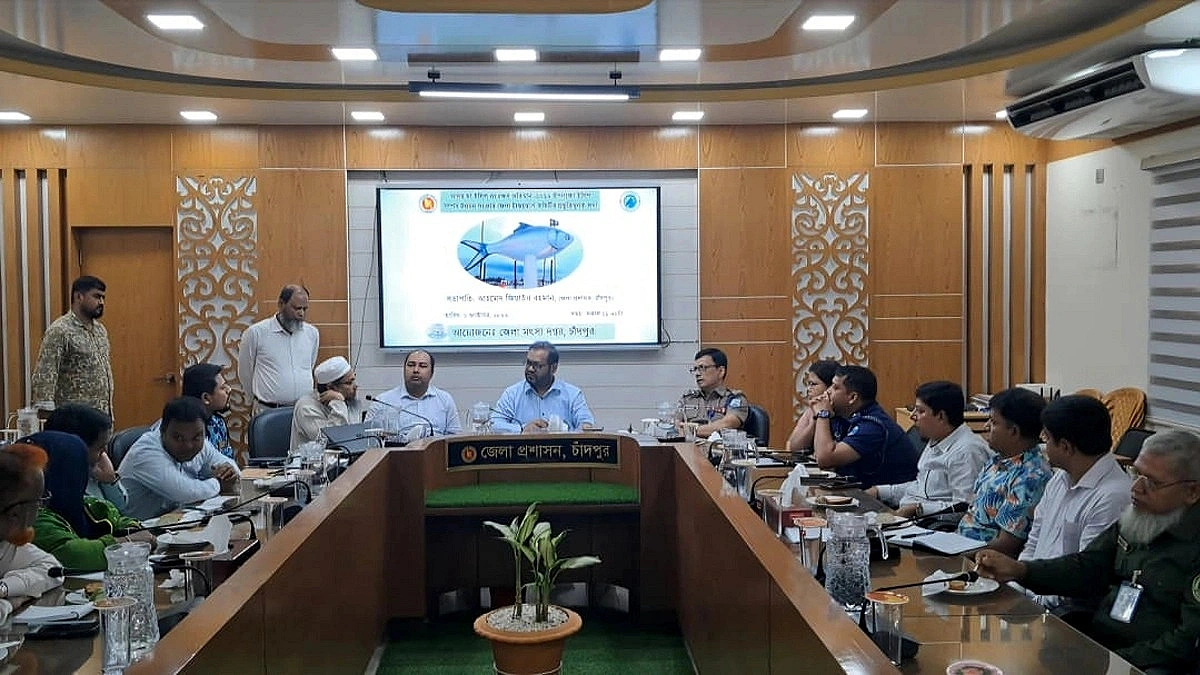
Photo: Agamir Somoy
Chandpur District Commissioner (DC) Ahmed Ziaur Rahman has said protecting the hilsa fish is everyone's responsibility. If fishermen violate the ban during the breeding season and catch mother hilsa, they will be sentenced to at least six months in prison. At the same time, arrangements will be made to cancel their fishermen's cards. To ensure the safe breeding of mother hilsa, decisions have been taken to close the mouths of canals connected to the river and to set up five temporary police camps in the sanctuary area.
His observations came at a meeting of the District Task Force Committee on the occasion of the Mother Hilsa Conservation Campaign at noon on Thursday (October 1) in the conference room of the Chandpur District Commissioner.
The District Commissioner said fishermen who do not go into the river during the ban and refrain from catching mother hilsa will each be given 25 kg of food assistance. In Chandpur district, 41,390 fishermen will receive this assistance. Besides, arrangements will also be made so that fishermen do not come under pressure to pay loan installments during the ban.
He further said there is no scope for any kind of concession in enforcing the law. However, effective steps must be taken considering the real situation. Public representatives of the Meghna coastal area, political figures, and everyone concerned must cooperate in implementing the ban. He expressed hope that the campaign will be successful if the task force maintains coordination with other stakeholders, as ensuring the safe breeding of hilsa is essential to preserve the heritage of Chandpur, known as the "home of hilsa."
During the main breeding season of hilsa, the catching, transportation, stocking, marketing, and buying and selling of hilsa will be completely banned across the country for 22 consecutive days from October 8 to October 29 to protect mother hilsa.
During this time, special monitoring will be carried out centered on about 70 kilometers of the Padma-Meghna river in Chandpur, from Shatnol in Matlab North Upazila to Char Bhairabi in Haimchar Upazila. The administration, Fisheries Department, Naval Police, and Coast Guard will work together to ensure the safe breeding of mother hilsa in this sanctuary.
At the meeting, District Fisheries Officer Md. Fakhrul Islam presented a presentation on the necessary steps to ensure the safe breeding of mother hilsa in the sanctuary area.
District Fisheries Officer Md. Fakhrul Islam said ice factories will remain closed during the 22 days of the ban. During this time, no dredger machines will be allowed to operate in the river. Special monitoring will also be in place so that fishermen from outside Chandpur cannot come and fish in the river. Last year too, measures were taken to stop outside fishermen from fishing. The same kind of steps will be taken this time as well.
He said there are plans to close the mouths of 8 to 9 important canals in the sanctuary area. This will reduce the opportunity for illegal fishing and make it easier to carry out the campaign. At the same time, checkposts will be set up on important roads at the initiative of the district police. A quick response team will remain ready to take immediate action if any kind of problem arises while conducting the campaign.
At the meeting, Naval Police Chandpur region Superintendent of Police Syed Moshfikur Rahman, Additional District Magistrate Ujala Rani Chakma, Additional Superintendent of Police (Sadar Circle) Md. Khairul Kabir, Coast Guard Station Commander Lt. Commander Muhtasin Islam, and Sadar Upazila Senior Fisheries Officer Mirza Omar Faruk spoke on ensuring the safe spawning by mother hilsa.
Besides, Haimchar Upazila Assistant Fisheries Officer Mahbubu Rahman, District Fishermen's Dal President Golam Mostafa, and on behalf of fishermen, Md. Zahid Hossain and Abdul Barek of the Tilabari area of the town also spoke.
The meeting discussed implementing the ban, ensuring food assistance for fishermen, increasing monitoring on river routes, and strengthening coordination among the relevant departments to stop illegal fishing.
Along with the administration's strict stance on protecting mother hilsa during the breeding season, emphasis was also placed on ensuring fishermen's livelihoods and government assistance.
