
Bangladesh loses Tk 28,800 cr in crops to poor storage

Graphics: Agamir Somoy
A lack of technology, scarce storage facilities, and mismanagement in transportation cause at least 16 million metric tons of crops and perishable produce worth around Tk 28,800 crore to end up in dustbins or rot away.
From the moment of harvest to the wholesale and retail markets - at every stage of product movement - the General Economics Division (GED) of the Planning Commission calculated this figure using the methodology of the Food and Agriculture Organization (FAO) of the United Nations. The picture of the country’s lost crops emerged in the Five Year Strategic Framework.
Bangladesh Agricultural University (BAU) former vice-chancellor Abdus Sattar Mandal said, “We already have a food shortage in our country. On top of that, after spending millions of takas, endless time, and hard labor to grow crops, will they simply evaporate like this during processing or marketing? This is a matter of deep concern! Except for mechanization across everything - from crop harvesting and threshing to winnowing - we have no second option open to us.
“Whether we like it or not, we must move toward combined harvesters. Even if large-scale ones are not feasible, we must deploy at least small and medium-sized harvesters in the fields. Along with that, we need modern dryers. In this land of alluvial soil, due to excessive rainfall or sudden natural disasters, field after field of crops rot because they cannot be dried. To prevent that loss, alongside dryers, a robust infrastructure of modern cold storage is necessary.”
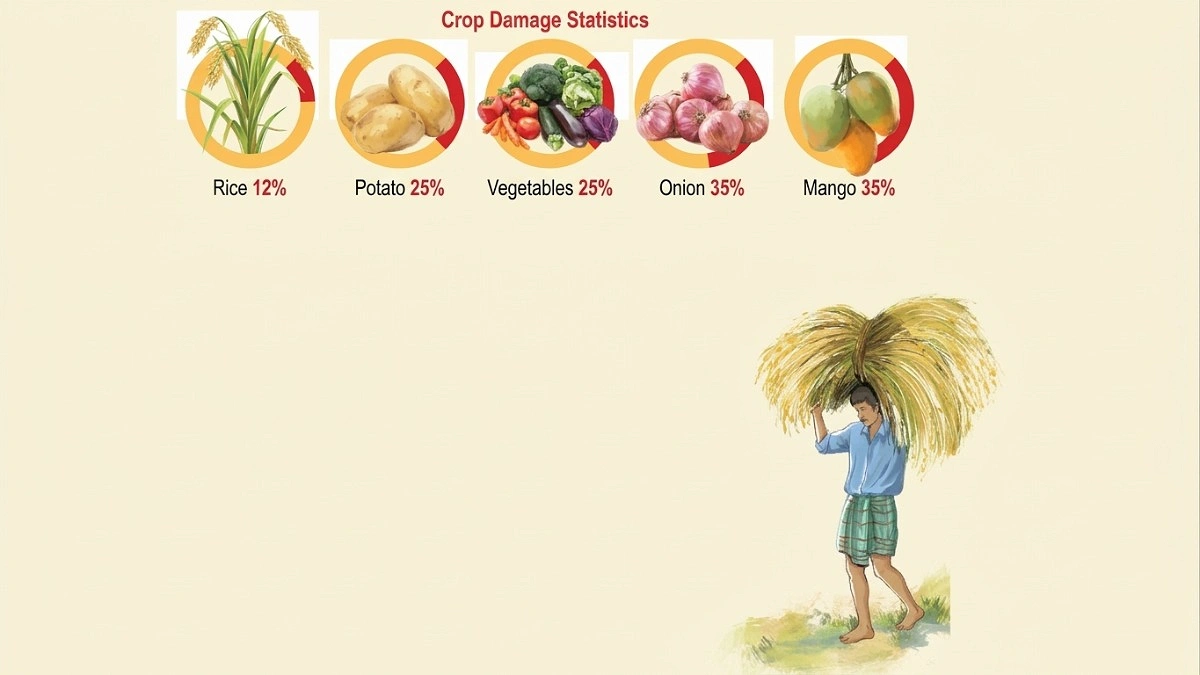
According to the 2024 statistics of the GED, due to traditional threshing, outdated drying methods, and dilapidated warehouses, 12 percent of the paddy grown by farmers disappears every year. A severe shortage of cold storage and the intense stress of transportation result in one-fourth of the country’s total potato production rotting away completely.
Improper handling and the lack of cold storage mean that one-fourth of vegetables never even reach the consumer market. Due to the lack of proper moisture control and modern warehouses, more than one-third of onions rot after harvest.
Lack of proper packaging and cold-chain transportation, 35 percent of mangoes from orchards, such as those in Rajshahi-Chapainawabganj, get half-rotten and spoiled on their way to the market.
Mirza Md Nizam Uddin, a farmer from Dairpara in Belgacha Union of Kurigram Sadar said, “While harvesting paddy, wheat, or foxtail millet from the field, a basketful of grain falls onto the ground right at that moment. Then, more is lost while being brought by vehicle or on workers’ shoulders.
“After bringing it home, crops vanish during threshing and winnowing as well - which can never be gathered up again. On top of that, after parboiling the paddy, sudden rain gets the paddy wet. That wet paddy rots and gives off a foul odor. It could no longer be processed into rice.”
He added, “The tragic thing is that we farmers have never even noticed this massive damage and loss! For generations, we have assumed that this is the rule, this is our fate! Therefore, taking precautionary measures never crosses our minds. The situation with vegetables is even worse.
“When there is a good harvest of potatoes, there is no space available in the cold storage in the market; and even if space is found, because generators do not run during power crises, potatoes rot and stink inside the cold storage itself.”
Although on paper there are around 450 cold storages nationwide, the reality is that 95 percent of them are restricted solely to storing potatoes.
For vegetables, onions, or mangoes, no institutional modern cold-chain or cold storage facilities have been developed in Bangladesh.
To address this deficit, a draft roadmap is being prepared to establish small and medium-sized multi-chamber cold storages, specialized refrigerated transport fleets, and collection centers near rural marketplaces based on Public-Private Partnerships (PPP). To reduce the cost of rural electrification, solar-powered mini-grid technology will be integrated with this initiative.
GED Member (Secretary) Monzur Hossain said to curb this national loss and waste, the government now adopted the “One Village One Product” approach.
Under this strategy, prioritizing local soil, weather, climate, and market demand, emphasis will be placed on specific products such as mangoes, pineapples, dairy products, fish, or spices tailored to a designated village or area.
Farmer Cards will be handed over to marginal farmers, providing them with insurance facilities and technological touchpoints. A master plan has also been drawn up to train unemployed rural youth and women digitally in packaging, sanitation, and processing to turn them into entrepreneurs, alongside providing microloans on soft terms.
International Food Policy Research Institute (IFPRI) Research Fellow Mehrab Bakhtiar delivered a clear warning, saying, “Our extensive research shows that from harvesting to final processing, losses in Bangladesh range from 20 to 40 percent - which deals a severe blow to the very foundation of food security across South Asia.
“Simply replacing cheap polythene bags with small technologies like ventilated plastic crates and changing transportation methods can prevent a major portion of this loss overnight.”
The global index of the FAO added that according to international standards, losses in paddy should be limited to below 5 percent, vegetables to 10-15 percent, and potatoes to 5-7 percent. However, the loss rates in Bangladesh are many times higher than the global standards.
