
Storms Disrupt Rural Power Supply

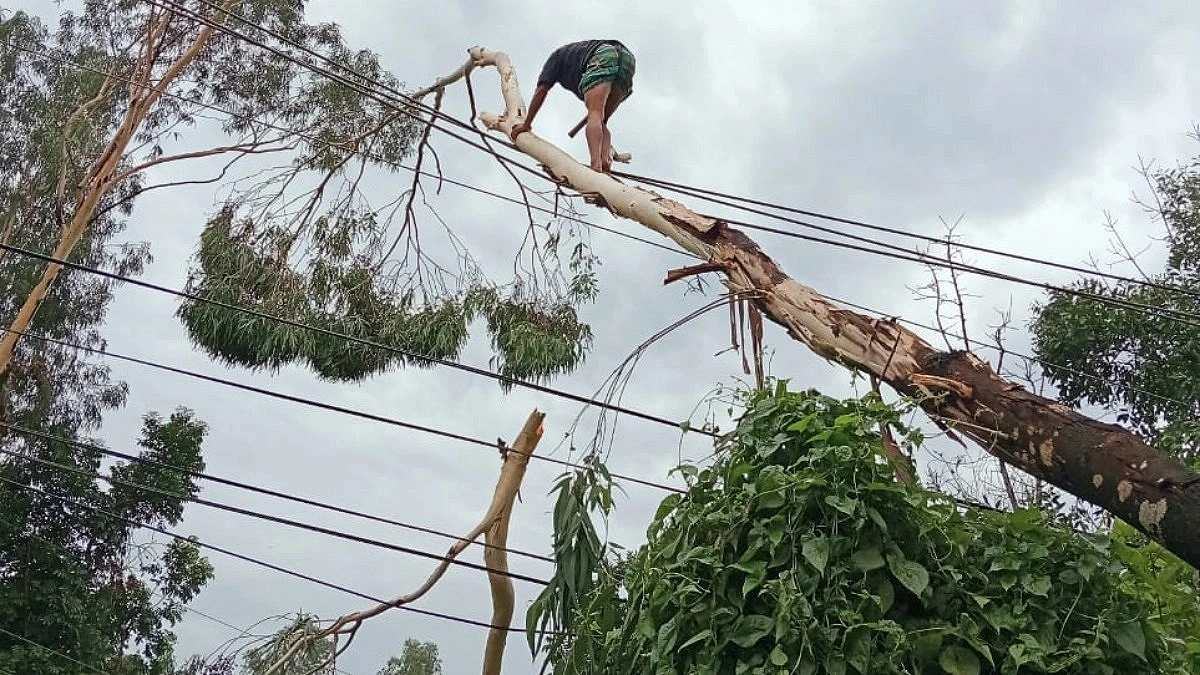
Photo: Agamir Somoy
The Rural Electrification Board (REB) distribution system has suffered extensive damage due to severe nor’westers and heavy rainfall across Bangladesh. Power supply was disrupted for long periods in more than half of the country’s districts after trees were uprooted and fell onto power lines, poles tilted, transmission wires snapped, and technical faults developed at various substations. In some areas, electricity remained unavailable throughout the day, while in others the disruption continued until night, causing severe hardship for consumers.
According to REB sources, severe storms and thunderstorms across different regions on Tuesday caused major disruption to the rural power distribution network. The central, northern, coastal, and southwestern regions experienced the most severe damage.
The worst-affected areas include various parts of Bhola, Narsingdi, Narayanganj, Tangail, Mymensingh, Gazipur, and Kurigram. Strong winds caused faults in both transmission and distribution lines in several locations. At the same time, power supply was also severely disrupted in Sherpur, Jamalpur, Netrokona, Cox’s Bazar, Feni, Noakhali PBS-1 and 2, Lakshmipur, and Chattogram PBS-3 areas.
The situation was even more complex in areas under the four Comilla rural electricity associations, where multiple line faults left many consumers without electricity for extended periods. A similar situation was reported in Shariatpur and Madaripur.
The southwestern region also sustained widespread damage. Distribution systems collapsed in Kushtia PBS-1 and 2, Jashor PBS-1 and 2, Magura, Khulna, Satkhira, Meherpur, Jhenaidah, and Bagerhat due to the storms. Emergency repair work had to be launched in many areas.
The Barishal region faced the most critical situation. With the exception of Bhola, almost the entire Barishal PBS-1 and 2, Patuakhali, Pirojpur, and Jhalokathi areas remained without electricity for long periods. Many consumers reported that frequent power outages also put electrical appliances at risk due to repeated power fluctuations.
REB officials said the outages were not caused by a generation shortage or load shedding. They stated that power supply had to be temporarily suspended due to local distribution line failures caused by storms and rainfall. Engineers and technical teams worked throughout the night in the field to restore normal supply.
Meanwhile, central REB data showed that despite the disaster, national electricity generation and supply remained largely stable. At 12:00 a.m. on May 26, peak demand in REB areas stood at 7,692 megawatts, against which 7,648 megawatts were supplied. At that time, only the Khulna region faced a minor shortage of 44 megawatts.
The following day at noon, electricity demand dropped significantly due to rainfall and cooler weather. At 12:00 p.m., demand fell to 3,958 megawatts and was fully met. Later at 3:00 p.m., demand rose to 4,459 megawatts, but full supply was still maintained.
Energy sector stakeholders said that as the stormy season has begun, further disruptions may increase in the coming days unless the protection of distribution lines and substations is strengthened immediately.
