

Drivers Obey Rules at One Intersection, Defy at Another

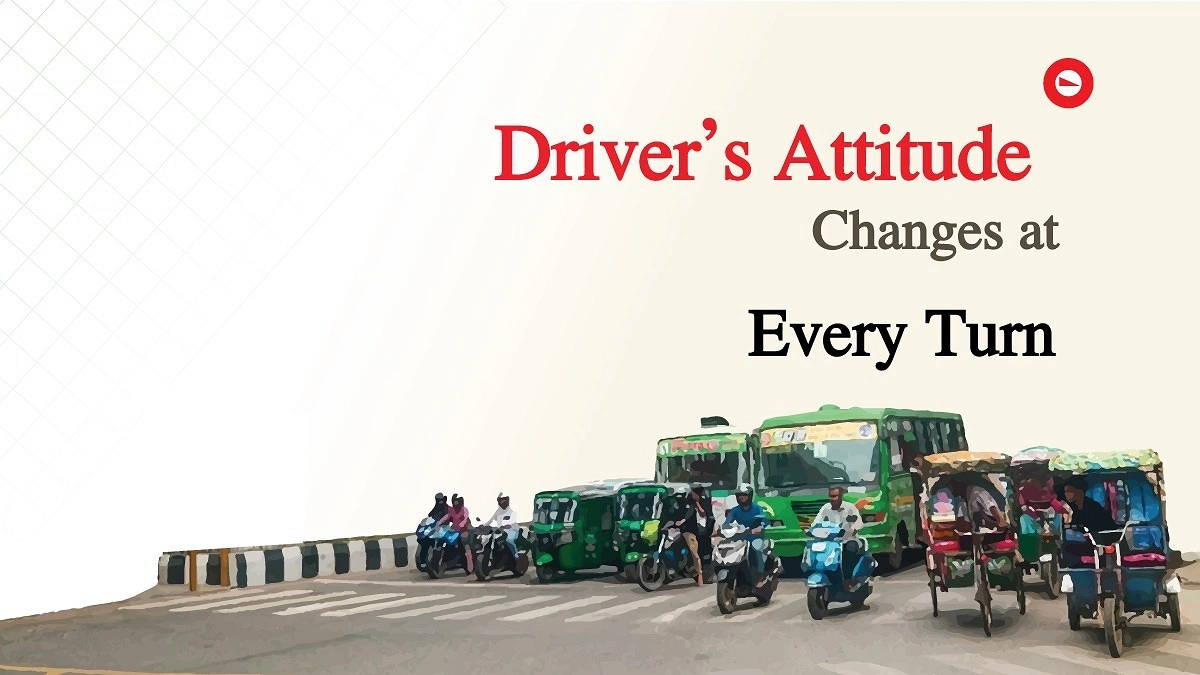
Graphics: Agamir Somoy
Under the scorching sun and humid heat, traffic in Dhaka moved in its familiar chaos. After enduring the midday gridlock at Gulistan-Paltan, a reckless Bihaan Paribahan local bus headed toward Mirpur along the Minto Road-Matsya Bhaban intersection route. Several motorcycles also sped alongside it. The scene shifted abruptly as the vehicles reached the Matsya Bhaban intersection.
No traffic police officer or sergeant stood with raised hands, yet as the traffic signal turned red, the bus driver voluntarily applied the brakes. Following his lead, motorcyclists behind him carefully stopped their vehicles well behind the zebra crossing and began waiting in an orderly manner. Their body language reflected an invisible sense of discipline and legal caution.
The seemingly ‘polite’ and ‘disciplined’ behavior lasted no more than two minutes. As soon as the vehicles crossed Matsya Bhaban and reached Shahbagh intersection, the same bus driver broke lanes instantly, taking advantage of the absence of digital monitoring. The bus overtook other vehicles and stopped diagonally in the middle of the road, quickly picking up passengers. Motorcyclists displayed similar behavior.
Ignoring traffic signals, they swarmed past the junction and moved along the edge of the footpath. However, just a couple of minutes later, as they approached the InterContinental Hotel intersection, the same disciplined body language returned. Whether bus or motorcycle, all drivers once again became compliant and law-abiding. The scene unfolded on Saturday.
The same drivers, the same vehicles yet within a span of just a few hundred meters, their behavior changed dramatically at two different intersections. At one point, a driver acted like a model citizen fully obeying the law; at the next, the same person turned into a violator.
Behind this dual behavior in the capital lies the newly installed artificial intelligence (AI) surveillance system of the Dhaka Metropolitan Police (DMP).
Where AI cameras are active, drivers behave strictly out of fear of prosecution. But in sections or stops without cameras, they revert to their usual disorderly and reckless behavior.
The distance from Paltan to Banglamotor is only about two and a half kilometers. On this roughly 15-minute stretch, transport drivers change their behavior up to four times. At stops equipped with AI cameras, they show one pattern of conduct, while at traditional intersections, they behave differently. The route from Paltan to Banglamotor includes four major intersections.
Of these, two are still under an analogue traffic system, while the other two fall under digital AI-based surveillance. Drivers move through both systems in turn. The Paltan intersection still operates under the analogue system. The next stop, Matsya Bhaban, is equipped with an overhead AI camera. Just a couple of minutes beyond that is Shahbagh intersection, which again operates under an analogue system. The following stop, Banglamotor, like Matsya Bhaban, is also under AI surveillance.
Since May 7, the traffic division of Dhaka Metropolitan Police (DMP) has been conducting experimental trials of this modern technology-based traffic monitoring system in the capital. Replacing the traditional manual system, several busy and important signal points in Dhaka have been brought under AI surveillance to restore order on the roads. Early trials have shown positive results, prompting plans to expand the system to 120 key intersections in the first phase.
How Automatic Cases Are Generated
According to information from the central control room of the DMP Traffic Division, high-powered PTZ (pan-tilt-zoom) cameras and special AI-enabled lenses installed on roads continuously scan vehicle movements. When any vehicle violates traffic rules, a pre-defined virtual line in the software is automatically activated. Immediately after a violation occurs, the AI system stores at least a 25-second video clip and a still image as evidence in the backend and sends them to the central server. A digital case file or prosecution record is then automatically generated. The system also sends a short message (SMS) to the registered mobile number of the vehicle owner from the BRTA database, along with a link where drivers can view video footage of their offence.
Speaking about the contrasting behavior of drivers at different intersections, Traffic Sergeant Md. Shahidul, who is stationed at the Kawran Bazar intersection, shared his experience with Agamir Somoy. He said AI technology has significantly reduced workload on the ground. At intersections equipped with AI cameras, drivers now comply with traffic laws even without seeing police presence. He added that drivers behave in an orderly manner at intersections such as InterContinental, Bangla Motor, and Kawran Bazar, but begin overtaking and driving against traffic at locations without cameras. He stressed that unless the entire city is brought under this surveillance system, it will be difficult to eliminate such evasion tendencies among drivers.
On the same day, Kamrul Hasan, an employee of a private company, was waiting on his motorcycle at the Bangla Motor signal. Speaking to Agamir Somoy, he recalled a recent incident involving an automatic case. He said he received an SMS last week, and upon clicking the link, he saw that he had been fined after his vehicle’s wheel crossed a zebra crossing at Kawran Bazar. Since then, he has become extremely cautious whenever he sees AI cameras. However, he admitted that during office rush hours, when time is short and no cameras are visible, he sometimes changes lanes, as there is no immediate enforcement in those areas.
A local bus driver, who requested anonymity, said the vehicle owner has instructed drivers to pay fines imposed through AI-based cases themselves. As a result, drivers now largely avoid violating signals. However, he admitted that in areas without cameras, many still break rules due to passenger competition and pressure to complete trips quickly.
Transport experts have welcomed the DMP’s digital transformation, calling it timely, but have also pointed out practical challenges. They noted that Dhaka’s traffic system is mixed, with a large presence of slow-moving vehicles such as rickshaws, lagunas, and auto-rickshaws, many of which are not included in any digital database. In such a context, they said, achieving full effectiveness of AI-based enforcement remains difficult. They added that while obeying digital traffic systems is a civic responsibility, compliance in manual systems is equally important.
Offences That Trigger AI-Based Cases
AI cameras accurately detect violations such as driving through a red light or ignoring traffic signals, crossing beyond zebra crossing boundaries while stopping at signals, and driving completely in the wrong direction against designated lanes. They also identify motorcyclists or passengers riding without helmets, and illegal parking on main roads such as stopping outside designated bus stops or blocking the left-side free lane.
The system also detects whether drivers or passengers are wearing seatbelts, as well as cases of motorcycle overloading, including pillion riding beyond permitted limits or ‘triple riding.’ None of these violations escape the camera’s lens.

