
690 prisoners still at large, prison authorities have no information on 166

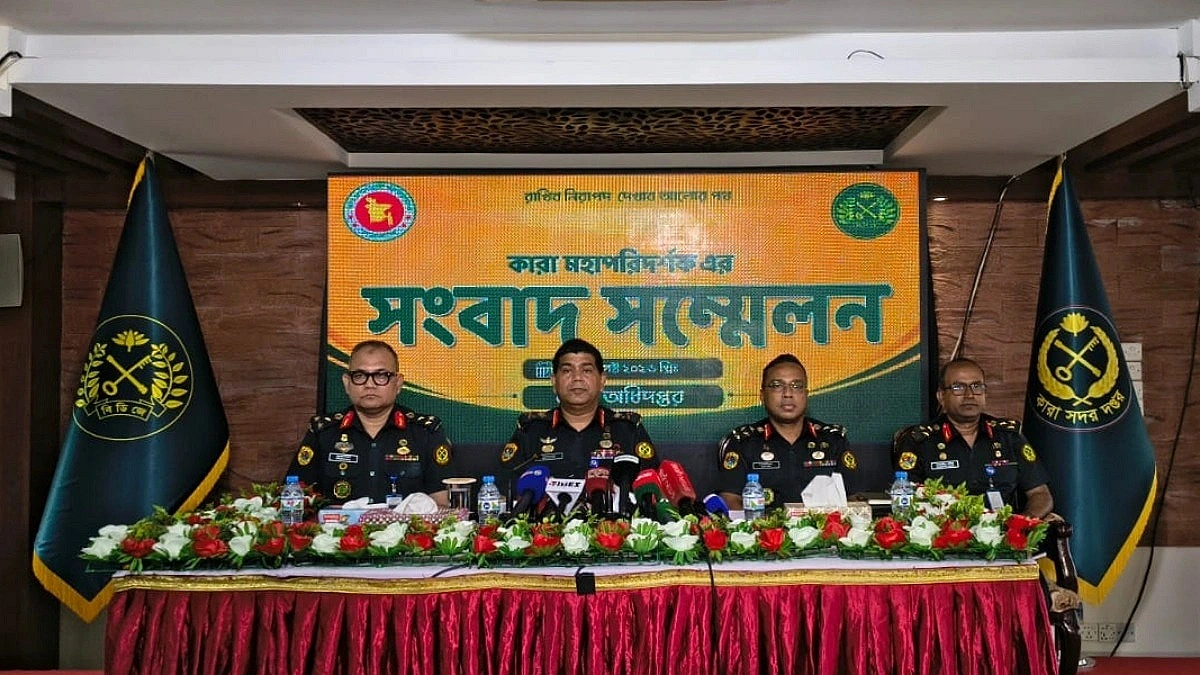
Photo: Agamir Somoy
Of the 2,247 prisoners who escaped from prisons across the country during the July uprising, 690 have yet to be arrested. Among them, the prison authorities have no identity related information on 166 prisoners. These prisoners escaped from Narsingdi Jail. The destruction of the jail’s records and server has created difficulties in collecting information about them.
In addition, six of the nine listed militants who escaped from prison have been rearrested. Three are still at large.
Inspector General of Prisons Brigadier General Syed Mohammad Motaher Hossain provided the information while answering questions from journalists at a press conference held at the Department of Prisons in Bakshibazar, Old Dhaka, on Tuesday.
The Inspector General of Prisons said around 2,247 prisoners escaped from prisons across the country on August 5. Around 690 of them are still at large. Of these, 166 escaped from Narsingdi Jail. Their identity related information is unavailable because the records and server of the jail were destroyed. An application has been submitted to the court to collect the information. A total of 826 prisoners escaped from Narsingdi Jail.
Regarding the escaped militants, he said a total of nine listed militants escaped from prison. Six of them have been rearrested. One of them, Jewel Ostad, was outside prison on bail. Police recently arrested him again. Three militants are still at large.
Asked whether there was any connection between the prisoners who escaped from prison and the recent recovery of bombs and bomb like objects in the capital and surrounding areas, the Inspector General of Prisons said they are also somewhat concerned about whether the escaped prisoners have any connection with the recent incidents. They are working on the matter.
Jewel Ostad, who was arrested recently, had developed a relationship in prison with fugitive bomber Mamun. Asked why militants like them were kept together in prison, the Inspector General of Prisons said the issue is a challenge for the prison authorities. As the number of prisoners is much higher than the capacity of the prisons, a shortage of accommodation has become a major problem in keeping them separately.
He said it is not always possible to keep anyone completely separated at present. Since prisoners stay in the same ward or building, they get opportunities to communicate with one another. There were some weaknesses in prison management in this regard. However, arrangements have now been made to keep high risk and serious offenders in separate zones under observation. Necessary measures are being taken in this regard in every prison.
Regarding allegations that Awami League ministers and members of parliament are being allowed to use mobile phones in prison through prison guards, he said it is not possible to guarantee that no mobile phones are being used in prisons. However, no concessions are being given in this regard. More than 3,000 mobile phones have been recovered in various raids over the past year. Such incidents have now decreased significantly compared with before. Whenever information is received or an incident is identified, measures are being taken to stop it.
The Inspector General of Prisons also spoke about healthcare for prisoners. He said, ‘There is a shortage of doctors in prisons. Although there are a total of 151 posts for doctors, only two doctors are currently working. Doctors are being temporarily assigned to other prisons through civil surgeons. As they are also responsible for duties elsewhere, they cannot provide full time service at the prisons. Currently, 101 civil surgeons are providing medical services in various prisons.’
Pharmacists have been appointed, and almost all prisons have pharmacists or employees with medical or diploma qualifications. The Public Service Commission recently issued an order to appoint 55 nurses. The Inspector General of Prisons expressed hope that they would join soon.
The Inspector General of Prisons also said that increased arrests during recent special police operations have created pressure on prisoner management in prisons. He said the prison authorities generally work with around 80,000 prisoners. Currently, the number has increased to around 98,000. On average, around 2,796 prisoners enter prisons every day and around 3,000 are released. As prisoners continue to enter and leave regularly, the number that remains behind is increasing the total prison population.
He further said that more than 26,000 people sentenced by mobile courts were taken to prison between June 1 and July 31. This is one of the main reasons for the increase in the prison population. Through mobile courts, many people are being given short sentences of one day, five days, seven days, one month or three months. This has created additional pressure on prisons. The matter has been reported to the government.
There are currently 379 foreign prisoners in the country’s prisons, the Inspector General of Prisons said. Among them, 170 have completed their sentences. They are waiting to return to their respective countries. Arrangements are being made to send them back to their countries in phases through the concerned embassies and the Ministry of Foreign Affairs.
Regarding the handling of the bodies of foreign prisoners who die, the Inspector General of Prisons said the bodies of around 17 foreign prisoners have been handled over the past two years. Of these, two bodies were sent to India. Currently, three bodies are being preserved in different cold storage facilities. Under existing policy, further action is generally taken regarding a body after three months. However, identity and other information are preserved. If no one from the concerned family or country comes to take the body, further action will be taken according to the government’s decision.
Earlier at the press conference, the Inspector General of Prisons spoke about a strict stance against corruption and drug related crimes in prisons. He said the Department of Prisons has adopted a zero-tolerance policy against corruption. Over the past two years, 21 people have been sent into compulsory retirement, 82 have been dismissed and departmental action of various kinds has been taken against 870 people. A total of 303 people has been administratively transferred out of various departments for minor offenses.
He also said that if any officer or employee, including prison guards, is involved in drug related crimes, a criminal case is filed against them and they are handed over to the police.
The Inspector General of Prisons further said the total capacity of the country’s prisons is around 45,000 prisoners, while around 98,000 prisoners are currently being held there.
