


Bhola power plant plan revives fears of rental plant scams

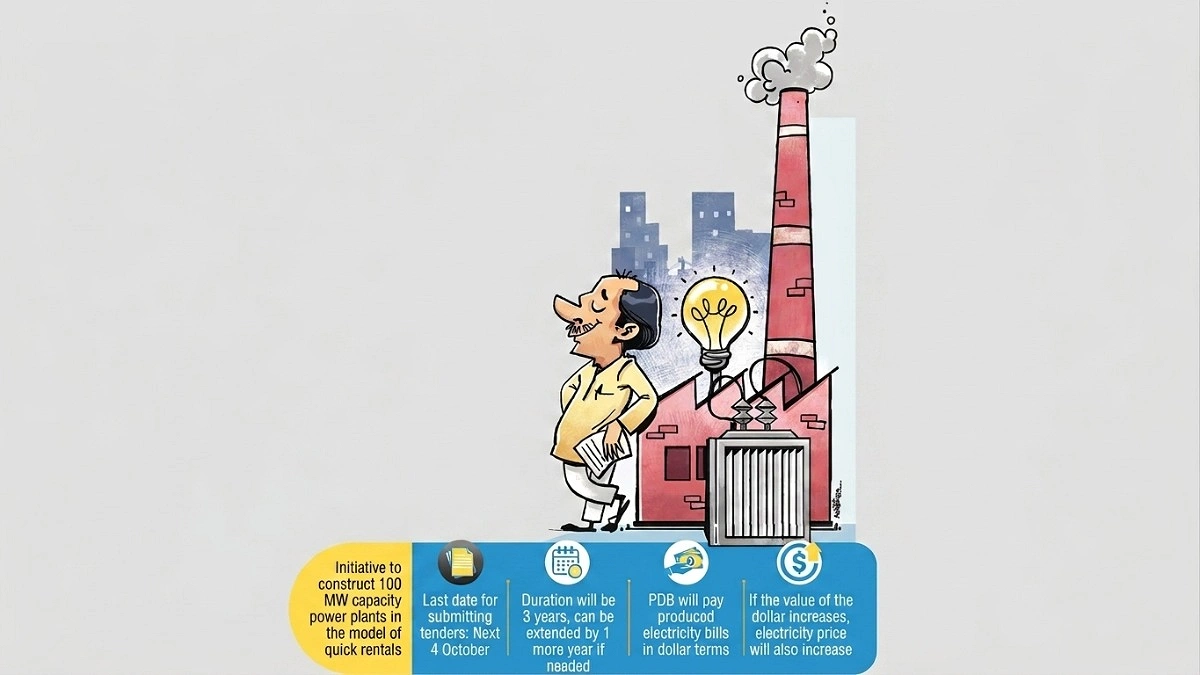
Graphics: Agamir Somoy
Amid proposals to build controversial “quick rental” 225 MW capacity power plant using Bhola’s gas, the government has initiated a move to construct a 100 MW capacity power plant in the private sector.
At the government’s direction, the Power Development Board (PDB) invited tenders for the construction of this plant, with the submission deadline set for 4 October. PDB will purchase electricity from this plant in US dollars at a fixed rate. As a result, if the price of the dollar increases, the price of electricity will also rise.
Initially, the tenure of the plant is set for three years, which can be extended by another year if necessary. Experts have raised questions regarding the logical basis of constructing such a relatively small power plant for such a short duration.
They say this will make electricity more expensive and escalate the crisis. Since the 100 MW power plant is a simple cycle plant, its fuel efficiency is low. It will require relatively more gas to produce electricity.
On the other hand, the plant proposed by the PDB is a combined cycle plant, which has a much higher efficiency. Immediately after taking office, the ousted Awami League government approved the construction of one rental and quick rental power plant after another under the guise of solving the power crisis.
Although the tenures of these plants built in the private sector were initially three and five years, they were then extended repeatedly.
Approved without competition under the Special Powers Act, these power plants not only sold electricity at exorbitant prices but also received massive amounts of capacity charges under the agreements, even when they did not produce any electricity.
Although this increased electricity generation, it brought the burden of constructing excess power plants beyond demand and unnecessary expenditures. As a result, PDB’s losses and the government’s subsidy increased.
To cope with this pressure, electricity prices were hiked repeatedly at the consumer level. When asked, PDB Chairman Engineer Rezaul Karim told Agamir Somoy that it will take three to four years to build PDB’s 225 MW power plant in Bhola. Since there is unused gas there, the government decided to build a short-term power plant for this interim period.
Rezaul said, “This will not be a rental power plant like before. It will be done through open tender. We will not be held hostage by anyone. Everything will be on a competitive basis. Many companies have shown interest. The decision will be made after proper evaluation.”
PDB officials added that the tender and evaluation process will take six to seven months. After that, at least six months will be given for the construction of the power plant. If everything goes well, it will take about one and a half years to get electricity from here.
The plant will be skid-mounted modular-based. This is a technology where the turbines/generators and auxiliary equipment of the power plant are pre-assembled and tested in the factory, then shipped to the site in large skids or modules.
At the site, only the foundation preparation, module installation, and interconnection work need to be done. Because of this, it can be set up much faster than conventional power plants.
For emergency and rapid power supply, more than 300 units of this type of power plant have been used worldwide. In neighboring Myanmar, there is a precedent of launching a 25 MW capacity plant of this type in two months.
In Sichuan, China, an LNG-based skid-mounted plant was commissioned in less than six months from module delivery. Regarding this, the PDB Chairman said that since Bhola is an island area and the communication system is not advanced, a slightly longer time has been allocated.
Officials of PDB’s IPP Cell-2 said the contract for the plant will be based on the IPP (Independent Power Producer) model. Payment will be made only for the exact amount of electricity purchased.
No additional capacity charge will be paid if there is no production. On the other hand, if the owner of the plant fails to produce the designated amount of electricity, they will have to pay a penalty.
However, there is no such short-term IPP plant in the country. Those that exist typically have a term of 15 years or more. Such short-term power plants are commonly known as quick rental power plants.
In such cases, the plant owner usually determines the rate by factoring in additional costs. This is because they must recover their investment and profit within three years. There are past precedents of keeping public power plants idle while running private ones.
According to the PDB Chairman, these short-term power plants are built for emergency needs in various countries. During the Beijing Olympics in China, a 100 MW power plant was built for one year. However, three years is a more “convenient” time than one year. Once the term expires, they will dismantle and take them away.
Independent University, Bangladesh Vice Chancellor M Tamim told Agamir Somoy, “This is very much like a rental plant. It is also relatively much smaller in size, and the timeframe is very short. The rationale behind this type of power plant is something that needs to be understood.
“The investor here will recover their investment and make a profit within three years. This will make the price of electricity much higher.”
However, the PDB Chairman’s stance is that the price of electricity generated at this plant will not be high. According to M Tamim, it is estimated that there could be 1-2 TCF (trillion cubic feet) of gas reserves in Bhola. Bringing this gas through a pipeline is the best option. That would take about three years. The second option is to build a power plant there. This power plant can be under either public or private initiative.
There is no guarantee that the price will be lower just because it is government-run, as the government has many “hidden” costs.
On the other hand, it is also incorrect to assume that giving it to the private sector is inherently dangerous, as Haripur and Meghnaghat are good examples of this. What matters here are the terms of the agreement.
During the tenure of the previous Awami League government, Agrico International built a 145 MW quick rental power plant in Ghorashal with an investment of 100 million dollars. Although it was initially a three-year contract, the term was extended several times to eventually span seven years.
Excluding the cost of fuel used for power generation, the company pocketed $ 211.41 million just as capacity charges during this period. There are more such horrific examples.
Regarding the plans for Bhola’s unused gas, in 1995, the Bangladesh Petroleum Exploration and Production Company (BAPEX) discovered the Shahbazpur gas field in Borhanuddin, Bhola. Gas production started in 2009.
The same organization discovered the second gas field, Bhola North, in 2018. The Ilisha gas field was discovered in 2023. Production from these two gas fields has not yet started. Although the Shahbazpur gas field has a production capacity of 150 million cubic feet per day, a maximum of 75 million cubic feet of gas is being used.
Indications have been found of around 2 TCF of gas reserves in the island district. However, because it is isolated from the mainland, that gas could not be brought to the national grid due to the lack of a pipeline.
Gas is being supplied to three power plants, two captive plants (industries’ self-generated power), industrial factories, and 2,500 households in Bhola. No new industrial factories have been established there.
As a result, Bhola’s gas remains unused even during this severe crisis period. During the tenure of the Awami League government, the CNG sector company Intraco secured the contract to supply Bhola’s gas in the form of CNG. The company started supplying gas to various factories in cylinders using special transport in December 2023.
However, the quantity is extremely small, and the price is also relatively high. Earlier in 2023, the state-owned Gas Transmission Company Limited (GTCL) proposed installing a 65-kilometer pipeline at an estimated cost of Tk 1,300 crore to bring gas from Bhola to Barisal, which is the country’s mainland. Later, it did not see the light of day.
Regarding the progress of the government-owned power plant, the interim government submitted a proposal to the Bangladesh Energy Regulatory Commission to bring 30 million cubic feet of gas daily from Bhola in the form of LNG.
Presenting a counterproposal during that public hearing, the Additional Director (Finance Directorate) of PDB Syed Zulfikar Ali said based on a transport cost of Tk 29.90 per cubic meter of the proposed LNG, transporting 30 million LNG would cost Tk 930 crore annually. On the other hand, it is possible to generate 4 to 5 units of electricity with 1 cubic meter of gas.
It will cost Tk 1.24 to bring that electricity to Dhaka. It can be transmitted through existing lines. Therefore, constructing a power plant there will be profitable.
If the gas to be used in that power plant is reduced in other power plants during an emergency, the gas crisis will decrease. It was after such a proposal that emphasis was placed on constructing a power plant there.
Although four organizations, including state-owned entities like Ashuganj Power Station Company and EGCB, proposed building a power plant there, it was finally decided that PDB would construct the power plant.
According to PDB sources, a proposal has been sent to the Planning Commission through the Power Division for funding search and PDPP approval, which is awaiting approval.
CAB Energy Adviser M Shamsul Alam told Agamir Somoy, “The previous government committed such grave sins and brought ruin. Why does the current government have to repeat that? Given the character of this government, this is beyond imagination.
“The high cost of electricity has turned into a structural crisis. There are many ways to overcome that crisis. If the government takes steps to reduce unnecessary spending in this sector, it is possible to save around Tk 40,000 crore within 3-6 months. This will help mitigate the energy crisis and lower the cost of electricity.
“Without pursuing such alternative paths, building this type of power plant will not solve the problem. Instead, the crisis will only intensify.”

