
CPD Review
Trade deficit reaches $10.4 billion, per capita foreign debt to rise to Tk 55,130

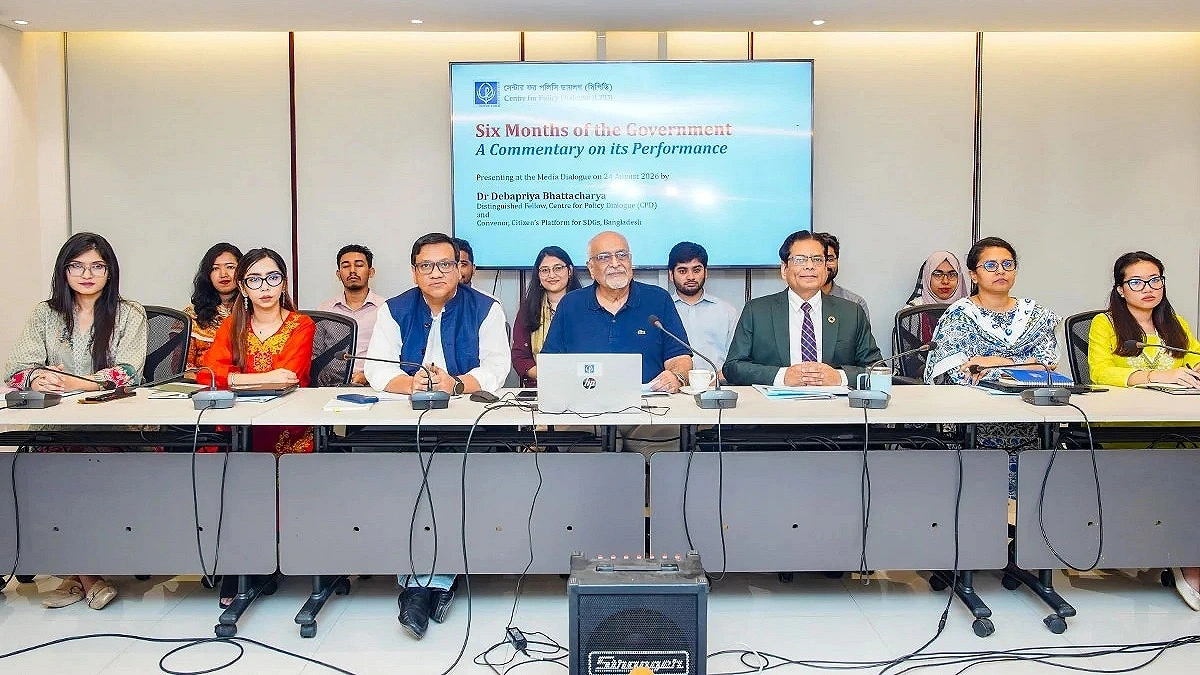
CPD’s ‘The First Six Months of the New Government: An Economic Review.’Photo: CPD website.
The country’s economic recovery process is at risk of becoming prolonged. While the stability achieved so far has become extremely fragile, the trade deficit has reached $10.4 billion. Per capita foreign debt is also expected to rise to Tk 55,130. Several structural weaknesses are holding back investment, employment and overall growth. These findings emerged from a review by the private research organization Center for Policy Dialogue (CPD).
The concerns were raised at a media dialogue titled “The First Six Months of the New Government: An Economic Review” organized by CPD on Monday. CPD Distinguished Fellow Dr. Debapriya Bhattacharya presented the keynote paper at the dialogue.
In his presentation, the government’s performance during its first six months was assessed against two major expectations. The first was to turn the economy around through higher growth, investment and employment while keeping inflation and the cost of living under control. The second was to ensure good governance through accountable and effective institutions.
Bank loan rates have increased from 48 percent to 53.8 percent. Per capita foreign debt in the country will increase by 14.5 percent from Tk 48,166 to Tk 55,130.
Dr. Debapriya said the current government inherited an economy with a highly fragile banking sector, weak revenue collection, a severe revenue deficit and sluggish investment. The global adverse environment has added further pressure. However, the absence of a clear economic foundation and a coordinated reform program has made it difficult to properly assess progress and ensure accountability in the recovery process.
CPD reviewed 362 specific measures taken by the government across nine sectors: governance, public financial management, industry and trade, banking, energy and transport, agriculture, education, health and social protection. The review focused on measures that had actually been implemented rather than mere announcements or commitments.
The economic recovery scorecard showed a mixed picture. However, negative trends outweighed positive achievements. Of the indicators assessed, 12 improved while 19 deteriorated. There was some relief in inflation. Overall inflation fell from 9.1 percent in February 2026 to 8.3 percent in July. Food inflation declined from 9.3 percent to 7.2 percent. Despite this, prices of essential commodities remain high. Real wage growth remains negative. At the same time, significant weakness was evident in investment and industrial production indicators.
According to CPD’s review, 95 factories permanently shut down between January and August 2026 in the industrial areas of Gazipur, Savar Ashulia and Narayanganj Narsingdi. As a result, 61,881 people lost their direct jobs. Overall industrial production growth fell from 3.4 percent to zero. Growth in the manufacturing sector also fell to zero.
Overall inflation fell from 9.1 percent in February 2026 to 8.3 percent in July. Food inflation declined from 9.3 percent to 7.2 percent. Despite this, prices of essential commodities remain high.
Private sector credit growth fell from 6 percent to 4.5 percent. Net FDI inflows declined from $662 million to $594 million. Letters of credit opened for imports of capital machinery fell from 14.6 percent to a negative 13.6 percent. This indicates a possible slowdown in investment in the future.
The trade deficit increased from $6.7 billion to $10.4 billion. The current account balance shifted from a surplus of $1.3 billion to a deficit of $0.6 billion. Remittance growth declined from 21.4 percent to 11.8 percent. Meanwhile, amid tensions in the Middle East, average monthly overseas employment fell from 95,521 to 51,235.
NBR revenue growth declined from 12.3 percent to 4.9 percent. Against the government’s annual target, the bank loan rate increased from 48 percent to 53.8 percent. Per capita foreign debt in the country will increase by 14.5 percent from Tk 48,166 to Tk 55,130.
According to the analysis, economic dynamism is being disrupted by the lack of a coordinated reform package, a weak revenue structure, global shocks, the inability to adapt to political and economic constraints, continued concerns over law and order and institutional capacity gaps. Dr. Debapriya stressed that there is no longer any scope to view economic recovery as a short-term process of about one year.
To manage this long term adjustment, CPD proposed preparing a reliable and real time data based ‘core budget’ for the period from October 2026 to June 2027. It also proposed aligning the timeline for reforms with revenue targets. In addition, it called for an integrated reform package covering banking, revenue administration, energy security, public expenditure, ADP implementation, logistics and digitalization. At the same time, emphasis was placed on increasing coordination within the government and ensuring regular parliamentary oversight of major economic and institutional reforms.
The discussion emphasized that employment policy should not focus only on how many jobs are created. The quality of jobs must also be improved. Industrialization should be the key driver of decent employment. The discussion also stressed reducing excessive dependence on imported LNG in the energy sector, strengthening domestic exploration, expanding renewable energy and developing an integrated strategy to meet short- and medium-term demand.
According to the discussants, political courage, institutional capacity and effective coordination are necessary to implement difficult reforms. Delays in making necessary decisions will make the existing crisis more complicated. If important institutions are politicized again, it could undermine economic reforms themselves. Therefore, sustainable recovery requires not just changes in individuals but structural changes in the way institutions operate as well as in coordination and accountability.
