
Garment industry unrest persists despite early warning
- Questions arise over failure to fulfill responsibilities and possible insider involvement
- Experts call for a thorough investigation into the matter
- Industrial police chief claims he made efforts within his capacity
- BKMEA executive president says law enforcement agencies were not prepared
- Home Ministry warned of potential labor unrest in December on October 18
- All law enforcement agencies, including police, were instructed to prepare, but questions remain over implementation

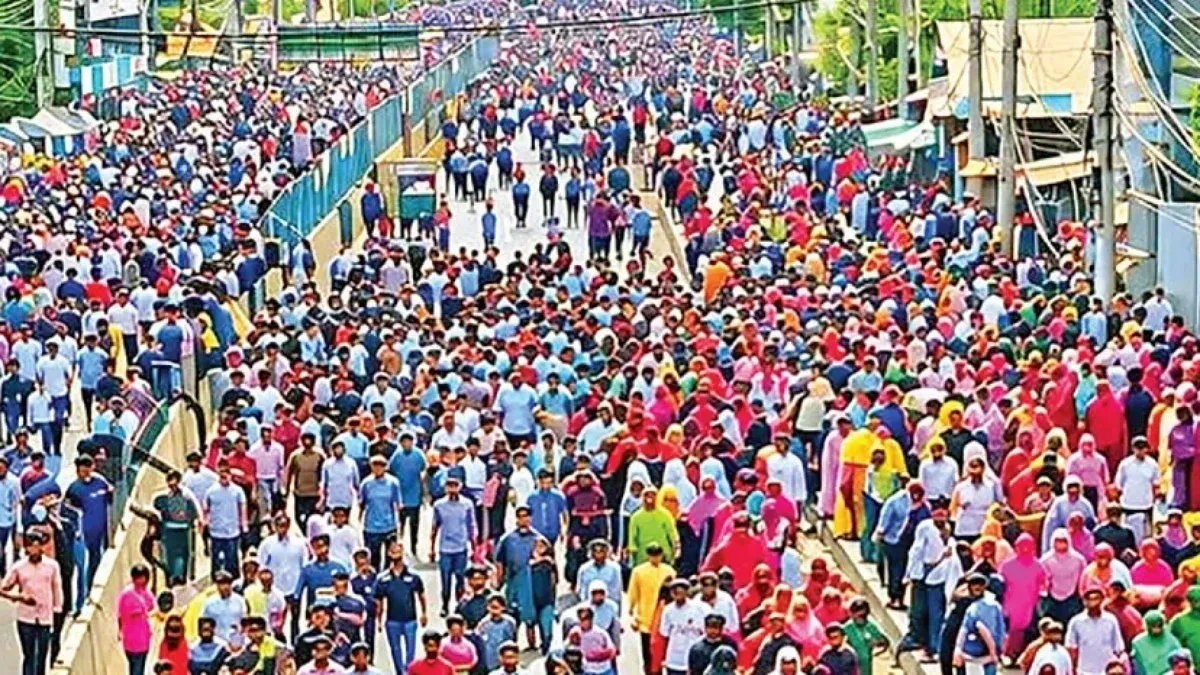
Photo: Agamir Somoy
An early warning had been issued that labor unrest could spread across the garment industry. The government’s top authorities were also aware of the potential risks. On October 18, the Ministry of Home Affairs sent a letter to police and all law enforcement agencies directing them to take necessary measures. However, despite all these preparations and warnings, unrest in the readymade garment industry could not be prevented.
Worker protests, clashes and violence have raised fresh questions about the preparedness of the relevant authorities and their performance of duties. Why did the situation spiral out of control despite prior information? Who failed to fulfill their responsibilities? Alongside these questions, concerns are also emerging about the possibility of a “wolf in sheep’s clothing.”
A copy of the Home Ministry’s warning has been obtained by Agamir Somoy. An analysis of the document shows that the ministry had placed particular emphasis on the possibility of labor unrest in the garment industry surrounding December. Considering the risk of protests over the determination of minimum wages for workers and a possible deterioration in law and order, the authorities were instructed to make advance preparations, strengthen intelligence surveillance and improve coordination among relevant stakeholders. However, unrest in industrial zones despite the warning has raised questions about the role of law enforcement agencies.
A letter issued on October 18 by the Political-2 Branch of the Ministry of Home Affairs (Memo No. 44.00.0000.000.075.03.0003.26.994) outlined several measures to address potential labor unrest. It called for the authorities to assess the situation in light of the proposed revision of workers’ minimum wages and take necessary steps to maintain law and order. The letter also mentioned that while a new national pay structure for government employees was being formulated, wage increases for workers in the private sector were also under discussion. Wages in the garment industry have been revised at different times. The letter also highlighted the provision under the Bangladesh Labour (Amended) Act 2026 regarding the periodic revision of minimum wages.
The letter specifically mentioned December 20 as a date concerning the determination of minimum wages for garment sector workers and urged the authorities to consider the possible situation. It warned that discontent could spread over workers’ expectations regarding the new wage structure, the position of factory owners and activities of various labor organizations. Therefore, emphasis was placed on taking preparations well in advance to address the situation.
The letter instructed law enforcement agencies to remain alert to prevent any untoward incidents in the name of labor unrest. It also recommended increased surveillance of various movements, programs and grassroots activities of labor organizations. Emphasis was placed on communicating with relevant parties and ensuring necessary coordination to understand workers’ demands and the reasons behind their grievances.
The letter also called on the relevant authorities to take necessary steps in determining and implementing minimum wages for workers. It recommended coordinated initiatives through discussions with leaders of garment and knitwear workers. In particular, there was an opportunity to identify the actual demands behind workers’ discontent, dissatisfaction over wages and any provocation by a particular group in connection with the protests. However, the situation has turned volatile despite the early warning, further intensifying questions about the preparedness and field-level activities of the relevant agencies.
After a meeting with labor leaders at the conference room of the Ministry of Home Affairs at the Secretariat on Monday afternoon, Home Minister Salahuddin Ahmed told journalists that supporters of fascism and opportunists were behind the ongoing unrest and violent protests in the readymade garment industry.
He said a group was deliberately infiltrating workers and spreading violence to gain political mileage in the name of protests and destroy a key industrial sector of the country. He claimed that analysis of CCTV footage and video recordings had revealed evidence of such activities by masked outsiders.
Many crime experts have expressed frustration over the failure to take necessary measures despite the early warning. Some have raised concerns about a possible “wolf in sheep’s clothing.”
Dr. Touhidul Haque, an associate professor at the Institute of Social Welfare and Research at Dhaka University, said, “The matter should be investigated thoroughly. If industrial factories become paralyzed, the country will come to a standstill. The government should introduce special surveillance measures to protect the industrial environment. If anyone is found negligent in performing their duties, they must be brought under exemplary punishment so that no one dares to do so in the future.”
Fazle Shamim Ehsan, executive president of the Bangladesh Knitwear Manufacturers and Exporters Association (BKMEA), believes intelligence and police failures may have led to protests, vandalism and attacks.
He said, “Although they had information, law enforcement personnel did not make preparations in advance. Taking advantage of this opportunity, a group infiltrated the workers and turned discontent into a movement.”
However, Additional Inspector General of Police and chief of the Industrial Police Gazi Jasimuddin claimed that they had made efforts to the best of their ability as part of their early preparations.
He said, “We also coordinated with other forces to the best of our ability. However, it started in the DMP (in the capital Dhaka). This is not under our jurisdiction.”
In response to a question, he said, “Many labor leaders and many factory owners are followers and activists of a banned political party. They are playing various roles in this movement. Workers have been instigated through different means. Many people participated in the protests posing as workers. We are involving local representatives in these matters to bring the situation under control.”
Those concerned say the garment industry is one of the country’s major sources of export earnings. Prolonged instability in this sector could have a significant impact on production, export orders and the supply chain. Situations such as work stoppages, road blockades and clashes not only affect workers and factory owners but also have consequences for the overall economy.
Therefore, the relevant authorities are responsible for resolving problems through dialogue while considering workers’ legitimate demands and maintaining law and order.
