
PM wants Marubeni on Bangladesh's side for technogies and fertiliser plant

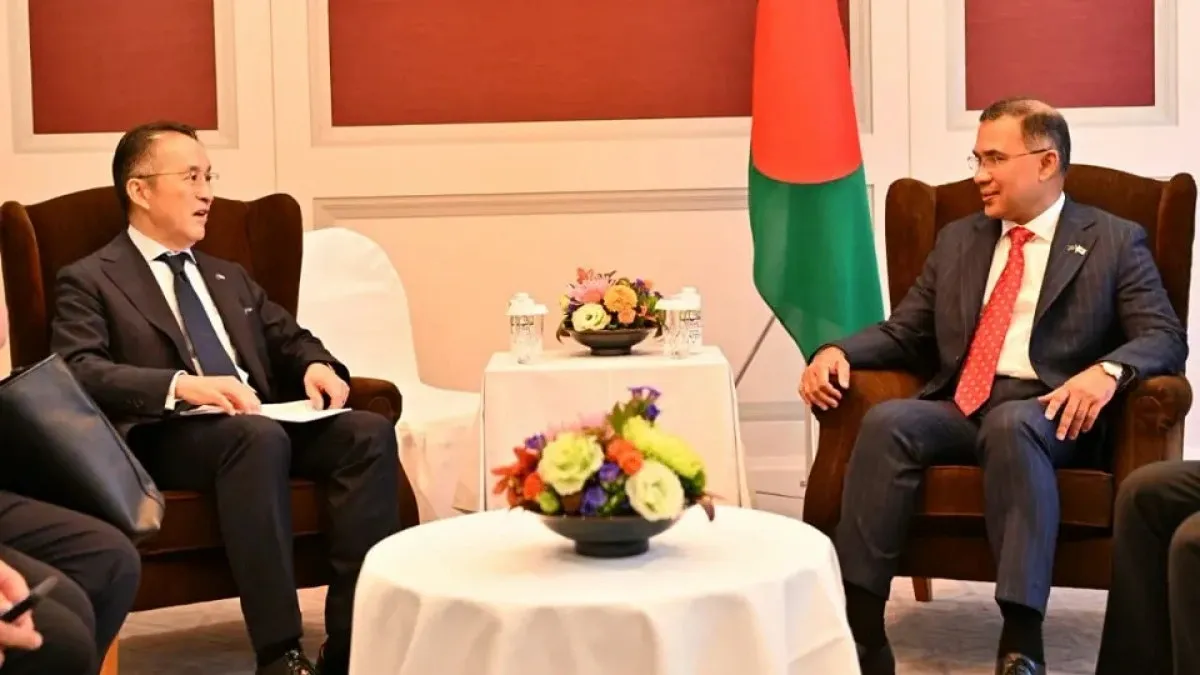
PM Tarique Rahman and Marubeni Chairman Masumi Kakinoki. Photo: Agamir Somoy.
Prime Minister Tarique Rahman has called for increased Japanese investment in potential sectors including automobiles, semiconductors, information technology, renewable energy, and advanced manufacturing industries.
He also sought Japan's cooperation in developing special economic zones in Bangladesh, modernizing the Karnaphuli Fertilizer Factory, and assessing the possibility of establishing a second fertilizer factory in the country. Bangladesh wants to accelerate industrialization, employment, and economic growth by utilizing Japan's technology, skills, and experience in these sectors.
The Prime Minister made these calls at a meeting with Masumi Kakinoki, President of the Japan-Bangladesh Committee for Commercial and Economic Cooperation and Chairman of Marubeni Corporation, at the Imperial Hotel in Tokyo on Monday afternoon local time.
Prime Minister's Deputy Press Secretary Shahadat Shadhin said that the meeting discussed ways to strengthen trade and economic cooperation between the two countries. The Prime Minister emphasized increasing Japanese investment in Bangladesh's automobile, semiconductor, information and communication technology, renewable energy, agricultural product processing, and advanced manufacturing industries.
Focus on special economic zones and fertilizer production
At the meeting, the Prime Minister expressed hope for cooperation from the Japan-Bangladesh Committee for Commercial and Economic Cooperation and Marubeni Corporation in developing Bangladesh Special Economic Zones (BSEZ). He also emphasized Japanese cooperation in modernizing Karnaphuli Fertilizer Company Limited (KAFCO) and assessing the possibility of establishing a second fertilizer factory in the country.
Due to Marubeni's existing investment in KAFCO, there is a special opportunity to expand cooperation in this sector. The modernization of the factory, efficient use of natural gas, and increasing fertilizer production capacity had also come up in earlier discussions with Marubeni representatives in Dhaka. As a result, alongside assessing the possibility of establishing a new factory, increasing the capacity of existing industrial infrastructure could also become an important area of economic cooperation between the two countries.
PM Tarique Rahman also highlighted the government's commitment to ensuring an investment-friendly environment in Bangladesh. He said the government is working to expand investment opportunities for Japanese businessmen through regulatory reforms, simplifying the investment approval process, and strengthening public-private partnerships.
The PM praised Masumi Kakinoki's leadership in increasing trade and economic cooperation with Bangladesh. He thanked him for his role in expanding Japanese investment in Bangladesh and developing business relations between the two countries.
Finance and Planning Minister Amir Khasru Mahmud Chowdhury, Prime Minister's Advisor on Finance and Planning Rashed Al Mahmud Titumir, State Minister for Foreign Affairs Humayun Kabir, State Minister for Power, Energy and Mineral Resources Anindya Islam Amit, Prime Minister's Advisor on Posts, Telecommunications and Information Technology and Science and Technology Rehan Asif Asad, Chairman of Invest Bangladesh Ashik Chowdhury, Governor of Bangladesh Bank Md. Mostaqur Rahman, and Prime Minister's Additional Press Secretary Atikur Rahman Ruman were present at the meeting.
From technology to energy—Marubeni's diversified business
Marubeni Corporation, a major Japanese trading company established in 1949, conducts a wide range of business activities in international trade, industry, energy, and infrastructure sectors. The company's businesses include food and agricultural products, metals and mineral resources, energy and chemical products, power and infrastructure, transportation and industrial machinery, information technology, and financial services.
Having experience in business and investment in various countries around the world, the company has the opportunity to play a role in Bangladesh's industrialization, energy security, technology transfer, and increasing production capacity. There are particularly promising possibilities for expanding cooperation in renewable energy, industrial infrastructure, agricultural product processing, and information technology sectors.
