
Slain BUET student Abrar Fahad's parents meet PM Tarique Rahman

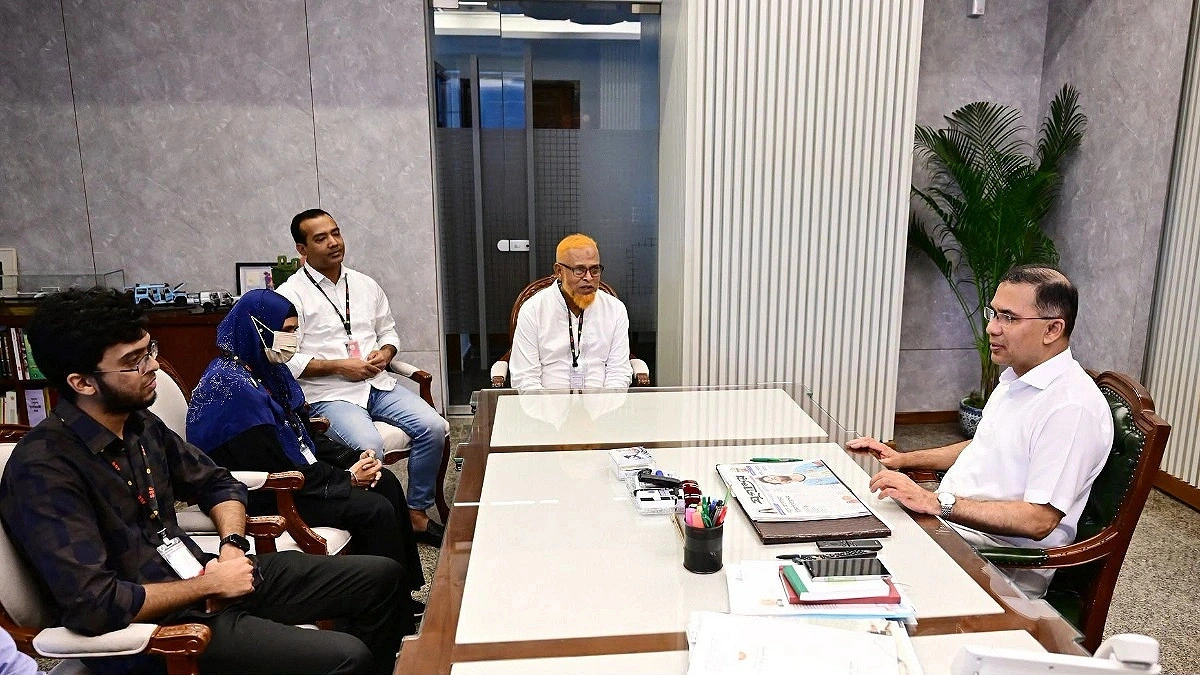
Family members of Abrar Fahad meets with Prime Minister Tarique Rahman in the Cabinet Division at the Secretariat. Photo: PID
Family members of slain Abrar Fahad Thursday met with Prime Minister Tarique Rahman at his office in the Cabinet Division at the Secretariat (Oct 8) seeking the prompt execution of the verdict in the Abrar Fahad murder case and the immediate arrest of the absconding accused.
They also requested the construction of a bridge named after Abrar, while his mother pleaded that no other student should ever suffer a similar fate.The delegation included Abrar’s father Md. Barkat Ullah, mother Rokeya Khatun, younger brother Abrar Faiyaz, along with an uncle and a maternal uncle. Deputy Press Secretary Sujon Mahmud confirmed that Prime Minister Tarique Rahman listened to the family and inquired about their overall well-being. Abrar Fahad, a student at Bangladesh University of Engineering and Technology (BUET), was beaten to death on the night of October 6, 2019, inside his residential hall by members of the Bangladesh Chhatra League (now banned) following a Facebook post in which he criticized bilateral agreements signed during former Prime Minister Sheikh Hasina's visit to India.
Addressing the family's plea for swift legal execution, Prime Minister Rahman said that the case is currently pending before the High Court division, where judicial proceedings will take place independently, and assured that the government will extend all necessary support to the family. Following the murder in 2019, Barkat Ullah had filed a case against 19 individuals at Chawkbazar Police Station.
The Dhaka Metropolitan Police Detective Branch (DB) subsequently submitted a charge sheet against 25 people. On December 8, 2021, Dhaka Fast-Track Trial Tribunal-1 sentenced 20 defendants to death and five to life imprisonment. The High Court upheld the judgment on March 16, 2025, and the case is currently under review by the Appellate Division of the Supreme Court.Abrar’s father also brought to the Prime Minister’s attention that one of the convicted individuals escaped from Kashimpur High Security Central Jail, a matter the family was only notified about nearly six months after the incident. He demanded that all escaped and remaining fugitive convicts be brought to justice immediately.
Abrar’s family home is in Raydanga village under Kaya Union of Kumarkhali Upazila in Kushtia. During the meeting, the family requested the construction of a bridge over the Gorai River in Kushtia.
Around 40,000 to 50,000 residents in that area currently rely on a makeshift bamboo bridge to cross the river. Upon hearing this, the Prime Minister assured them that the bridge would be built and promised to name it after Abrar Fahad.
Abrar’s father, Barkat Ullah, also sought the Prime Minister's assistance in paving Abrar's grave and completing the construction of the adjacent mosque. The Prime Minister immediately directed the relevant authorities to complete the mosque's construction without delay.
Abrar Fahad’s younger brother, Abrar Faiyaz, who is currently studying at BUET, invited the Prime Minister to visit the campus. He also requested the construction of a new residential hall at BUET named after Abrar Fahad, prompting the Prime Minister to speak directly with the Education Secretary on the spot.
Furthermore, his brother requested that Abrar Fahad’s story be included in school textbooks to educate the younger generation about his sacrifice.
Abrar Faiyaz also pointed out that while the government has compiled a list of martyrs from the July movement, a similar official record should be created for those like Abrar Fahad who were killed during earlier regimes. In response, the Prime Minister said that a project addressing this is currently being processed by the Ministry of Liberation War Affairs.
Abrar’s mother, Rokeya Khatun, urged the Prime Minister to ensure that no more lives are lost in educational institutions, stating: "The children on every campus belong to a mother like me. I want to ensure that the toxic environment of the past never returns to any campus, so that no other mother has to endure a empty nest like mine."
The murder of Abrar Fahad sparked national outrage and led to protests against campus violence. Out of 25 convicts, 20 were given death sentences and the other five were give life sentences in relation to the murder of Abrar Fahad following a highly publicized trial.
