
Police uniform chaos persists as deadline nears

Graphics: Agamir Somoy
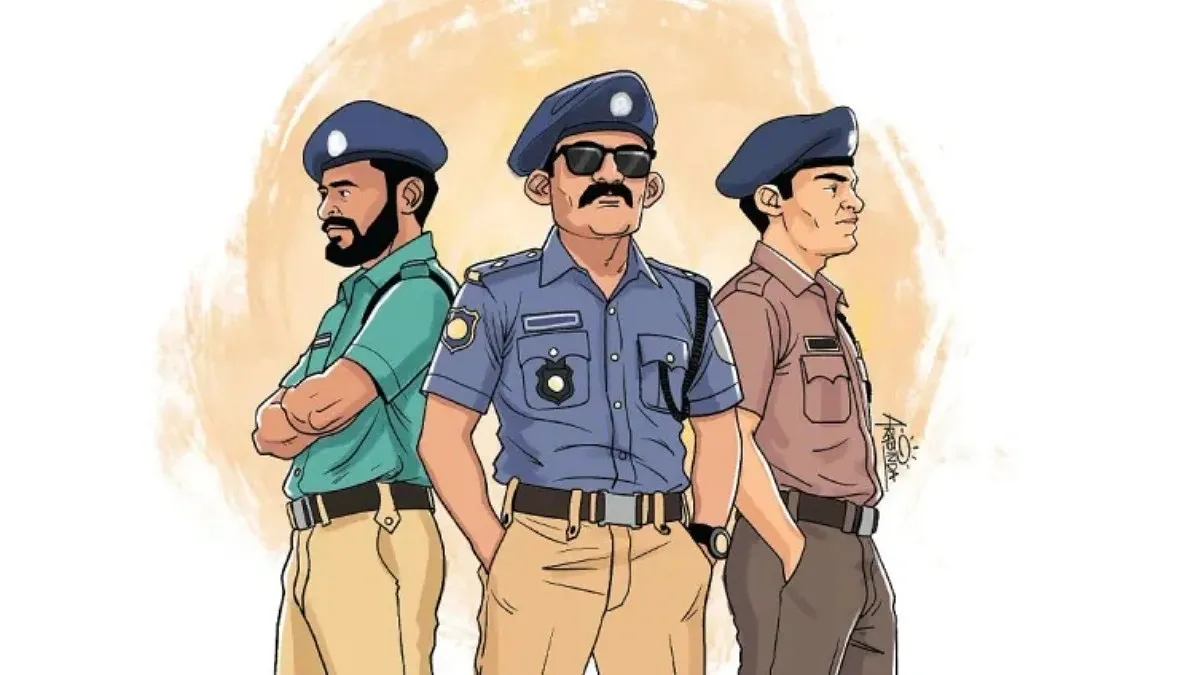
Several police members performing duties at the same point are being seen in different attire. Some are wearing light olive shirts with khaki pants, while others wear dark blue shirts with khaki pants. Meanwhile, some members are seen wearing iron gray shirts and coffee-brown pants.
Similarly, police members inside the same vehicle are occasionally seen in different colored uniforms. Frequent changes in uniform color and design, slow distribution, and exact similarities with the attire of the Village Police, the Department of Narcotics Control (DNC), and private security personnel have created extreme confusion among the public.
The question is: who are police officers and who belong to other forces? Against this backdrop, the Police Headquarters said new uniforms will reach all members of the metropolitan and district police by December.
Field-level inquiries revealed that this confusion over police uniform colors is growing due to resemblances to the uniforms of other government and private organizations. Members of the DNC are seen wearing iron gray shirts and coffee-brown pants.
The uniforms of Village Police members also share similarities with blue shirts and khaki pants. Additionally, the attire of security guards at various private institutions closely resembles police uniform colors. As a result, it often becomes difficult for ordinary citizens to distinguish between members of different forces from a distance.
Police officers on duty on roads and during various drives, alongside their subordinate sergeants, sub-inspectors, or constables, are being seen side by side in two different types of attire. Many citizens are falling into hesitation over who among them is actually a police member, particularly regarding police personnel assigned around the lower court area in Old Dhaka.
Speaking to Agamir Somoy, a few field-level police members, wishing to remain anonymous, said members of different agencies often perform duties in the same area. Because their uniform colors are close to one another, citizens cannot easily understand who belongs to which force.
In particular, embarrassing situations arise due to color similarities between the uniforms of the Village Police and the district police. In some instances, they fear that accountability for allegations raised against Village Police members might fall upon the police due to uniform confusion.
Questions exist not only regarding government agencies but also about the attire of private security firms. The iron gray and coffee-colored uniforms belong to the internal security team of Bashundhara Group.
Although this attire largely matched the previous police uniform, the then-administration showed no initiative regarding the matter. Despite clear violations of the Private Security Services Act, 2006 or Section 171 of the Penal Code of 1860, there was silence on the issue for unknown reasons. Multiple police officials told this reporter that the Dhaka Metropolitan Police (DMP) authorities could have instructed relevant institutions to change their uniform colors by summoning them under the existing Police Act and special directives (DMP Ordinance).
Such situations regarding police uniforms have arisen repeatedly following color and design changes. Since independence, at least five major changes or revisions have been made to police uniforms at various times. The latest uniform - comprising iron gray shirts and coffee-brown pants introduced in November 2025 - did not last long either.
On 18 June 2026, changes were brought again through a notification from Police Headquarters. Light olive shirts and khaki pants were designated for the metropolitan police, while dark blue shirts and khaki pants were set for the district police and other designated units.
However, the new uniforms have not reached everyone, resulting in old and new uniforms being seen side by side. Color similarities with other agencies’ attire, complaints about fabric quality, and slow distribution have together plunged police uniforms into fresh controversy once again.
New complaints over khaki pants and fabric quality
Dissatisfaction also exists among members regarding the fabric quality of the new uniform. Several police members stated that khaki pants get dirty quickly. Members assigned to drives and traffic control, in particular, have to wash their uniforms frequently, causing the fabric color to fade rapidly and raising questions about fabric durability.
Previously, complaints had also been raised regarding the fabric of iron gray shirts and coffee-brown pants. The complaint was that because the fabric was overly dense, it caused discomfort in hot weather and had low sweat absorption capacity.
Although the moisture absorption capacity of that uniform fabric was supposed to be 6-10 centimeters according to the contract, tests reportedly revealed it to be 4.5 centimeters, as noted in a report. Allegations were also raised that yarn density was lower than the specified standard.
Although the previous suppliers later supplied police fabric, Noman Group is supplying shirt fabric, Paramount Group is supplying pant fabric, and Spectrum Limited is supplying fabric for SPBN and APBN uniforms.
Earlier, multiple associations of police members demanded a reconsideration of the new uniform. In March, voting took place with the participation of nearly two lakh members at welfare meetings organized across 64 districts and various units.
In this vote, more than 96 percent of members reportedly favored scrapping the new uniform and returning to the previous attire.
Headquarters promises new attire for all by December
Although uniform colors have changed, a lack of coordination in distribution is visible at the field level. Most police members performing duties in Dhaka’s Shahbagh, Doyel Chattar, Paltan, Press Club, Matsya Bhaban, Banglamotor, and Farmgate areas were seen in old uniforms.
On the other hand, some members in the Airport and Motijheel areas were wearing new uniforms. As a result, members of the same force within the same city are seen performing duties in different uniforms.
The Police Headquarters claims that fabric for the new uniforms was delivered to all units by 5 November, and tailoring work is underway. So far, nearly 35 percent of members in metropolitan units of the police have received new uniforms, with officers from Assistant Superintendent of Police (ASP) and above receiving new attire at the outset.
Speaking to Agamir Somoy, Kamarun Munira, assistant inspector general (Media) of the Police Headquarters Media Branch, said, “Members of all police units will receive new uniforms by upcoming December. Meanwhile, uniform fabric has reached members across all units. Tailoring work is now underway.”
Regarding allegations about the fabric quality of iron gray shirts and coffee-brown pants, she stated that the complaint was not true.
Frequent uniform changes since independence
The primary color of Bangladesh Police uniforms was khaki for a long time. Following the formation of the DMP in 1976, blue shirts and khaki pants were introduced for the metropolitan police, while attire for district police and other unit members remained khaki shirts and khaki pants.
In 2004, during the BNP-led four-party alliance government, changes arrived in uniforms once again. The shirt color for metropolitan police was made dark blue, while pants remained khaki; khaki shirts and pants were retained for district police and other units. Later, light olive shirts and dark blue pants were introduced for the metropolitan police, and dark gray shirts and dark blue pants for other units.
After this system continued for nearly 21 years, new uniforms were introduced in November 2025, with the shirt color set to iron gray and the pant color set to coffee shell or coffee-brown.
Following the fall of the Awami League government in the July mass uprising, demands for police force reform and uniform changes emerged. In view of this, a decision to change uniforms was made at the Law and Order Advisory Council Committee meeting on 20 January 2025.
Police Headquarters formed a 10-member committee, reviewed police attire from several countries, and conducted trial runs of 18 types of uniforms. Later, the new uniform color was finalized from among five colors, and changes were also brought to the logo.
On 25 November 2025, police took to the field in the new attire, but dissatisfaction arose at the field level regarding color and fabric. Members also expressed objections in various meetings. Later, after the BNP government came to power, demands for uniform changes grew strong again.
On 18 June, uniform colors were revised again via a Police Headquarters notification. According to the new provision, metropolitan police shirts will be light olive with khaki pants, while shirts for district police and other units designated in the notification will be dark blue with khaki pants. However, several units including APBN, SPBN, SB, CID, and RAB have been kept separate from this designated provision.
Clear policy needed beyond uniform changes
During the July mass uprising, allegations of crackdown were raised against the police. Following that, demands for structural reform, accountability, and rebuilding public relations grew strong.
Against that backdrop, uniform changes were seen as a visible step toward reform. However, according to experts, qualitative change in the police will not come merely by changing uniforms or logos; changes must also be brought to the behavior of force members, their mode of duty execution, accountability, and the standard of public service.
Former inspector general of police (IGP) Ashraful Huda said, “Merely changing colors will not suffice; a change in mindset is necessary. However, following the recent movement, changing uniforms was necessary to reduce the distance between the police and the public.”
Although several officers of the rank of Additional DIG of police added that qualitative change does not come merely by changing attire; internal reform of the police in the public interest is essential.
