
Bangladesh’s child stunting crisis persists despite long-term gains

Graphics: Agamir Somoy
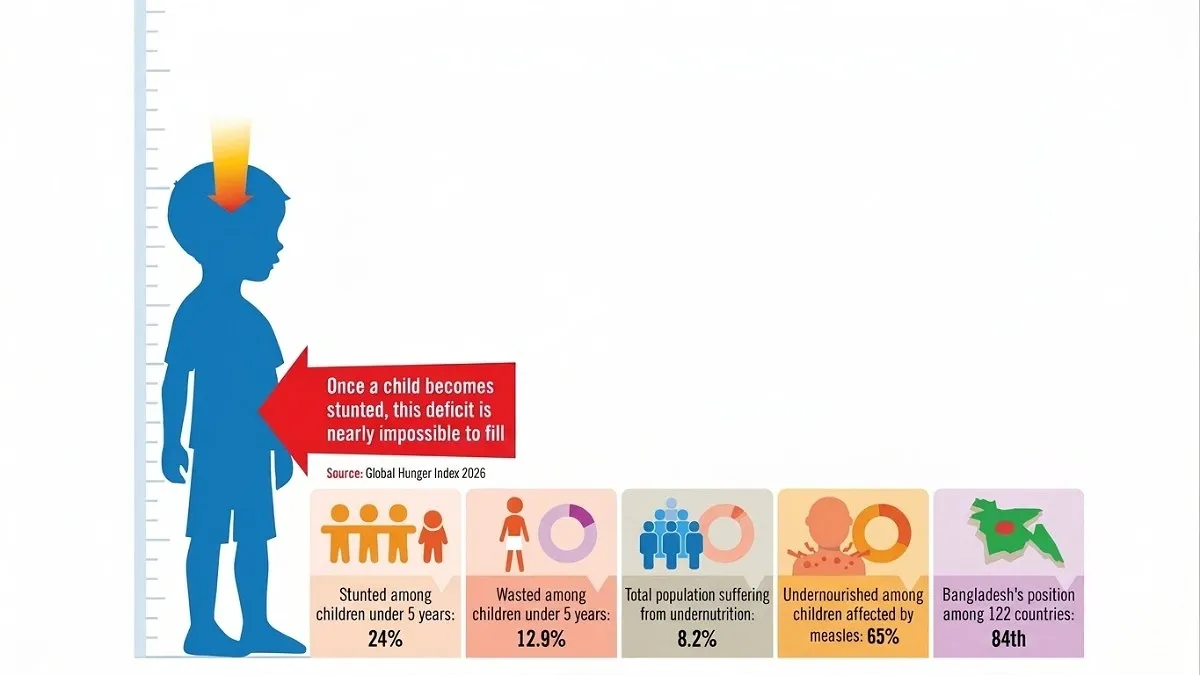
Despite long-term progress against hunger and malnutrition, Bangladesh’s child nutrition crisis remains alarming, with 24 percent of children under five stunted - chronic malnutrition leaves one in four too short for their age.
Global Hunger Index (GHI) confirmed the matter and Bangladesh ranks 84th among 122 countries globally. This time, Bangladesh scored 19.2, which indicates a “moderate” level of hunger. Previously in 2018, the score was 20. Over the past eight years, the situation has improved somewhat, though it remains insufficient. In 2000, the score stood at 34.6.
Published annually since 2006, this international index measures global levels of hunger and malnutrition. It evaluates undernourishment, child stunting, child wasting, and the mortality rate of children under five years old.
Prime Minister’s Special Assistant on Health Matters and a Public Health Expert SM Ziauddin Haider said, “Although Bangladesh has improved in many child-related indicators, progress in preventing stunting is not sufficient. Stunting is primarily a major indicator of brain development issues. Stunted children have less memory, attention, and learning ability compared to others. Even due to stunting, Bangladesh loses 8 percent of its potential GDP every year.”
Ishtiaq Mannan, a public health expert working at an international organization, added that a child’s nutritional status is determined within the first 1,000 days of life, counting from pregnancy. Once a child becomes stunted, recovering from those physical and mental deficits is nearly impossible.
The effects of this childhood malnutrition carry over into adolescence and puberty. A global study published in the international medical journal The Lancet revealed that the average height of 19-year-old women in Bangladesh is close to five feet, placing it among the countries with the lowest average height in the world.
For instance, 19-year-old women in the Netherlands average at least 7 inches taller than their Bangladeshi peers. Reviewing the physical growth of children and adolescents across 200 countries and territories from 1985 to 2019, the study highlighted how Bangladeshi youths lag behind in physical development.
The family of Sumi Akter in Shewrapara, Dhaka illustrates a realistic picture of how food inflation impacts a child’s daily diet. Sumi, who just turned seven, is significantly shorter than normal height. Her mother, Morium Akter, works as a domestic helper, while her father remains unemployed.
Morium said, “Earlier, I used to at least buy eggs. Now, due to high prices, I cannot even do that. Vegetable prices are also sky-high. I pass most days with potatoes and dried fish. Occasionally, I buy tilapia fish.”
In Bangladesh, specific height requirements are designated for various jobs. Despite holding all necessary qualifications, many individuals see their career dreams halted purely due to height.
From childhood, Mirza Abida dreamed of joining a law enforcement agency, yet her height prevented her from even applying. Over recent years, law enforcement recruitment has slightly lowered height thresholds compared to earlier standards.
Short stature also creates hurdles in sports, where candidates often face elimination during initial selection trials. Similarly, the modeling profession treats height as a primary qualification.
According to public health experts, four main factors drive child stunting: maternal malnutrition and anemia during pregnancy; failure to maintain exclusive breastfeeding for the first six months alongside a lack of appropriate complementary foods thereafter; recurring gastrointestinal infections, including diarrhea; and household shortages of balanced nutrition caused by high market food prices.
Data from GHI 2026 indicates that alongside stunting, wasting (excessively low weight relative to height) has recently increased among children under five years old. In 2000, the wasting rate stood at 12.5 percent, dropping to 8.4 percent in 2018.
However, it recently rose again to 12.9 percent and 8.2 percent of the country’s total population suffers from overall undernourishment.
Abdullah Al Mamun, sector lead of Child Protection and Child Rights at the international organization Save the Children, said, “Such an increase in the wasting rate among children under five years old is rare since 2000. Food inflation and the crisis of complementary nutrition are the main reasons for this. Identifying these children at the field level and providing them with complementary food urgently from the government’s side is necessary.”
The GHI report further demonstrates that the under-five child mortality rate in Bangladesh stands at 3 percent, meaning roughly 30 out of every 1,000 children die before reaching five years of age.
Mirza Mohammad Ziaul Islam, director of the Bangladesh Shishu Hospital and Institute, noted that a major portion of child patients admitted to the hospital suffer from malnutrition.
Referencing a recent study, he said, “There is a direct link between deaths from measles and malnutrition. Sixty-five percent of measles-infected children undergoing treatment at the hospital were suffering from malnutrition. Among them, 12 percent suffered from severe malnutrition and 53 percent from moderate malnutrition.”
This year, 2,46,030 people contracted measles across the country, resulting in 1,233 deaths, with the majority of fatalities occurring among children under five years old.
To break this vicious cycle of malnutrition, experts urge adopting the successful model implemented in China. In 1990, China’s child stunting rate among children under five years old was 28.1 percent.
Through integrated initiatives, China reduced this rate to 4.5 percent by 2026. Rapid economic development, guaranteed complementary nutrition for pregnant mothers and infants, nutritious school meals in low-income areas, and sweeping upgrades to safe water and sanitation drove this achievement.
Ziauddin emphasized that reducing child stunting requires strong political commitment and a robust institutional framework. The government continues working toward achieving the Sustainable Development Goals (SDGs) by executing a coordinated, long-term strategy.
